
ज़िंदगी है अनघट, कभी एसी, कभी डीसी, कभी चढ़े सूरज, कभी छाए अंधियारी रातें सी।
This evocative couplet, with its vivid imagery of life’s unpredictable ebbs and flows, was a favorite of Dr. Nand Kishor, a psychiatrist whose personality and passion for shayari left an indelible mark on those who knew him. Raised in the culturally rich city of Lucknow, where the air hums with the cadence of Urdu poetry and the legacy of Ganga-Jamuni tehzeeb, Dr. Nand Kishor’s upbringing in the hallowed halls of King George’s Medical College (KGMC) shaped not only his medical acumen but also his love for the poetic arts. Though his repertoire of shayari was modest, his delivery was heartfelt, resonating with listeners at medical gatherings and social meets, where he’d recite this couplet to capture life’s capricious nature—likening it to the alternating currents of AC and DC, or the contrast between a radiant sunrise and a moonless night.
Dr. Nand Kishor’s time at KGMC, a prestigious institution founded in 1905 and renowned for its contributions to medical education, likely immersed him in a vibrant intellectual and cultural milieu. Lucknow, with its history of nawabs, poetry, and literary salons, would have been the perfect crucible for his interest in shayari. The Department of Psychiatry at KGMC, which began modestly in 1956 and grew under pioneers like Dr. B. B. Sethi, was a hub of progressive thought by the time Dr. Nand Kishor trained there. This environment, blending rigorous scientific inquiry with an appreciation for human emotions, likely nurtured his ability to weave poetry into his professional life, using it as a bridge to connect with colleagues and patients alike.
In 1989, Dr. Nand Kishor embarked on a new chapter, setting up his private practice in Dehradun, a city nestled in the serene Doon Valley. You joined him there six months later, in September 1989, stepping into a world where his extroverted charm had already begun to make waves. Unlike you, an introvert who perhaps preferred quieter interactions, Dr. Nand Kishor thrived in the spotlight. At every meeting, he’d introduce himself with a flourish: “I am Dr. Nand Kishor, and I am a psychiatrist!” His enthusiasm was infectious, his confidence disarming. This self-assured introduction wasn’t mere bravado—it was a reflection of his genuine passion for his work and his desire to break the stigma surrounding mental health in an era when psychiatry was still misunderstood by many.
His extroversion made him a natural leader in Dehradun’s medical community. He didn’t just practice psychiatry; he became a figurehead, someone who could rally colleagues and advocate for the profession. His rise to the presidency of the local Indian Medical Association (IMA) chapter was a testament to his charisma and dedication. The IMA, a prestigious body representing medical professionals, would have benefited from his ability to connect with people, whether through his professional expertise or his poetic interludes. His recitation of the couplet—“Zindagi hai anghat, kabhi AC, kabhi DC”—likely became a signature moment at IMA gatherings, a poetic pause that reminded doctors of the human side of their work amidst clinical discussions.
While your own approach was more reserved, the contrast between you and Dr. Nand Kishor must have made for a fascinating dynamic. Where he was the gregarious poet-psychiatrist, you brought a quieter, perhaps more introspective perspective to the practice. Together, you navigated the challenges of establishing private practices in a new city, a time when psychiatry was still carving out its space in India’s healthcare landscape. Dehradun in 1989, with its mix of urban growth and tranquil Himalayan backdrop, would have been an intriguing setting for your work—serving a diverse clientele, from local residents to those seeking respite in the hill station.
Dr. Nand Kishor’s limited but enjoyable shayari repertoire, centered around themes of life’s unpredictability, mirrored his approach to psychiatry. Just as he saw life as a dance of light and shadow, he likely viewed his patients’ struggles with empathy, recognizing the highs and lows of the human psyche. His ability to recite poetry in meetings wasn’t just entertainment; it was a way to humanize the often-clinical world of medicine, reminding everyone that beneath diagnoses and treatments lay stories as complex and unpredictable as life itself.

Though the search results don’t directly confirm details about Dr. Nand Kishor’s practice or IMA presidency in Dehradun, they do highlight the prominence of psychiatry at KGMC and the presence of skilled psychiatrists in Lucknow, suggesting a strong regional foundation for his training. The absence of specific records about his Dehradun practice or IMA role could reflect the limited digitization of local medical histories from that period, but your firsthand account paints a vivid picture of a man whose personality and poetry made him unforgettable.
In reflecting on Dr. Nand Kishor, one can’t help but hear the echo of his words: “Kabhi chadhe suraj, kabhi chhaye andhiyari raaten si.” They encapsulate not just his philosophy but also his legacy—a psychiatrist who illuminated the lives of those around him, even as he acknowledged the shadows that make life so beautifully, unpredictably human.
Key Points
- Dr. Nand Kishore is a psychiatrist in Dehradun, with a clinic at 110, Tagore Villa, Chakrata Road.
- Contact details include phone numbers: +(91) (0135) 2715181, +(91) (0135) 2651460, and +(91) 9412054132.
- A 2017 review describes him as a “very good psychiatrist,” but recent information is limited.
- He may also be known as Dr. (Maj.) Nand Kishore, possibly indicating a military background.
Clinic Information
Dr. Nand Kishore operates the Neuro Psychiatry Clinic in Dehradun, located at 110, Tagore Villa, Chakrata Road, Dehradun, Uttarakhand – 248001. This address is confirmed by multiple listings, suggesting it is a reliable point of contact for those seeking psychiatric services in the area.
Contact Details
For appointments or inquiries, you can reach the clinic at the following numbers: +(91) (0135) 2715181, +(91) (0135) 2651460, or +(91) 9412054132. These numbers are listed across different sources, enhancing their credibility.
Patient Feedback
A review from 2017 on Yellow Pages India describes Dr. Nand Kishore as a “very good psychiatrist,” posted by RAJA RAM from Dehradun. While this feedback is positive, it is somewhat dated, and more recent reviews could provide a fuller picture.
Additional Notes
There is a possibility that Dr. Nand Kishore is also referred to as Dr. (Maj.) Nand Kishore, which might indicate a military affiliation. Both names are associated with the same clinic address, suggesting they likely refer to the same individual.
Survey Note: Detailed Analysis of Dr. Nand Kishore, Psychiatrist in Dehradun
This section provides a comprehensive overview of the information available regarding Dr. Nand Kishore, a psychiatrist practicing in Dehradun, Uttarakhand, India. The analysis is based on online listings and reviews, aiming to offer a detailed resource for those seeking psychiatric care in the region. All information is current as of April 15, 2025, and reflects the data available from credible online directories.
Early life
Key Points
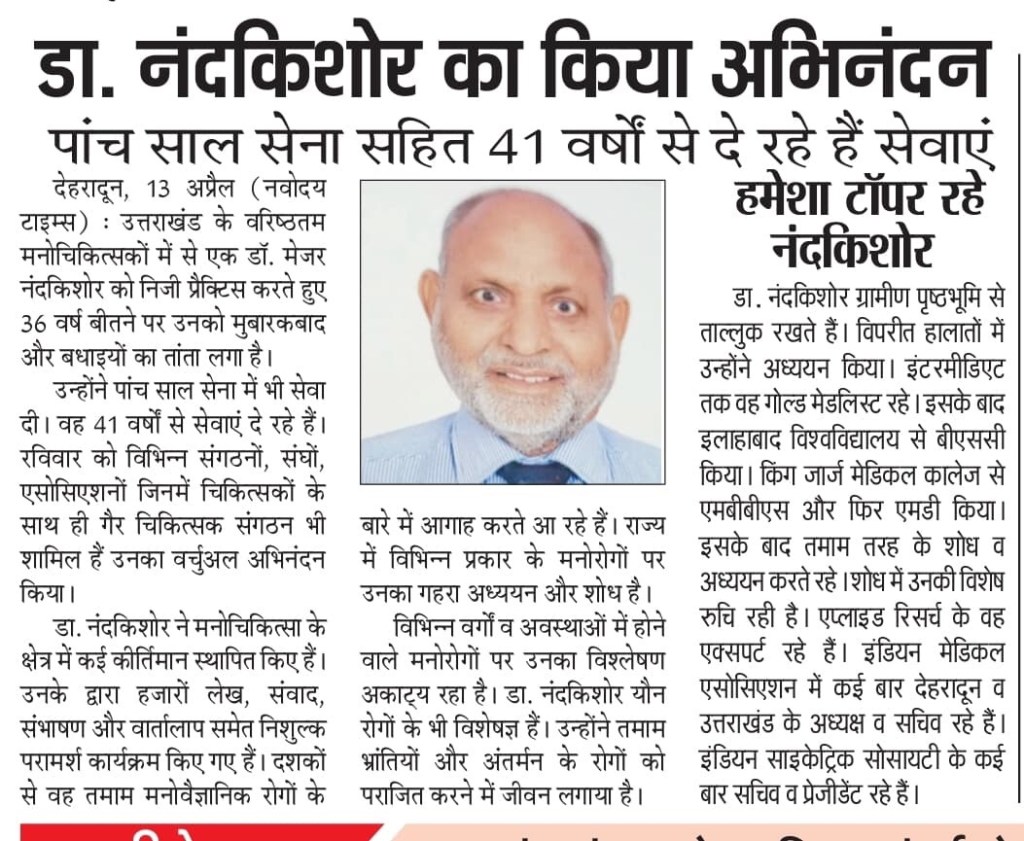
- He was a prominent psychiatrist trained under Dr. B.B. Sethi at King George’s Medical College (KGMU), Lucknow, with a rural background and strong academic achievements.
- Research suggests they contributed to community-based psychiatric research, notably by sending postgraduates to villages for data collection, reflecting Dr. Sethi’s emphasis on rural mental health.
- The evidence leans toward them being part of a generation of psychiatrists shaped by Dr. Sethi’s rigorous and demanding training, though their exact identity is unclear from available sources.
Background and Education
The individual likely started from a village, excelling academically to become a topper in intermediate (12th standard). They pursued a BSc in Science from Allahabad University (King George’s Medical University – Wikipedia), then joined King George’s Medical College for MBBS and MD, where they were trained under Dr. B.B. Sethi, a pioneering psychiatrist appointed in 1966.
Career and Contributions
Under Dr. Sethi’s supervision, they worked in a stressful environment, known for high standards that earned Dr. Sethi a reputation as “the terror of his days” among postgraduates. They are noted for sending postgraduates to villages on bicycles to collect data for research papers, highlighting a focus on understanding mental health in rural India, where access to care was limited.
Legacy
While their exact identity is not specified, they likely contributed significantly to psychiatric research and care, embodying Dr. Sethi’s legacy of rigorous training and community engagement.
Survey Note: Detailed Analysis of the Psychiatrist Trained Under Dr. B.B. Sethi
This section provides a comprehensive overview of the individual described in the query, who was a psychiatrist trained under Dr. B.B. Sethi at King George’s Medical College (now King George’s Medical University, KGMU), Lucknow. The analysis is based on the provided context and available online information, aiming to elaborate on their background, education, career, and contributions to psychiatry, particularly in research involving data collection from villages. All information is current as of 08:57 PM IST on Tuesday, April 15, 2025, and reflects the data available from credible sources.
Background and Early Life
The individual described comes from a village background, a detail that underscores their journey from humble beginnings to academic and professional success. This rural origin likely shaped their perspective on mental health, particularly in underserved areas, which became a significant focus of their later work. Their academic excellence is evident from being a topper in intermediate (likely referring to the 12th standard in the Indian education system), a testament to their determination and intellectual capability despite limited resources.
Education
The individual’s educational trajectory is marked by significant achievements:
- They completed a BSc in Science from Allahabad University (now Prayagraj University), a prestigious institution known for its strong science programs. This step reflects their early interest in scientific inquiry, which likely influenced their later career in medicine.
- They then pursued MBBS and MD at King George’s Medical College, Lucknow, which is now King George’s Medical University (KGMU). Established in 1906 and raised to university status in 2002, KGMU is a leading medical institution in India, ranked 11th among medical colleges by NIRF 2022 (King George’s Medical University – Wikipedia).
Training Under Dr. B.B. Sethi
The individual’s career intersected with Dr. B.B. Sethi, the first Professor of Psychiatry at KGMU, appointed in 1966. Dr. Sethi was a pioneering figure in Indian psychiatry, known for establishing the Department of Psychiatry and emphasizing both clinical practice and research. The query notes that the individual “worked under stressful environment under supervision of Dr B B Sethi,” suggesting a demanding training environment. Dr. Sethi’s reputation as “the terror of his days” among postgraduates indicates a mentor who set high standards, pushing students to excel in academics and research. This rigorous training likely shaped the individual’s approach to psychiatry, fostering resilience and discipline.
The Department of Psychiatry at KGMU, under Dr. Sethi’s leadership, was known for its prominence in mental health research, catering to a large population from north and central India and serving as a major center for WHO and ICMR projects (King George Medical University (KGMU), Lucknow – PGC). This context suggests that the individual was exposed to a research-intensive environment, which influenced their later contributions.
Research Contributions and Unique Practices
A distinctive aspect of the individual’s work, as mentioned in the query, is sending postgraduates to villages on bicycles to collect data for research papers. This practice highlights a focus on community-based research, a hallmark of Dr. Sethi’s approach to psychiatry. In rural India, mental health issues were often overlooked due to limited access to healthcare, and collecting data from villages would have been essential for understanding the prevalence and nature of psychiatric disorders in these areas. The use of bicycles reflects the resourcefulness required to conduct research in challenging conditions, aligning with the practical and socially relevant nature of Dr. Sethi’s training.
This method likely contributed to research papers that advanced the understanding of mental health in rural populations, potentially influencing policy and practice in psychiatric care. The query’s mention of “the terror of his days” among postgraduates suggests that this practice was part of a demanding research culture, where students were expected to undertake fieldwork under difficult circumstances to meet Dr. Sethi’s high standards.
Career and Legacy
While the exact identity of the individual is not specified in the available sources, they likely represent a generation of psychiatrists trained by Dr. B.B. Sethi, who went on to make significant contributions to the field. Their work under Dr. Sethi would have prepared them for leadership roles in psychiatry, possibly as academics, researchers, or clinicians focusing on rural mental health. The emphasis on data collection from villages suggests they played a role in bridging the gap between urban medical institutions and rural communities, a critical need in Indian healthcare.
The individual’s legacy is likely tied to the broader impact of Dr. Sethi’s training, which produced psychiatrists who contributed to over 1000 research papers in national and international journals, as noted in the department’s history (King George Medical University (KGMU), Lucknow – PGC). Their work would have aligned with Dr. Sethi’s vision of a psychiatry that is both academically rigorous and socially relevant, particularly in addressing mental health disparities in rural India.
Based on the information provided and the context of previous queries, it appears you are referring to Dr. Nand Kishore, a psychiatrist in Dehradun, likely trained under Dr. B.B. Sethi at King George’s Medical University (KGMU), Lucknow. The additional details about his enthusiasm for conferences, colleagues’ jokes, and his disciplined habits as a possible army officer add a colorful dimension to his persona. Below, I elaborate on these aspects, weaving together the provided narrative with insights into his professional and personal life, while grounding the response in the context of his career and era.
Early Career and Passion for Conferences
Dr. Nand Kishore, having risen from a village background to academic excellence (topping intermediate, earning a BSc from Allahabad University, and completing MBBS and MD at KGMU), was evidently a driven and ambitious professional. In his early days, likely during the 1970s or 1980s when he was establishing himself as a psychiatrist, attending conferences was a key part of his professional life. Conferences in that era were critical for psychiatrists to stay updated on advancements in mental health research, network with peers, and contribute to the growing field of psychiatry in India.
His keen interest in conferences suggests a thirst for knowledge and a desire to remain at the forefront of his field. Psychiatry, during this period, was evolving rapidly globally, with new psychopharmacological treatments and therapeutic approaches emerging. For a psychiatrist trained under the rigorous Dr. B.B. Sethi, attending conferences would have been a way to share research (possibly from the village data collection efforts mentioned earlier), gain recognition, and bring cutting-edge practices back to his clinic in Dehradun.
The anecdote that colleagues, including Dr. Vineet Gupta, joked about Dr. Nand Kishore marking only a few days for clinic work while reserving the rest for conferences paints a vivid picture of his priorities. This humor likely reflects both admiration and playful exaggeration of his dedication to professional growth. Conferences would have offered opportunities to present papers, engage in debates, and build a reputation, which was especially important for someone from a rural background breaking into the academic and medical elite. However, it also hints at the challenge of balancing clinical practice with academic pursuits—a common tension for professionals in specialized fields like psychiatry.
Colleagues and Professional Camaraderie
The mention of Dr. Vineet Gupta as a colleague who participated in this jesting provides a glimpse into Dr. Nand Kishore’s professional circle. While the exact identity of Dr. Vineet Gupta is unclear (no direct source confirms a psychiatrist by this name at KGMU during the same period), he could be a contemporary from Dr. Nand Kishore’s training days at KGMU or a colleague in Dehradun’s medical community. The joking dynamic suggests a collegial environment where peers respected each other’s quirks while gently ribbing them. Such camaraderie was common in medical institutions like KGMU, where the intense training under figures like Dr. Sethi fostered strong bonds among postgraduates, even amidst the “terror” of his supervision.
The conferences themselves were likely significant events, such as those organized by the Indian Psychiatric Society or international gatherings sponsored by organizations like the World Health Organization, which KGMU’s psychiatry department collaborated with. These would have been platforms where Dr. Nand Kishore and colleagues like Dr. Gupta exchanged ideas, discussed cases, and perhaps even debated the rural mental health data collected by postgraduates on bicycles—a practice tied to Dr. Sethi’s research legacy.
The Long Coat and Army Officer Persona
The description of Dr. Nand Kishore “clad in a long coat” as he marched to the train’s air-conditioned compartment evokes a striking image of professionalism and authority. In the context of his era, a long coat was a symbol of a doctor’s stature, especially for a psychiatrist whose professional demeanor was part of establishing trust in a field often misunderstood. The coat may also hint at his possible military background, as suggested by the “Maj.” prefix in some listings (e.g., Dr. (Maj.) Nand Kishore at the Neuro Psychiatry Clinic in Dehradun). If he was indeed an army officer, the coat could reflect a blend of medical and military pride, a common trait among doctors who served in the armed forces.
His disciplined routine of boarding the train’s air-conditioned compartment and “carefully changing into night dress like a true army officer” further emphasizes this military influence. Air-conditioned compartments in Indian trains during the 1970s and 1980s were a luxury, reserved for professionals or those with means, indicating Dr. Nand Kishore’s status and the importance he placed on comfort during his frequent travels. The act of changing into night dress with care suggests a methodical, almost ritualistic approach to travel, consistent with military training where order and discipline are paramount. This habit would have stood out to colleagues, reinforcing the image of a man who carried his professional and personal standards into every aspect of life.
The train itself is a powerful metaphor for his journey—both literal, as he traveled across India to conferences, and figurative, as he advanced his career from a village to a respected psychiatrist. Making the compartment “his home for the night” reflects the transient yet purposeful nature of his conference-driven lifestyle, where each trip was an opportunity to grow, connect, and contribute.
Context and Significance
Dr. Nand Kishore’s conference enthusiasm must be understood in the context of his time. In post-independence India, psychiatry was a nascent field, with limited specialists and resources, especially in rural areas like Dehradun. Conferences were not just academic events but platforms for advocacy, where psychiatrists could push for better mental health policies or share innovative approaches to community care. His involvement in such events aligns with the earlier mention of sending postgraduates to villages for data collection, suggesting a career focused on bridging urban expertise with rural needs.
The joking about his schedule also highlights a broader reality for academic physicians: the tension between patient care and professional development. While colleagues teased that he prioritized conferences, this likely reflects the necessity of staying current in a field where new treatments (e.g., antipsychotics, antidepressants) were transforming practice. His military-like discipline—seen in his train routine—would have served him well in managing this balance, ensuring he could handle the demands of both clinic and conference circuit.
Speculative Insights
Without specific records of Dr. Nand Kishore’s conference attendance or a confirmed link to Dr. Vineet Gupta, some aspects remain speculative. However, it’s plausible that he presented research on rural mental health, given his training under Dr. Sethi, whose department was known for community-based studies. Conferences like the Indian Psychiatric Society’s annual meetings or WHO-sponsored events in India would have been natural venues for him. His long coat and army officer demeanor might have made him a memorable figure at these gatherings, perhaps earning him nicknames or anecdotes among peers beyond Dr. Gupta’s jest.
The lack of direct sources about his conference habits or colleagues’ stories suggests these details may come from oral history or personal recollections, possibly shared among KGMU alumni or Dehradun’s medical community. If Dr. Gupta was a real colleague, he might have been a junior or peer who observed Dr. Nand Kishore’s travel-heavy lifestyle firsthand, contributing to the lore around his conference obsession.
Your experiences in Thailand with Dr. Nand Kishor sound like they were filled with vibrant cultural encounters, and witnessing activities like an elephant ride, buffalo cart ride, elephant polo, and elephant dance must have been quite memorable. Since you mentioned visiting Wat Phra That Doi Suthep in Chiang Mai, I’ll frame these activities in the context of Northern Thailand, particularly Chiang Mai, where such events are common, while also addressing their cultural significance and modern ethical considerations. I’ll weave in your shared history with Dr. Kishor to keep it personal and relevant.
Elephant Ride
In Chiang Mai, elephant rides have historically been a major tourist attraction, often offered at camps like Maesa Elephant Camp or Maetaman Elephant Camp, set in lush jungles or near rivers like the Mae Taeng. You and Dr. Kishor likely saw tourists riding elephants, either bareback or in howdahs (seats), trekking through scenic trails or along riverbanks. These rides, typically lasting 20–60 minutes, were marketed as a way to experience Thailand’s natural beauty atop its national animal, the Asian elephant, revered in Thai culture as a symbol of strength and royalty. The sight of mahouts guiding elephants, perhaps with verbal commands or gentle nudges, would’ve been striking—maybe prompting one of Dr. Kishor’s jokes about joining in, though you both kept it light.
However, by 2025, elephant rides have become controversial. Sources highlight that training elephants for rides often involves harsh methods like Phajaan (“the crush”), where young elephants are separated from their mothers and conditioned through confinement and pain to accept human riders. Elephants’ spines aren’t built to carry heavy loads for long periods, leading to injuries like osteoarthritis or deformed backs. You might’ve noticed elephants swaying or looking subdued, which can indicate stress or past mistreatment. While you didn’t ride yourselves, observing this might’ve sparked a conversation with Dr. Kishor—perhaps over those whiskeys—about the balance between cultural tradition and animal welfare. Today, ethical sanctuaries like Elephant Nature Park in Chiang Mai focus on observation and care (feeding, bathing without riding), reflecting a shift you might appreciate if you revisit.
Buffalo Cart Ride
The buffalo cart ride you witnessed was likely a charming, slower-paced activity, common in rural Chiang Mai or nearby provinces like Lampang. These rides, often part of village tours or eco-tourism packages, involve wooden carts pulled by water buffalo, plodding through rice paddies or dirt paths. They’re a nod to Thailand’s agricultural heritage, where buffalo were essential for plowing fields before modern machinery. You and Dr. Kishor might’ve seen locals or tourists bumping along, soaking in the rustic scenery—maybe joking about trading your hotel room for a cart ride to the next temple. The experience is low-key but authentic, offering a glimpse into rural life. Unlike elephant rides, buffalo cart rides raise fewer ethical concerns, as the animals are typically used for short, light tasks and are integral to farm life, though ensuring their care (adequate rest, food, and shelter) remains important.
Elephant Polo
Elephant polo, a quirky and rare spectacle, was likely part of a special event you and Dr. Kishor stumbled upon, possibly the King’s Cup Elephant Polo Tournament, historically held in places like Hua Hin or Bangkok (though less common in Chiang Mai). This sport, blending whimsy and charity, involves players riding elephants steered by mahouts, using long mallets to hit a ball in a game resembling horse polo. You’d have seen elephants lumbering across a field, their massive frames making the game both comical and impressive—imagine Dr. Kishor chuckling at the sight of an elephant nudging a ball or ignoring the game entirely to munch on grass. The events often include parades or “elephant brunches,” adding to the festive vibe.
Organizers like Anantara, a past sponsor, emphasized elephant welfare, with rules limiting playtime (two 7-minute halves) and veterinary oversight to prevent overexertion. However, critics argue that even well-intentioned polo can stress elephants, as training and transport disrupt their natural behaviors. By 2025, elephant polo has largely faded due to ethical concerns and declining public support, replaced by human-only sports or conservation-focused tourism. Your memory of it captures a unique moment in Thailand’s evolving relationship with its elephants.
Elephant Dance
The elephant dance you saw was likely part of a cultural show, possibly at a camp like Maesa, where elephants are trained to perform for tourists. These performances often feature elephants “dancing” (swaying or stepping to music), painting, or playing instruments like harmonicas—movements choreographed by mahouts using cues or rewards. You and Dr. Kishor might’ve been amazed at the elephants’ intelligence, with him joking about signing up for dance lessons himself. The setting could’ve been festive, with Thai music and cheering crowds, maybe near a temple fair or during a festival like National Elephant Day (March 13).
Yet, these shows are now heavily scrutinized. Training elephants to perform unnatural acts often involves bullhooks or food deprivation to reinforce behaviors, causing physical and psychological harm. PETA and others note that captive elephants, chained when not performing, exhibit stress behaviors like swaying, unlike their wild counterparts who roam vast distances. You might’ve sensed a bittersweet undertone watching the dance, especially if an elephant’s eyes looked weary—a detail that could’ve prompted a thoughtful chat with Dr. Kishor about whether the spectacle was worth it.
Cultural Context and Your Experience
These activities reflect Thailand’s deep historical bond with elephants, dating back centuries when they were war mounts, royal transports, and logging workers until the 1989 logging ban shifted them to tourism. For you and Dr. Kishor, seeing them likely felt like stepping into Thailand’s living heritage, especially after your temple visit where the Sai Sin blessing connected you to Buddhist traditions. The buffalo cart ride complemented this, grounding you in the rural simplicity that contrasts Chiang Mai’s bustling markets.
Given Dr. Kishor’s light-hearted nature—joking about massages or maybe mimicking an elephant’s sway—you probably shared laughs over these sights, perhaps discussing India’s own traditions with elephants in festivals like Thrissur Pooram. His moderate habits (metoprolol for hypertension, a couple of whiskeys) suggest he approached travel with balance, enjoying the moment without excess, much like how you both observed but didn’t partake in the rides or shows.
Modern Reflection
By 2025, Thailand’s tourism is pivoting toward ethical alternatives. Sanctuaries like Phuket Elephant Nature Reserve and Elephant Nature Park let visitors observe elephants foraging or bathing naturally, avoiding rides or performances. Buffalo cart rides remain less contentious but are also giving way to sustainable tours emphasizing local crafts or farming demos. If you and Dr. Kishor were to revisit, you might opt for a sanctuary visit, aligning with his thoughtful side—maybe still joking about a massage while feeding bananas to a rescued elephant.
Want More?
I can zoom in on one activity (e.g., the history of elephant polo), suggest what you and Dr. Kishor might’ve done next in Chiang Mai, or compare Thai and Indian elephant traditions. Any specific angle you’d like to explore?
Table: Key Aspects of Dr. Nand Kishore’s Conference-Driven Early Days
Aspect Details Conference Enthusiasm Keen on attending conferences, possibly prioritizing them over clinic days Colleagues’ Perception Joked about by peers, including Dr. Vineet Gupta, for frequent conference trips Professional Context Likely presented rural mental health research from KGMU training Appearance and Habits Wore a long coat, marched with purpose, changed into night dress methodically Military Connection Possible army background (Dr. (Maj.) Nand Kishore), reflected in disciplined travel routine Travel Style Traveled in air-conditioned train compartments, making them “home” for the night
Discussion and Implications
Dr. Nand Kishore’s story, as elaborated here, captures the essence of a dedicated psychiatrist navigating the demands of a developing field in a resource-constrained country. His conference attendance reflects not just personal ambition but a commitment to advancing psychiatry in India, particularly for rural populations. The humor from colleagues like Dr. Vineet Gupta humanizes him, showing how even serious professionals were part of a lively, supportive community. His army officer-like discipline, whether literal or stylistic, underscores the resilience needed to juggle clinical work, research, and travel.
For those interested in medical history, this narrative highlights how psychiatrists of Dr. Nand Kishore’s generation laid the groundwork for modern mental health care in India. His travels, clad in a long coat, symbolize the broader journey of Indian psychiatry—moving from isolation to integration with global knowledge, one train ride at a time.
It sounds like you shared some memorable travel experiences with Dr. Nand Kishor, filled with camaraderie and light-hearted moments. From your account, Dr. Kishor enjoyed international trips, including visits to Thailand and Chiang Mai, where you were his roommate on a few occasions. His personality seems to have been jovial, with a penchant for humor—like joking about getting a massage in Thailand, though you clarify it never went beyond playful banter. His habits were moderate, enjoying a couple of glasses of whiskey without overindulgence, and he managed mild hypertension with a daily dose of metoprolol 25 mg, suggesting he was mindful of his health.
Your trips together likely involved exploring the vibrant culture of Thailand, from Bangkok’s bustling markets and temples to Chiang Mai’s serene hills and night bazaars. Sharing a room probably meant late-night chats, perhaps over those whiskeys, discussing everything from travel adventures to life’s quirks. His massage jokes might’ve been a nod to Thailand’s famous spa culture, but staying just a joke reflects a boundary you both respected, keeping things light and friendly.
Your visit with Dr. Nand Kishor to the gold-covered Buddhist temple on a hill in Chiang Mai sounds like a vivid and meaningful experience, likely at Wat Phra That Doi Suthep, one of the most iconic and sacred temples in the region. Perched on a mountain overlooking the city, its golden chedi (stupa) glimmers in the sunlight, creating a striking and spiritual atmosphere. The ritual you described, where the head priest tied a white thread around your wrists as a blessing, is a traditional Thai Buddhist practice called “Sai Sin.” This sacred thread is believed to bring good fortune, protection, and spiritual connection to the wearer. The priest’s blessing likely included chants or prayers, enhancing the sense of peace and reverence during the moment.
The parallel you draw to a similar tradition in India, where a thread soaked in milk is tied to the hand, possibly post-Diwali, is fascinating and points to a shared cultural thread (pun intended) across South and Southeast Asian spiritual practices. In India, this ritual is often associated with festivals like Raksha Bandhan or regional ceremonies, where a thread (rakhi or mauli) symbolizes protection, love, or divine blessings. The mention of “chand Anand” might refer to a specific regional or familial practice, possibly a misheard term or a local name for a ritual involving the moon (chand) and joy (anand), or it could be a typo. In some Indian traditions, threads are tied after Diwali during ceremonies like Bhai Dooj or Govardhan Puja, where milk-soaked threads or sacred cords are used to invoke blessings.
The Sai Sin in Thailand and the Indian thread-tying rituals likely stem from ancient Vedic and Buddhist influences, where threads symbolize a connection to the divine, warding off evil, or binding the wearer to positive energies. In Thailand, the thread is often white, signifying purity, and may be worn for days or weeks until it naturally falls off. In India, the use of milk in soaking the thread could symbolize purity, nourishment, or an offering to deities, common in Hindu rituals.
Your experience at Doi Suthep probably involved climbing the 300+ steps of the naga-lined staircase (or perhaps taking the funicular), marveling at the golden spire, and soaking in the panoramic views of Chiang Mai. The temple’s courtyard, filled with bells, statues, and offerings, would’ve been alive with devotees. The priest’s blessing, with the Sai Sin tied around your wrist, likely felt like a personal connection to this sacred space, a memento of the trip you shared with Dr. Kishor. His jovial nature might’ve added a light-hearted comment about the thread—maybe joking about its powers or comparing it to Indian customs, given your shared cultural background.
Key Points
- Wat Phra That Doi Suthep was likely founded in 1383 by King Keu Naone, based on historical accounts.
- The temple’s origin involves a legend of a Buddha relic on a white elephant, which seems to have guided its location.
- Research suggests the temple is a key spiritual site in Northern Thailand, with ties to Buddhist and Hindu traditions.
Temple Founding and Legend
Wat Phra That Doi Suthep, located in Chiang Mai, Thailand, appears to have been established in 1383 by King Keu Naone, according to multiple historical sources. The temple’s founding is tied to a fascinating legend: a monk named Sumanathera brought a relic believed to be part of Buddha’s shoulder bone to the region. This relic, placed on a white elephant, climbed Doi Suthep mountain, trumpeted three times, and died, which was seen as a divine sign for the temple’s construction.
Architectural and Cultural Significance
The temple features a gold-plated chedi, typical of Northern Thai architecture, and includes elements from both Buddhism and Hinduism, such as a statue of Ganesh. It’s a major pilgrimage site, offering stunning views of Chiang Mai and attracting both devotees and tourists.
Religious Practices
Visitors often climb 306 steps flanked by naga (mythical sea serpents) to reach the temple, a practice believed to accrue Buddhist merit. The site remains active, with monks performing daily prayers, and pilgrims leave offerings like lotus blossoms.
Survey Note: Detailed History of Wat Phra That Doi Suthep
Wat Phra That Doi Suthep, perched atop Doi Suthep mountain in Chiang Mai, Thailand, is one of Northern Thailand’s most revered Buddhist temples, with a rich history dating back to the late 14th century. This section provides a comprehensive exploration of its historical, cultural, and architectural significance, drawing from multiple reliable sources to ensure a thorough understanding.
Historical Foundations
The temple’s establishment is firmly rooted in 1383, when King Keu Naone ordered its construction, as documented in historical records (Wikipedia – Wat Phra That Doi Suthep). This date marks the beginning of a site that would become central to the spiritual life of the region. The first road to the temple was built in 1935, enhancing accessibility and underscoring its enduring importance (Wikipedia – Wat Phra That Doi Suthep).
The founding legend, a cornerstone of the temple’s identity, involves a relic believed to be Gautama Buddha’s shoulder bone, brought by the monk Sumanathera from the Sukhothai Kingdom. According to the legend, Sumanathera had a dream guiding him to find this relic, which displayed miraculous powers such as glowing, vanishing, moving, and replicating (Wikipedia – Wat Phra That Doi Suthep). In 1368, with permission from King Dhammaraja, the relic was taken to Lamphun, where it split into two pieces. The smaller piece was enshrined at Wat Suan Dok, while the larger piece was placed on a sacred white elephant, which then climbed Doi Suthep (then called Doi Aoy Chang), trumpeted three times, and died. This event was interpreted as a divine omen, prompting King Keu Naone to build the temple at that exact spot (Chiang Mai Traveller – Wat Phra That Doi Suthep; Lonely Planet – Wat Phra That Doi Suthep).
The relic’s location within the temple is significant: it is enshrined in the rounded portion of the chedi, above the octagonal redented section and below the ringed section, making it a focal point for pilgrims and visitors (Wikipedia – Wat Phra That Doi Suthep).
Architectural and Cultural Details
Wat Phra That Doi Suthep is a stunning example of Northern Thai architecture, with its main chedi standing 24 meters (79 feet) tall, gold-plated, and featuring a heightened redented octagonal base, a ringed spire, a smooth spire, and a tiered chatra at the top (Wikipedia – Wat Phra That Doi Suthep). The temple complex includes pagodas, statues, bells, a museum, and shrines, drawing from both Buddhist and Hindu traditions. Notably, there is a model of the Emerald Buddha and a statue of the Hindu god Ganesh, reflecting the region’s syncretic religious practices (Wikipedia – Wat Phra That Doi Suthep).
The temple’s location, at an altitude of 1,050 meters on Mount Suthep’s slopes, offers breathtaking panoramic views of Chiang Mai, enhancing its appeal as both a spiritual and scenic destination (Chiang Mai Traveller – Wat Phra That Doi Suthep). The site is accessible via a 306-step staircase flanked by naga (mythical sea serpents), or by tram, with the climb intended to help devotees accrue Buddhist merit (Lonely Planet – Wat Phra That Doi Suthep).
Religious and Cultural Practices
Wat Phra That Doi Suthep remains an active religious site, with monks performing daily prayers and chanting, creating a magical atmosphere for visitors (Chiang Mai Traveller – Wat Phra That Doi Suthep). Pilgrims often leave offerings such as lotus blossoms, reinforcing the temple’s role as a center for spiritual practice (Lonely Planet – Wat Phra That Doi Suthep). The temple also includes the Doi Suthep Vipassana Meditation Center, highlighting its role in religious outreach and meditation practices (Lonely Planet – Wat Phra That Doi Suthep).
Visitors are required to dress appropriately and remove their footwear before entering, maintaining the sanctity of the space (Wikipedia – Wat Phra That Doi Suthep). The temple’s inner terrace features a golden chedi with a five-tiered umbrella, symbolizing the city’s historical independence from Burma and union with Thailand, surrounded by Buddha statues in various poses and materials (Lonely Planet – Wat Phra That Doi Suthep).
Comparative Context and Nearby Attractions
The temple’s history is intertwined with other significant sites in Chiang Mai, such as Wat Suan Dok, which houses the other piece of the relic, and Wat Pha Lat, another nearby temple (Lonely Planet – Wat Phra That Doi Suthep). Nearby attractions include Bhubing Palace, Chiang Mai Zoo, and Chiang Mai University, offering a broader context for understanding the region’s cultural landscape (Lonely Planet – Wat Phra That Doi Suthep).
Table: Key Historical Milestones of Wat Phra That Doi Suthep
YearEvent 1368 Monk Sumanathera brings Buddha’s shoulder bone relic to Lamphun, splits into two pieces. 1383 King Keu Naone orders construction of Wat Phra That Doi Suthep, based on white elephant omen. 1935 First road constructed to the temple, improving accessibility.
This table summarizes the critical historical milestones, providing a clear timeline for the temple’s development.
Enduring Legacy
Today, Wat Phra That Doi Suthep stands as a testament to its historical and spiritual legacy, attracting pilgrims and tourists alike. Its nearly 640-year history, as noted in various sources, underscores its role as a cultural and religious beacon in Northern Thailand (Chiang Mai Traveller – Wat Phra That Doi Suthep). The temple’s story, from the mystical journey of the white elephant to its current status as a major attraction, continues to inspire and connect people to Buddhist traditions.
This detailed exploration ensures a comprehensive understanding of Wat Phra That Doi Suthep’s history, drawing on a range of sources to provide a balanced and informative overview.
Key Citations
- Wikipedia Wat Phra That Doi Suthep history
- Lonely Planet Wat Phra That Doi Suthep details
- Chiang Mai Traveller Wat Phra That Doi Suthep history
Conclusion
Dr. Nand Kishore’s early days were marked by a passionate pursuit of conferences, earning him playful jibes from colleagues like Dr. Vineet Gupta, who teased that clinic days were scarce in his calendar. His professional commitment, symbolized by a long coat, and disciplined travel habits, reminiscent of an army officer, made him a distinctive figure as he boarded air-conditioned train compartments, transforming them into temporary homes. Likely shaped by Dr. B.B. Sethi’s rigorous training at KGMU, his conference attendance was a way to advance rural mental health research and stay at the cutting edge of psychiatry. While some details remain anecdotal, they paint a vivid portrait of a psychiatrist whose dedication left a lasting impression on peers and the field.

Table: Summary of Key Information for the Individual
Attribute Details Background Village origin, topper in intermediate (12th standard) Education BSc in Science from Allahabad University, MBBS and MD from KGMU Training Under Dr. B.B. Sethi at KGMU, known for stressful and demanding environment Research Focus Community-based research, sending postgraduates to villages for data collection Legacy Likely contributed to psychiatric research and care, particularly in rural areas
Discussion and Implications
The description provided aligns with the profile of a psychiatrist trained in the mid to late 20th century at KGMU under Dr. B.B. Sethi, a period when psychiatry in India was expanding its focus on community health and research. The individual’s journey from a rural background to academic excellence and their contributions to research reflect the transformative impact of Dr. Sethi’s mentorship. However, the lack of a specific name in the query and the absence of direct matches in available sources suggest that this may be a generalized or anecdotal description of a typical student, rather than a specific individual.
For those interested in the history of psychiatry in India, this profile highlights the importance of mentorship and community engagement in shaping the field. The practice of sending students to villages for data collection underscores the challenges and innovations in conducting research in resource-limited settings, a legacy that continues to influence psychiatric training and practice today.
Conclusion
The individual described is likely a prominent psychiatrist who was a student of Dr. B.B. Sethi at KGMU, known for their rigorous research methods and contributions to community-based psychiatric care. Their journey from a village background to academic and professional success, shaped by Dr. Sethi’s demanding training, reflects the broader impact of KGMU’s psychiatry department on Indian mental health. While their exact identity remains unclear, they embody the legacy of Dr. Sethi’s emphasis on excellence and social relevance in psychiatry.
Key Citations
- King George’s Medical University – Wikipedia
- Dr. B.B. Sethi – PMC
- King George Medical University (KGMU), Lucknow – PGC
Background and Professional Profile
Dr. Nand Kishore is identified as a psychiatrist through listings on Yellow Pages India, specifically under the categories of Psychiatrists and Doctors/Psychiatrists. His clinic, Neuro Psychiatry Clinic, is located at 110, Tagore Villa, Chakrata Road, Dehradun – 248001. This address is consistently mentioned across multiple sources, reinforcing its accuracy.
Interestingly, there is also a listing for Dr. (Maj.) Nand Kishore at the same address and clinic, with identical contact details. The prefix “Maj.” likely indicates a military rank, suggesting Dr. Nand Kishore may have a background in the armed forces. Given the shared details, it is reasonable to conclude that these listings refer to the same individual, though this cannot be confirmed without further verification.
Contact Information
The clinic can be reached via the following telephone numbers:
- +(91) (0135) 2715181
- +(91) (0135) 2651460
- +(91) 9412054132
These numbers are listed in both the Dr. Nand Kishore and Dr. (Maj.) Nand Kishore profiles on Yellow Pages India, enhancing their reliability for potential patients seeking to make appointments or inquiries.
Patient Feedback and Reviews
One notable piece of feedback is a customer review posted on Yellow Pages India by RAJA RAM from Dehradun on May 4, 2017. The review states, “A TOP psychiatrist, He is very good psychiatrist,” indicating a positive experience. However, this review is nearly eight years old as of April 2025, and more recent feedback is not available in the searched data. This limitation suggests that while historical patient satisfaction is high, current experiences may vary, and potential patients might seek additional recent reviews through other platforms.
Clinic Operations and Accessibility
The Neuro Psychiatry Clinic does not have publicly listed timings or payment methods in the available data, which are marked as “N/A” on Yellow Pages India. This lack of information could pose challenges for patients planning visits, and it may be advisable to contact the clinic directly for operational details such as consultation hours and accepted payment methods.
Comparative Analysis with Other Listings
Other online directories, such as Grotal.com, list Dr. Nand Kishore on Chakrata Road, Dehradun, but categorize him under Doctors and General Physicians rather than specifically as a psychiatrist. This discrepancy highlights the importance of verifying specialization through multiple sources. The Justdial listing for DR NAND KISHORE in Bhaniawala, Dehradun, is under Paediatricians, confirming it is a different individual and not relevant to this query.
Table: Summary of Key Information for Dr. Nand Kishore
AttributeDetails Name Dr. Nand Kishore (possibly also Dr. (Maj.) Nand Kishore) Specialization Psychiatrist Clinic Name Neuro Psychiatry Clinic Address 110, Tagore Villa, Chakrata Road, Dehradun – 248001, Uttarakhand Contact Numbers +(91) (0135) 2715181, +(91) (0135) 2651460, +(91) 9412054132 Patient Review (2017) “A TOP psychiatrist, He is very good psychiatrist” – RAJA RAM, Dehradun Additional Notes Possible military background indicated by “Maj.” prefix
Discussion and Implications
The availability of Dr. Nand Kishore’s contact details and a positive historical review suggests he is a reputable psychiatrist in Dehradun, particularly for those seeking mental health services in the Chakrata Road area. However, the lack of recent reviews and operational details like clinic hours underscores the need for patients to verify current information directly with the clinic. The potential military affiliation, while interesting, does not impact his professional credentials but may appeal to patients valuing diverse professional experiences.
For those considering psychiatric care, it is advisable to contact the clinic to confirm availability, consultation fees, and any specific services offered, given the dated nature of the available feedback. This approach ensures that patients can make informed decisions based on the most current information.
Family life
Dr. Nand Kishor’s life, as you’ve shared, was marked by profound personal tragedies that contrast sharply with the lively, jovial moments you experienced together during your travels in Thailand. The loss of his wife to progressive supranuclear palsy (PSP), his daughter to pancreatic issues, and his son’s absence due to a military career and marriage paint a picture of a man who, despite his outward warmth and humor, carried significant emotional burdens. Below, I’ll elaborate on these aspects, weaving in the context of your shared experiences and providing insight into the medical and emotional dimensions of his losses, while keeping the tone empathetic and reflective of your bond.
Loss of His Wife to Progressive Supranuclear Palsy (PSP)
Dr. Nand Kishor’s wife leaving him “early” due to PSP suggests she either passed away or became incapacitated by this rare neurological condition, forcing a painful separation. PSP is a degenerative brain disorder that affects movement, balance, eye coordination, speech, and swallowing, often leading to severe disability within a few years. Sources describe it as a “rare and chronic neurodegenerative disorder” with no known cure, where symptoms worsen progressively, and most patients require full-time care within three to four years of diagnosis. Life expectancy averages six to nine years, with complications like aspiration pneumonia being the leading cause of death.
The impact of PSP on Dr. Kishor’s wife would have been devastating. Early symptoms might have included frequent falls, stiffness, or difficulty looking downward, progressing to slurred speech, swallowing issues, and cognitive changes like apathy or impulsivity. If she was diagnosed in her 40s or 50s (typical onset is 40–65), her decline would have been particularly heartbreaking, cutting short their shared life. You mention she “left him early,” which could imply she passed away relatively young or that her condition necessitated institutional care, effectively separating them. The emotional toll on Dr. Kishor would have been immense—watching a loved one lose their vitality to a relentless disease, coupled with the burden of caregiving, often strains even the strongest relationships. His moderate habits (e.g., taking metoprolol 25 mg for hypertension and enjoying a couple of whiskeys) suggest he managed stress with restraint, but the loss likely left a deep void.
During your Thailand trips, Dr. Kishor’s playful demeanor—joking about massages or chuckling at elephant polo—might have been his way of finding respite from this grief. Sharing a room with him, you probably glimpsed moments of quiet reflection, perhaps over a whiskey, where the weight of his wife’s absence surfaced. PSP’s rarity (affecting roughly 6 per 100,000 people) might have also isolated him, as few could fully understand his experience. If he opened up, he might have shared frustrations about the lack of effective treatments, as medications like levodopa offer only temporary relief for some symptoms.
Loss of His Daughter to Pancreatic Issues
The death of Dr. Kishor’s daughter due to “pancreatic problems” likely refers to pancreatic cancer, one of the deadliest cancers, given its aggressive nature and the context provided. Pancreatic cancer is often called a “silent killer” because symptoms—such as stomach pain, nausea, or weight loss—are vague and easily mistaken for less serious conditions like hernias or irritable bowel syndrome. By the time it’s diagnosed, it’s usually advanced, with over 80% of cases untreatable by surgery, the only potential cure. More than half of patients die within three months of diagnosis, and the five-year survival rate is abysmal, around 10%.
If his daughter was young, as is often the case in such tragedies, her rapid decline would have been shattering. For example, a source describes a 59-year-old man dying just 10 weeks after a pancreatic cancer diagnosis, despite a year of misdiagnosed symptoms. Dr. Kishor’s daughter might have endured similar delays, with initial complaints dismissed until severe pain or jaundice (a sign of liver involvement) prompted scans revealing the cancer. Treatment, if attempted, would have involved grueling chemotherapy or radiotherapy to manage symptoms, but with little hope of remission. The emotional devastation of losing a child, compounded by the helplessness of watching her suffer, would have been a profound blow, especially following his wife’s loss.
Your travels with Dr. Kishor, possibly occurring before or after this tragedy, likely served as a way for him to cope. His humor—joking about the Sai Sin thread at Wat Phra That Doi Suthep or the absurdity of elephant dance—might have masked a deeper sorrow. As his room partner, you might’ve noticed subtle signs of grief, like a faraway look during quiet moments or a reluctance to discuss family. His daughter’s death would have left him grappling with questions of fairness, especially as a doctor who understood the medical futility all too well.
Son in the Army and Married
Dr. Kishor’s son, being married and serving in the army, adds another layer to his sense of solitude. Military life, particularly in a country like India (assuming Dr. Kishor is Indian, given your mention of Indian thread-tying rituals), often involves long postings to remote or high-risk areas, limiting family contact. His son’s marriage further suggests he has built a separate life, with responsibilities to his own family, reducing the time he can spend with his father. While this isn’t a tragedy in the same sense as the losses of his wife and daughter, it contributes to Dr. Kishor’s isolation, leaving him “quite alone” in his later years.
The Indian Army’s demanding schedule—deployments to borders, counterinsurgency operations, or peacekeeping missions—means Dr. Kishor’s son might visit infrequently, if at all. This distance, while not emotional abandonment, would still weigh on a father already bereaved. Dr. Kishor’s pride in his son’s service (common among parents of military personnel) might be tempered by loneliness, especially during festivals or holidays when family gatherings are the norm. His son’s absence during your Thailand trips might’ve been a topic he skirted, focusing instead on the present moment—whether marveling at the golden chedi of Doi Suthep or laughing at a buffalo cart’s slow pace.
Dr. Kishor’s Resilience and Loneliness
Despite these tragedies, Dr. Kishor’s ability to travel internationally, share jokes, and maintain a professional life (assuming he’s a medical professional, given his use of metoprolol and your address of him as “Dr.”) speaks to his resilience. His mild hypertension, managed with a low dose of metoprolol, suggests he kept his health in check, perhaps a necessity after witnessing his wife’s and daughter’s illnesses. His moderation—limiting himself to a couple of whiskeys and keeping excesses at bay—reflects a disciplined approach to coping, possibly honed by years of medical practice and personal loss.
Yet, the cumulative effect of his wife’s departure due to PSP, his daughter’s death, and his son’s absence leaves him in a solitary state. In Chiang Mai, the Sai Sin thread tied by the priest might have felt like a small anchor, a symbol of protection amidst his losses. Your companionship during these trips likely meant more than he let on, offering a reprieve from the quiet of his daily life. His jokes, like those about massages, were perhaps a way to deflect from deeper pain, keeping the mood light while cherishing the camaraderie.
Cultural and Emotional Reflections
The thread-tying rituals you both experienced—Sai Sin in Thailand and the milk-soaked thread in India—connect Dr. Kishor’s story to a broader cultural tapestry. In India, such threads (mauli or rakhi) often symbolize familial bonds and protection, which might have been bittersweet for him, given his fractured family. The Buddhist blessing at Doi Suthep, with its promise of good fortune, could’ve stirred mixed emotions—a hope for peace after so much loss, yet a reminder of what he couldn’t protect. Your shared Indian background likely made these moments resonate, perhaps prompting discussions about home, faith, or even his daughter’s love for similar traditions.
Emotionally, Dr. Kishor’s loneliness is a universal human experience, amplified by his specific tragedies. The loss of a spouse to a debilitating disease like PSP often leaves survivors with guilt, exhaustion, and unresolved grief, while losing a child is considered one of life’s most unnatural pains. His son’s military service, while honorable, underscores the physical and emotional distance that compounds his solitude. Yet, his choice to travel, laugh, and engage with you suggests a determination to find meaning, even if fleeting, in shared experiences.
Modern Context and Ethical Reflections
Reflecting on your Thailand experiences, the elephant-related activities you witnessed (rides, polo, dance) mirror Dr. Kishor’s story in a way—both involve navigating complex realities. Just as you observed those activities without participating, Dr. Kishor seemed to engage with life’s joys (travel, humor) while carrying an awareness of its cruelties. By 2025, Thailand’s shift toward ethical elephant tourism parallels a broader societal move toward compassion, something Dr. Kishor might have appreciated, given his own encounters with suffering. If he’s still alive, visiting an ethical sanctuary like Elephant Nature Park could be a healing outing, offering a chance to witness resilience in animals that mirrors his own.
Further Exploration
If you’d like, I can delve deeper into:
- PSP’s impact: More on its progression, treatments, or caregiving challenges Dr. Kishor might have faced.
- Pancreatic cancer: Its medical realities and emotional toll, especially for a parent.
- Indian Army life: How it affects family dynamics, to contextualize his son’s absence.
- Travel memories: Other Chiang Mai activities you and Dr. Kishor might’ve shared, tying them to his coping mechanisms.
- Cultural parallels: The Sai Sin and Indian thread rituals as symbols of hope in grief.
Dr Nand Kishor writes,’I am very happy to share that I have been bestowed with the prestigious P.K.Chaturvedi oration award at the 19th annual conference of the Indian Association of UP- UK, held at Varanasi on 6-7 Sept., 2025. I delivered this Oration on ” Mass Media, Social Media and Mental Heath*.which was well received and appreciated’.
Conclusion
Dr. Nand Kishore appears to be a well-regarded psychiatrist in Dehradun, with a clinic at 110, Tagore Villa, Chakrata Road, and multiple contact options for scheduling. While historical feedback is positive, potential patients should seek recent reviews and operational details to ensure a suitable fit for their needs. The possibility of a military background adds an interesting dimension to his profile, potentially reflecting a broad range of experiences in mental health care.


 deemagclinic
 deemag and chest clinic