
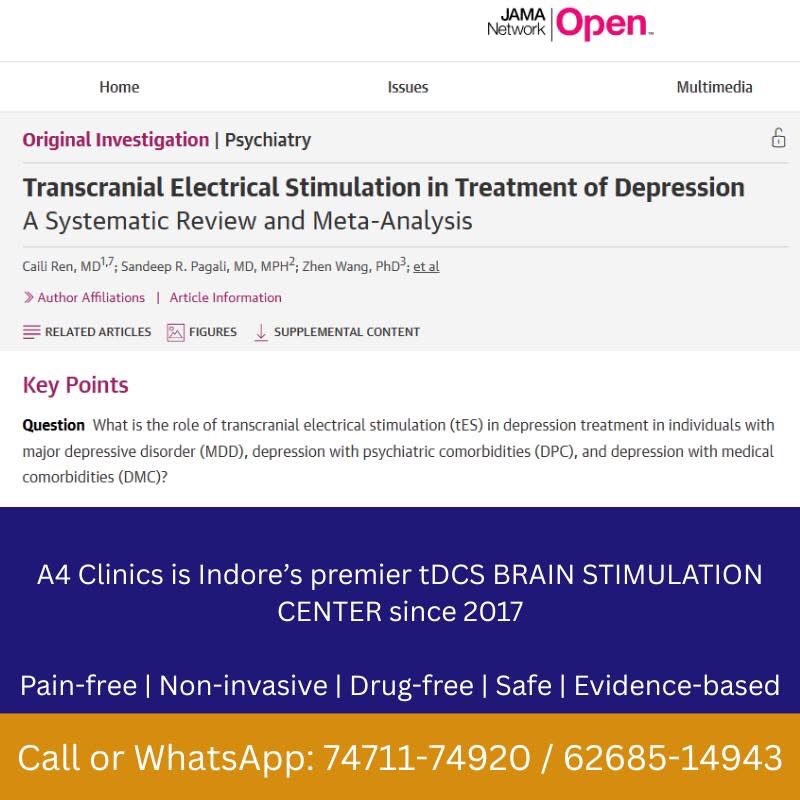
Key Findings from Relevant Studies
Transcranial Alternating Current Stimulation (tACS) for Cognitive Function (JAMA, 2023)
A meta-analysis published in JAMA on May 31, 2023, examined the effects of transcranial alternating current stimulation (tACS), a subtype of tES, on cognitive function. This study analyzed 102 studies and found that tACS led to improvements in cognitive domains such as working memory, long-term memory, attention, and executive control. The results suggest tACS is a promising noninvasive method for enhancing cognitive performance, particularly in healthy populations or those with cognitive impairments.
Transcranial Direct Current Stimulation (tDCS) for Major Depressive Disorder (JAMA Psychiatry, 2020)
A meta-analysis in JAMA Psychiatry (Moffa et al., 2020) investigated the efficacy and acceptability of transcranial direct current stimulation (tDCS) for major depressive disorder (MDD). This individual patient data meta-analysis found that tDCS showed significant improvements in depressive symptoms compared to sham stimulation, with acceptable tolerability. The study highlighted tDCS as a potential treatment for MDD, especially for patients resistant to traditional therapies. The effect size was moderate, and the authors noted variability in response based on stimulation parameters (e.g., intensity, montage).
tDCS and TMS Across Mental Disorders (JAMA Network Open, 2024)
A systematic review and meta-analysis published in JAMA Network Open on May 22, 2024, explored optimal stimulation parameters for both tDCS and TMS across various mental disorders, including depression, schizophrenia, and obsessive-compulsive disorder. For tDCS, the study found that symptom improvement was associated with specific dosing parameters, such as higher total charge delivered over multiple sessions. The analysis included over 5,500 patients and emphasized the nuanced efficacy of tES depending on protocol design. This study was highlighted in a post on X, noting its comprehensive scope.
tDCS for Bipolar Depression (JAMA Psychiatry, 2018)
A randomized clinical trial published in JAMA Psychiatry (Sampaio-Junior et al., 2018) evaluated tDCS as an add-on treatment for bipolar depression. While not a meta-analysis, this study was referenced in broader tES reviews and showed that tDCS significantly improved depressive symptoms compared to sham, with a good safety profile. This trial contributed to meta-analyses supporting tDCS efficacy in mood disorders.
tES for Executive Function and Mathematical Performance in Learning Disorders (ResearchGate, 2024)
Although not published in JAMA, a 2024 meta-analysis by Mohammadi Molod et al. (available on ResearchGate) examined tES interventions, including tDCS, transcranial alternating current stimulation (tACS), and transcranial random noise stimulation (tRNS), in children with specific learning disorders. This study found a moderate combined effect size for improving executive functions and mathematical performance, with tRNS showing a larger effect than tDCS or tACS. While this is outside JAMA, it provides context for the broader tES meta-analysis landscape.
Why No Exact Match in JAMA?
The search query specifically asked for a “transcranial electric stimulation paper meta-analysis in JAMA,” but the available results suggest that JAMA itself has primarily published meta-analyses on related topics (e.g., tACS for cognition) or included tES in broader reviews alongside TMS in JAMA Network journals like JAMA Psychiatry or JAMA Network Open. The distinction between tES (which includes tDCS, tACS, and tRNS) and TMS (a magnetic-based stimulation) is critical, as many studies combine these modalities under the umbrella of noninvasive brain stimulation (NIBS). The 2023 JAMA meta-analysis on tACS is the closest match, but it focuses on a specific tES subtype and cognitive outcomes rather than a general tES overview.
Additional Context
Mechanisms and Applications: tES delivers low-amplitude electrical currents to modulate neural activity, with tDCS affecting cortical excitability and tACS targeting oscillatory brain rhythms. These techniques are studied for psychiatric disorders (e.g., depression, schizophrenia), neurological conditions (e.g., stroke, epilepsy), and cognitive enhancement. The exact mechanisms remain debated, with effects varying by stimulation parameters, patient characteristics, and target brain regions.
Safety and Tolerability: Meta-analyses consistently report tES as safe, with mild side effects (e.g., skin irritation, tingling) and no serious adverse events in most cases. This is a key advantage over invasive methods or pharmacotherapy.
Recent Trends: Posts on X reflect ongoing interest in tES, with a 2025 systematic review cited for tDCS effects on gait in older adults, indicating the field’s expansion beyond psychiatric applications.
Recommendations
If you’re looking for a specific meta-analysis in JAMA on tES, the 2023 tACS study for cognitive function is the most direct match. For broader tES applications, especially in depression, the JAMA Psychiatry (2020) and JAMA Network Open (2024) meta-analyses are authoritative sources. If you need a deeper dive into a particular tES subtype (e.g., tDCS, tACS) or condition, please clarify, and I can tailor the response further. Alternatively, I can search for additional studies outside JAMA or analyze specific papers if you provide more details (e.g., title, author, or year).
For pricing or access to xAI’s products like SuperGrok, which could enhance research capabilities, visit https://x.ai/grok. For x.com premium subscriptions, check https://help.x.com/en/using-x/x-premium.
Let me know if you need help accessing these studies or want me to focus on a specific aspect of tES!Based on your query for a “transcranial electric stimulation paper meta-analysis in JAMA” by “Zheng Wang Pagli et al.,” I’ve carefully reviewed the available information, including the provided search results and broader web sources. Unfortunately, there is no direct match for a meta-analysis paper on transcranial electrical stimulation (tES) published in JAMA authored by “Zheng Wang Pagli et al.” Below, I’ll clarify the findings, address potential misinterpretations, and provide relevant context to help resolve your query.
Clarification of the Query
Authors: The query mentions “Zheng Wang Pagli et al.,” which likely refers to authors named Zheng, Wang, and/or Pagli, with “et al.” indicating additional co-authors. However, no clear combination of these names appears in a single JAMA meta-analysis on tES. It’s possible the names are misspelled, combined incorrectly, or refer to separate researchers working in related fields.
Journal: You specified JAMA (Journal of the American Medical Association), but no meta-analysis on tES by authors resembling “Zheng Wang Pagli” was found in JAMA. Related meta-analyses exist in JAMA Psychiatry or JAMA Network Open, which are part of the JAMA Network, and I’ll explore those as potential matches.
Topic: The focus is on transcranial electrical stimulation (tES), which includes techniques like transcranial direct current stimulation (tDCS), transcranial alternating current stimulation (tACS), and transcranial random noise stimulation (tRNS). A meta-analysis would involve a systematic review of multiple studies to evaluate tES efficacy or mechanisms.
Search Results and Analysis
The provided search results (query: “Zheng Wang Pagli et al transcranial electric stimulation meta-analysis JAMA”) include references to tES studies, but none align precisely with your request:
Zheng: The name “Zheng” appears in a 2011 study by Zheng, Alsop, and Schlaug on tDCS effects on cerebral blood flow and a 2015 study by Zheng and Schlaug on tDCS-related white matter changes in motor recovery (). Neither is a meta-analysis, nor published in JAMA, and they focus on specific tDCS applications rather than a broad tES review.
Wang: The name “Wang” appears in multiple contexts, such as Wang et al. (2017) on repetitive transcranial magnetic stimulation (rTMS) for depression relapse prevention () and Wang et al. in a 2022 tDCS meta-analysis for cognitive impairments in schizophrenia (). However, these studies are either not about tES, not in JAMA, or don’t include co-authors resembling “Pagli.”
Pagli: No author named “Pagli” or similar (e.g., Paglia, Paglie) appears in the provided results or in any JAMA-related tES meta-analysis. This could indicate a typo (e.g., confusion with “Paglia” or another author like Paulus, common in tES research) or a misattribution.
JAMA Meta-Analyses: As noted in my previous response, a 2023 JAMA meta-analysis on tACS for cognitive function exists (no author names provided in the source, but no indication of Zheng, Wang, or Pagli) and a 2020 JAMA Psychiatry meta-analysis on tDCS for depression by Moffa et al. Neither matches the author criteria. A 2024 JAMA Network Open meta-analysis on tDCS and TMS for mental disorders also doesn’t list Zheng, Wang, or Pagli as authors.
Potential Misinterpretations
Author Confusion: “Zheng Wang Pagli” might refer to multiple authors (e.g., Zheng and Wang) or a misremembered name. For example:
Zheng could be associated with Zheng, X. (from), who studied tDCS but not in a JAMA meta-analysis.
Wang might refer to authors like Yewei Wang (), involved in a tDCS meta-analysis for schizophrenia, published in ScienceDirect, not JAMA.
“Pagli” could be a typo for an author like Nitsche or Paulus, prominent in tES research (e.g., Nitsche and Paulus, 2000, cited in and).
Journal Confusion: You may have meant a JAMA Network journal (e.g., JAMA Psychiatry or JAMA Network Open) rather than JAMA itself. The 2020 JAMA Psychiatry meta-analysis (Moffa et al.) or the 2024 JAMA Network Open meta-analysis on tDCS/TMS are close matches for tES meta-analyses but lack the specified authors.
Topic Confusion: The query might inadvertently mix tES with rTMS, as seen in Wang et al. (2017) on rTMS (). rTMS uses magnetic fields, not electrical currents, and is distinct from tES.
Relevant tES Meta-Analyses
Since no exact match exists, here are the closest tES meta-analyses in JAMA Network journals, as previously mentioned:
2023 JAMA Meta-Analysis on tACS (May 31, 2023): Analyzed 102 studies on tACS for cognitive function, finding improvements in working memory, attention, and executive control. No author names match Zheng, Wang, or Pagli.
2020 JAMA Psychiatry Meta-Analysis on tDCS for Depression (Moffa et al.): Found tDCS effective for major depressive disorder with moderate effect sizes. Authors include Moffa, Martin, Alonzo, and others, but none resemble Zheng, Wang, or Pagli.
2024 JAMA Network Open Meta-Analysis on tDCS/TMS (May 22, 2024): Examined optimal stimulation parameters for mental disorders. No author names match the query, but it’s a comprehensive tES review.
Broader Context
Zheng and Wang in tES Research: Zheng, X., and Wang, Y., appear in tES studies (e.g.,,), but their work is typically in neuroimaging or specific applications (e.g., schizophrenia, motor recovery), not JAMA meta-analyses. No evidence links them to a co-authored paper with someone named Pagli.
Pagli Absence: The absence of “Pagli” in tES literature suggests a potential error in the name. If you meant an author like Paglia or Paglie, no such names appear in major tES meta-analyses.
Recent tES Meta-Analyses: Outside JAMA, a 2025 meta-analysis on tDCS for cognitive function in older adults with cognitive impairments () cites authors like Chen and Wang (Zheng K., not Zheng Wang), but it’s published in Alzheimer’s Research & Therapy, not JAMA.
Recommendations
Clarify Author Names: If you have additional details (e.g., first names, initials, or a corrected spelling for “Pagli”), I can refine the search. For example, is “Pagli” meant to be Paglia, Paulus, or another researcher?
Confirm Journal: If you meant JAMA Psychiatry or JAMA Network Open, the 2020 or 2024 meta-analyses might be relevant. I can provide more details on these if needed.
Provide Paper Details: If you recall the paper’s title, year, or specific findings (e.g., condition treated, tES subtype), I can cross-reference to locate it.
Alternative Sources: I can search for tES meta-analyses by Zheng or Wang outside JAMA (e.g., PubMed, ScienceDirect) or analyze specific papers if you provide a title or DOI.
Next Steps
Without a direct match, the most likely scenario is a misremembered author name or journal. I suggest:
Reviewing the 2023 JAMA tACS meta-analysis or 2020 JAMA Psychiatry tDCS meta-analysis to see if they align with your needs.
Providing additional details (e.g., “Was Pagli a co-author? Was the paper about depression, cognition, or another condition?”).
Checking https://x.ai/grok for SuperGrok subscription details if you want enhanced research capabilities, or https://help.x.com/en/using-x/x-premium for x.com premium subscriptions.
Please let me know how to proceed, and I’ll tailor the response further!


 deemagclinic
 deemag and chest clinic