
Imagine a young boy in the misty hills of Dehradun, Uttarakhand, growing up in a home where values like compassion and service weren’t just words—they were a way of life. That boy was Harish Kohli, son of Smt. Kamla Kohli and the late Shri Hari Ram Kohli. “From my earliest days, I watched my parents help those in need,” Dr. Kohli recalls with a warm smile. “My mother taught me that true strength lies in kindness, and my father showed me the power of hard work. Those lessons shaped everything I became.”

Harish’s journey began in the classrooms of SGRR School in Dehradun, where he balanced books with a passion for sports and culture. As a hockey goalkeeper for DBS College and later King George’s Medical College (KGMC) teams, he learned the art of teamwork under pressure. “Goalkeeping is like surgery,” he chuckles. “One wrong move, and the whole game changes. But with focus and trust in your team, you can turn the tide.” Not stopping at sports, he captained the Bhangra dance team and shone on stage as an award-winning actor and performer—even winning the Lucknow Smile Contest twice. “Those days were full of energy,” he says. “Dancing taught me rhythm in life, and acting? Well, it helped me connect with people on a deeper level.”Beyond medicine, Dr. Kohli’s life bursts with color. A hockey goalkeeper and captain for DBS and KGMC teams, he’d dive for saves with the same precision he uses in surgery. “The rink taught me teamwork—orthopaedics is no solo act.” As captain of the Bhangra dance team, he’d lead energetic performances, his laughter echoing. Theatre was his playground too, winning awards for acting. “On stage, I could be anyone; in the OR, I’m just me—saving the day.”
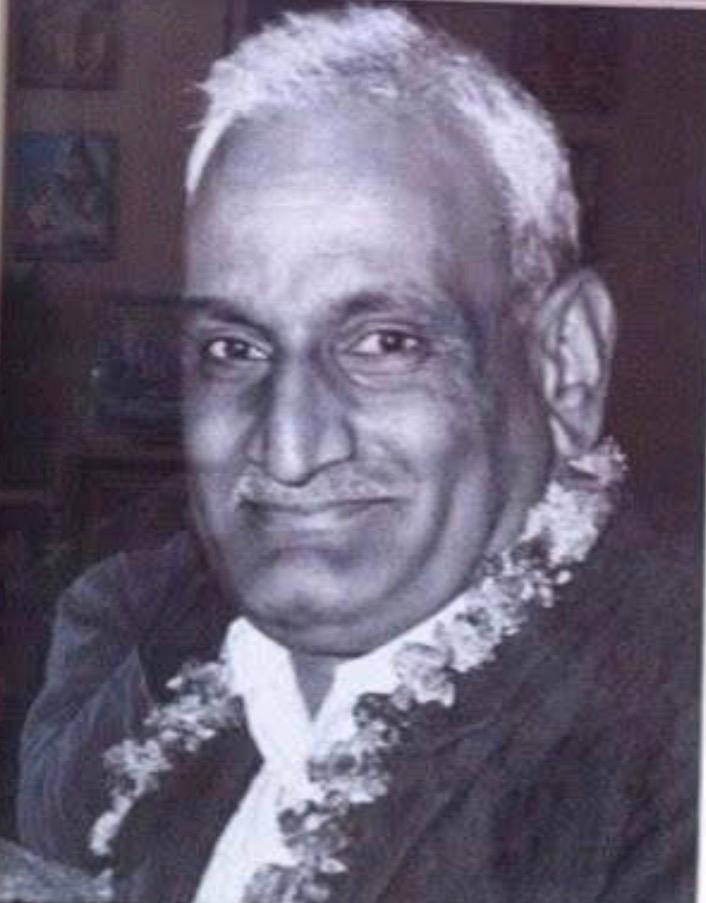
Academically, Harish was a star. After earning his B.Sc. from DBS College, he cracked the All India Entrance Exam for MBBS at the Institute of Medical Sciences, BHU, before transferring via CPMT to KGMC, Lucknow (1979–1984). He topped his MS in Orthopaedics, bagging the B.N. Sinha Gold Medal, and earlier, the S.S. Khan Gold Medal in MBBS. As Chief Resident in KGMC’s Orthopaedics Department, he honed his skills, setting the stage for a remarkable career.His father, Shri Hari Ram Kohli, was a respected businessman in Dehradun, known for his integrity and community spirit. But tragedy struck when Harish was in his third year of MBBS—his father passed away suddenly. “I remember that day like it was yesterday,” Dr. Kohli recalls with a somber smile. “He pulled me aside one evening and said, ‘Harish, no matter what, finish what you start. The world needs more healers than traders.’ Those words carried me through the grief.” The family’s legacy of dedication didn’t fade; it fueled Harish’s resolve to honor his parents through his work.
Fast-forward four decades, and Dr. Kohli stands as a pillar of orthopaedic surgery in India. In 1989, he founded a nursing home in Dehradun in memory of his father, starting with a humble consultation fee of just Rs. 30—because affordable care was his mantra. “I wanted medicine to be for everyone, not just the privileged,” he explains earnestly. “Back then, Rs. 30 was a token, but it meant no one was turned away.” His surgical prowess shines through in complex procedures: total hip, knee, shoulder, and elbow replacements; arthroscopic surgeries on knees, shoulders, and spines. He pioneered spinal surgery in Uttarakhand, becoming the state’s first spinal surgeon. And who can forget his entry in the Limca Book of Records? Performing a hip replacement on a 105-year-old woman. “She walked out stronger than ever,” he beams. “Age is just a number when the spirit is willing.”

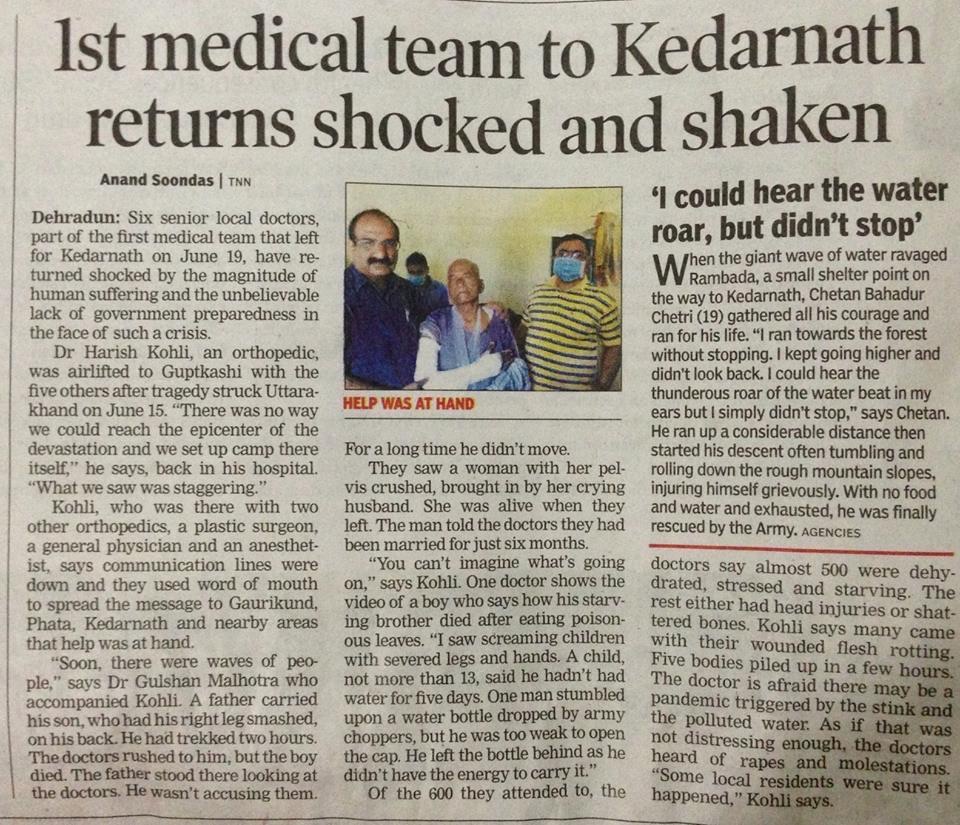
But Dr. Kohli’s story isn’t confined to operating rooms—it’s etched in the annals of humanitarian heroism. During the devastating 2013 Kedarnath floods, he led a team airlifted by the Uttarakhand government, becoming one of the first on-site for emergency surgeries and mass-casualty care. “The rain was relentless, the chaos unimaginable,” he recounts vividly. “We set up makeshift theaters in tents, operating by flashlight sometimes. A young man with a shattered leg looked at me and said, ‘Doctor, will I walk again?’ I promised him yes—and we made it happen.” His efforts extended to rehabilitation, partnering with the Indian Medical Association (IMA) to build a hospital in Guptkashi, complete with a free medical lab that’s still saving lives today.

For over 20 years before COVID, he’s run a free charitable clinic in Ganeshpur village, Uttar Pradesh, named after his mother. “It’s my way of giving back to her memory,” he says softly. “Every patient there is like family.” As a COVID warrior, he was honored for his selfless service, and his role as Patron of Khukhrain Biradari, known for free medical camps, amplifies his impact. “Service isn’t a choice; it’s a calling,” he insists.
Leadership flows naturally for Dr. Kohli. He’s served as Ex-President of IMA Dehradun and the Indian Orthopaedic Association (Uttarakhand), Ex-Vice President and Acting President of the Uttarakhand Medical Council, and Chairperson of the IMA Disaster Management Committee. He’s also President of the Doon Spine Club and a Member of the Board of Directors at SGRR University. A life member of the Indian Medical Association, its Dehradun branch, the Indian Orthopaedic Association, and IOA Uttarakhand, he’s mentored countless young surgeons. “Teaching is my legacy,” he shares. “I tell my trainees: ‘Operate with your hands, but heal with your heart.'”
His accolades are many: Honored by India’s then-Health Minister Ghulam Nabi Azad and the Uttarakhand government for Kedarnath relief, plus numerous recognitions for community health and disaster leadership. Yet, he remains humble. “Awards are nice, but the real reward is a patient’s smile,” he reflects.

In his own words: “The highest calling of medicine is service to humanity. I’ve striven to put patients first, whether in surgery, clinics, or disasters. Guided by compassion and humility, I commit to training the next generation.” Dr. Harish Kohli isn’t just a surgeon—he’s a beacon of hope, proving that one person’s dedication can touch countless lives. As he puts it, “Life’s too short not to make it meaningful. Let’s heal the world, one step at a time.”
In the misty hills of Dehradun, where the Ganges whispers ancient tales, Dr. Harish Kohli was born into a family that valued service above all else. His mother, Smt. Kamla Kohli, was the epitome of quiet strength—a god-fearing woman whose mornings began with prayers and whose evenings ended with stories from the scriptures. “Beta, true wealth isn’t in gold or land; it’s in the blessings you earn by helping others,” she’d often tell young Harish as they sat by the family altar, the scent of incense filling the air. Her spiritual guidance became the compass for his life, instilling in him a deep sense of compassion.
Education was Harish’s gateway to that purpose. He started at SGRR School in Dehradun, where his curiosity about the human body first sparked. “Why do bones break, and how do they mend?” he’d pester his teachers, his eyes wide with wonder. He pursued a B.Sc. at DBS College, Dehradun, before diving into medicine. His MBBS journey began at the Institute of Medical Sciences, BHU, but fate—and a stellar performance in the CPMT exam—led him to King George’s Medical College (KGMC) in Lucknow in 1979. Graduating in 1984, he didn’t stop there; he earned his MS in Orthopaedics from KGMC, topping his class.
His academic prowess shone brightly. “Winning the S.S. Khan Gold Medal in MBBS was surreal,” he chuckles. “I was just a kid from Dehradun, studying under a dim lamp after long hospital shifts.” The B.N. Sinha Gold Medal for being the MS Orthopaedics topper followed, and he capped it off as Chief Resident in the Orthopaedics Department. “It wasn’t about the medals,” he says. “It was about proving to myself—and to my late father—that I could make a difference.”
In 1989, Dr. Kohli returned to Uttarakhand, his heart set on charitable healthcare. He founded a nursing home in Dehradun in memory of his father, Shri Hari Ram Kohli—a place where healing came first, profits last. Starting his private practice with a consultation fee of just ₹30, he set a benchmark for selfless service. “Medicine isn’t a business; it’s a calling,” he’d tell skeptical colleagues. “If a farmer can’t afford to see me, how can I call myself a doctor?” Over 35 years, he’s touched countless lives, turning his clinic into a beacon of hope.
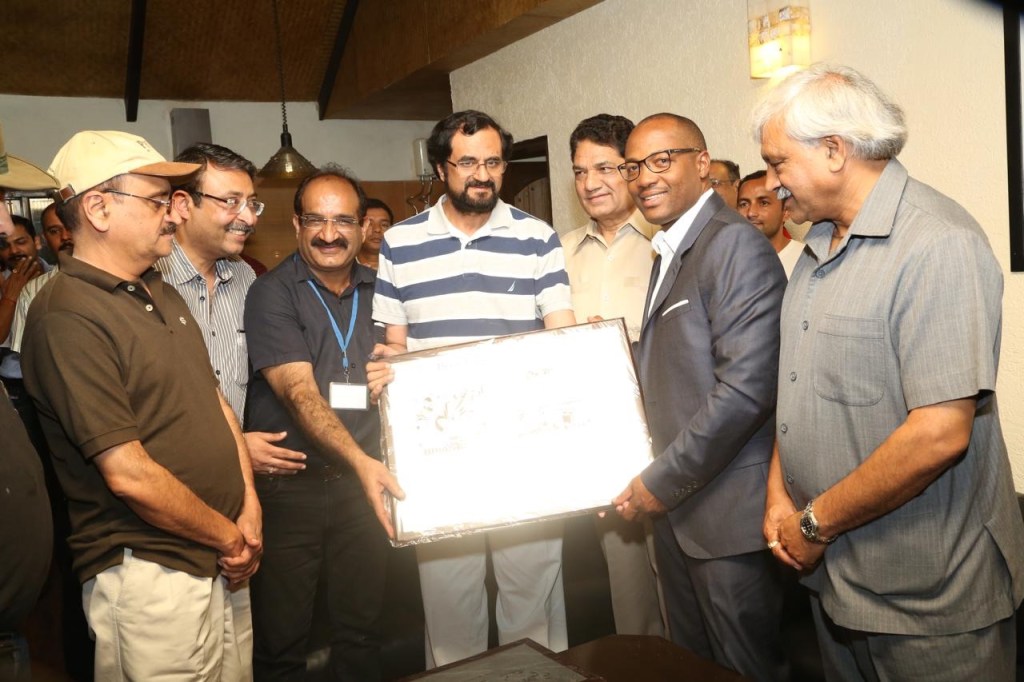
But it was the Kedarnath disaster in 2013 that etched his name in heroism’s annals. Airlifted by the Uttarakhand government, Dr. Kohli’s team was reportedly the first to reach the ravaged site—even before the NDRF. Amidst the chaos of floods, landslides, and despair, he operated on the ground, surrounded by devastation. “Bodies everywhere, the air thick with sorrow,” he recounts vividly. “A pilgrim with a shattered leg grabbed my hand and whispered, ‘Doctor sahib, will I walk again?’ I looked him in the eyes and said, ‘Not just walk— you’ll dance at your daughter’s wedding.’ We stitched wounds by flashlight, saved limbs, and restored faith.” Hundreds owed their lives to his grit. Later, partnering with the IMA and government, he helped build a hospital in Guptkashi, which still runs a free medical lab. To sustain it, he organized a charity cricket match featuring the legendary Brian Lara. “Brian hit a six, and I thought, ‘That’s one more life we can save,'” Dr. Kohli laughs.
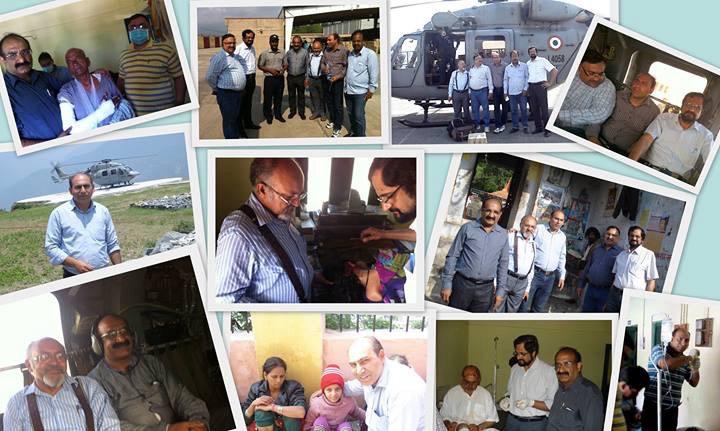
His leadership extends far: as Chairperson of the IMA Disaster Management Committee, Ex-President of IMA Dehradun and IOA Uttarakhand, and Ex-Vice President & Acting President of the Uttarakhand Medical Council. Recognition poured in—honored by Health Minister Ghulam Nabi Azad and the Uttarakhand government for his Kedarnath efforts. He even made the Limca Book of Records for a hip replacement on a 105-year-old woman. “She woke up post-surgery and said, ‘Doctor, now I can chase my great-grandkids!’ Moments like that? Priceless.” And who could forget his back-to-back wins in the Lucknow Smile Contest? “Smiling through tough times keeps the spirit alive,” he quips.
Family remains his anchor. Married to Dr. Vinita Kohli, they raised a dynasty of healers. Their son, Dr. Tushar Kohli, an orthopaedic surgeon, married Dr. Surabhi Kohli, a gynaecologist; together, they dote on grandsons Rudra Dev and Atharv Dev. Daughter Dr. Kanika Kohli Khetan, a dental surgeon, and her husband Dr. Harsh Khetan, a pathologist, complete the circle with grandson Harshu. “Watching my kids and grandkids in white coats? It’s like my father’s dream multiplied,” Dr. Kohli says warmly. “We gather for dinners, sharing stories of the day—laughter, lessons, and a lot of love.”

Dr. Harish Kohli isn’t just a surgeon; he’s a storyteller of resilience, a bridge between science and soul. In a world racing for accolades, he reminds us: “Healing starts with heart. And that’s a legacy worth living.”
Dr. Harish Kohli’s journey is a vivid testament to the power of perseverance, charisma, and an unshakeable connection to his roots. Born into a humble family in a small town in Uttarakhand, Harish was shaped by the simplicity and values of his parents. His father, Hari Ram Kohli, was a respected gur merchant, known for his honesty in trade, while his mother, Asha Kohli, was a pillar of faith, her days steeped in devotion to Lord Ram. Their modest home was filled with love, but resources though not scarce, still were wanting enough to push Harish to carve his own path through sheer determination.
As a boy, Harish attended a local school, of Shri guru ram rai mission, where his sharp mind and relentless work ethic began to shine. He later pursued a B.Sc. at DBS Public College, but his sights were set higher—on a medical career that seemed like a distant dream given his circumstances. Preparing for the Combined Pre-Medical Test (CPMT), Harish purposely turned the rooftop of his family’s home into his study haven. Under a tin roof that absorbed the sun’s relentless heat, he pored over books, the discomfort keeping him alert. “Sleep was the enemy,” he’d later joke, “and that roof was my drill sergeant.”. His friend Prabhakar and Rajesh also got selected. Prabhakar works as Aneasthsia specialist in his hospital. Rajesh became an ophthalmologist. Prabhakar is always at praise for him. He has many first to his credit including knee transplant, elbow surgery and spine surgeries.
The Remarkable Odyssey of Dr. Harish Kohli: From Dehradun’s Hills to Heroic Heights
Nestled in the verdant valleys of Dehradun, Uttarakhand, Dr. Harish Kohli grew up with the Himalayas as his backyard playground. “Those mountains taught me resilience early on,” he often reflects with a grin. “You climb, you fall, you get up—that’s life, and that’s surgery.” His journey began at SGRR School, where a young Harish’s curiosity about broken bones from playground mishaps sparked his medical dreams. He breezed through a B.Sc. at DBS College, Dehradun, before fate steered him to the Institute of Medical Sciences at BHU. But acing the CPMT exam changed everything—he joined the prestigious King George’s Medical College (KGMC) in Lucknow in 1979, wrapping up his MBBS in 1984 and mastering an MS in Orthopaedics soon after.
Excellence wasn’t just a goal; it was Harish’s hallmark. “When they handed me the S.S. Khan Gold Medal for MBBS, I thought, ‘This is for every late-night study session fueled by chai and determination,'” he recalls. Topping his MS with the B.N. Sinha Gold Medal? “Pure adrenaline.” As Chief Resident in KGMC’s Orthopaedics Department, he honed his skills, leading teams through grueling shifts. “It’s not about the title,” he’d tell his juniors. “It’s about the hands you steady when they’re shaking.”
By 1989, Dr. Kohli was back in Uttarakhand, channeling his expertise into charitable miracles. He founded a nursing home in Dehradun, naming it after his late father, Shri Hariram Kohli—a tribute that still brings a tear to his eye. “Dad always said, ‘Help without expecting,'” Harish shares. “So, I started my practice charging just Rs. 30 per consultation. Affordable care isn’t charity; it’s justice.” For over 35 years, he’s been the go-to healer for the underprivileged, turning operating rooms into sanctuaries of hope.
But nothing defined his valor like the Kedarnath disaster of 2013. Airlifted by the Uttarakhand government, Dr. Kohli’s team beat even the NDRF to the ground zero of utter devastation. “We landed amid chaos—rivers raging, bodies strewn like forgotten dreams,” he recounts vividly. “A survivor clutched my arm and whispered, ‘Doctor, my leg… will I ever walk?’ I knelt in the mud and said, ‘Not only walk—you’ll run to embrace your family again.'” Stitching wounds on the cold earth, treating thousands amid the lifeless, it was a trial by fire. “Life-changing? Absolutely. You realize medicine isn’t just scalpels; it’s soul.” Back home, he didn’t rest—he rallied the government and IMA to build a hospital in Guptkashi. Today, its free medical lab hums with activity, a living legacy.
Fundraising? Dr. Kohli turned it into fun. “Let’s organize a cricket match!” he proposed, roping in West Indies legend Brian Lara for a charity game supporting the Guptkashi hospital. “Brian smashed a boundary, and I yelled from the sidelines, ‘That’s for the next X-ray machine!’ The crowd went wild—it was magic.”

Leadership came naturally. As Chairperson of the IMA Disaster Management Committee, Ex-President of IMA Dehradun and the Indian Orthopaedic Association (IOA) Uttarakhand, plus Ex-Vice President and Acting President of the Uttarakhand Medical Council, he’s shaped policies that save lives. “Committees aren’t about meetings; they’re about movements,” he insists.
Accolades followed like well-deserved applause. Honored by Health Minister Ghulam Nabi Azad and the Uttarakhand government for his Kedarnath heroics, Dr. Kohli beams with humility. His Limca Book of Records entry? Performing a hip replacement on a 105-year-old woman—a feat that had her quipping post-surgery, “Doctor, now I can outdance my grandchildren!” And winning the Lucknow Smile Contest twice? “Smiles are contagious,” he laughs. “In medicine, a warm one can heal half the hurt.”
Life beyond the white coat? Vibrant and varied. As hockey goalkeeper and captain for DBS and KGMC teams, he’d dive into saves with surgical precision. “The goalpost was my first operating table—defend at all costs!” Leading the Bhangra dance team, his rhythms electrified stages. “Bhangra’s all heart and energy—just like a good surgery.” An accomplished stage artist, he scooped multiple acting awards, channeling emotions that later helped him connect with patients. “Theatre taught me empathy; medicine made it real.”
Dr. Harish Kohli isn’t just a surgeon—he’s a symphony of service, spirit, and stories. In a world of fleeting fame, he reminds us: “True greatness? It’s in the lives you touch, one stitch at a time.”
Harish wasn’t just a studious recluse; he was a vibrant, outgoing soul with a flair for the dramatic. An exhibitionist at heart, he carried himself with a swagger that turned heads. When he secured admission to the prestigious King George’s Medical College (KGMC) in Lucknow, that swagger only grew. He’d saunter through Paltan Bazar, his chest puffed with pride, reveling in the whispers of onlookers who recognized a young man destined for greatness. On train journeys to Lucknow, Harish would strategically pull out his Cunningham’s Manual of Practical Anatomy, flipping its pages with purpose. One day, a curious fellow passenger leaned over and asked, “What’s that book, beta? You a doctor?” Harish’s eyes sparkled as he replied, “Not yet, uncle, but I’m studying at KGMC to become one. Watch this space!”
At KGMC, Harish’s talents flourished. His athletic side shone through when he won a medal in hockey, earning cheers from teammates who admired his tenacity on the field. In the dissection hall, his steady hands and keen eye earned him prizes and the respect of professors. “This boy could dissect a nerve with his eyes closed,” one instructor reportedly said, shaking his head in awe. Those steady hands would later define his career as a surgeon, known for precision and calm under pressure.
Harish’s courage was never more evident than during the 2013 Kedarnath disaster. While others fled the flood-ravaged region, Harish boarded a helicopter to reach the stranded victims. With limited resources and chaotic conditions, he worked tirelessly, stitching wounds and saving lives. The Uttarakhand government later honored him for his selfless service, a moment Harish accepted with his characteristic blend of humility and pride. “It’s what doctors do,” he said simply, though his eyes betrayed the weight of those days.

His family mirrors his legacy of excellence. His son, an orthopedic surgeon, inherited Harish’s surgical precision, while his daughter, a dentist, carries his knack for detail. His wife, Vinita, a general gynecologist, is his rock—devoted, compassionate, and a force in her own right. His son-in-law, is a pathologist, settled in Arhat Bazar at harish old clinic and his brother, a chartered accountant, settled in Canada, round out a family that embodies ambition and achievement. Harish’s confidence is legendary; he’s never one to shrink before authority. At a state function, he once grabbed a minister’s arm, his voice firm but warm: “Sir, we need better equipment for the hospital. Let’s make it happen!” The minister, taken aback, could only nod.

Harish’s love for technology set him apart early on. In a town where such things were rare, he brought home the first movie projector, hosting screenings that drew neighbors in droves. Today, his collection of premium cars, including a sleek Jaguar, is a point of pride. “Come, let me show you the beast!” he’d say to friends, popping the hood to reveal its features with the enthusiasm of a teenager. He has a fleet of cars including Honda jazz, Tata nexon, Toyota fortuner with his favourite jaguar and now brand new defender.
His home on Haridwar Road is a reflection of his personality—grand yet welcoming, with sprawling rooms and a temple housing life-size statues of Ram, Sita, and Lakshman. The temple, a tribute to his mother’s faith, is where Harish finds solace, often sitting in quiet reflection. His dog a very big Bhutia dog is fearsome but gentle. They call him as his family. If he barks at someone, sure enough Harish would become suspicious.
Mrs Kamala Kohli’s devotion to Lord Ram was the heartbeat of their family. Even in her final years, as dementia clouded her mind, she recited Ram’s name with unwavering clarity. I carry a quiet regret about her: not taking her to Rameswaram for pilgrimage. Years ago, when my family planned the trip, I hesitated, worried about his mother’s frailty. “She’d have walked every step, chanting Ram Tarak mantra,” he later confided to me, a close friend, his voice thick with emotion. “We should’ve made it happen.”
Dr. Harish Kohli’s life is a vibrant mosaic—humble beginnings, audacious dreams, and a heart that balances swagger with service. From the tin-roofed rooftop to the operating theater, from Paltan Bazar’s dusty lanes to the sacred quiet of his home temple, Harish remains a man who lives boldly, loves deeply, and leaves an indelible mark on everyone he meets.
Dr. Harish Kohli is a renowned orthopedic surgeon based in Dehradun, Uttarakhand, and the director of Hari Ram Kohli Memorial Hospital, which he established in 1991. He completed his MBBS and specialization (MS in Orthopedics) from King George’s Medical College (KGMC), Lucknow. With over 35 years in healthcare, Dr. Kohli is recognized as one of Dehradun’s most senior and respected orthopedic surgeons, specializing in orthopedics, joint replacement, and arthroscopy. His vision is to provide affordable, advanced healthcare to the people of Uttarakhand, and he has received multiple awards from government and private organizations for his contributions to the field. His clinic is located at Shop No. 35, Saharanpur Chowk, Arhat Bazar, Dehradun, and he is associated with the Indian Medical Association (IMA) Dehradun, now it is Dr Khetan pathology laboratory, his son in law workplace.
The making of SGRR Medical College, Dehradun
Dr. Harish Kohli’s journey is a tale of grit, vision, and a deep-rooted commitment to serving humanity—a story that feels like it was scripted by destiny itself. Born and raised in the nurturing embrace of Dehradun, Harish’s early years were shaped by the Shri Guru Ram Rai (SGRR) School, where he wasn’t just another student but a trailblazer. He etched his name in history as the first SGRR student to crack the entrance to medical college, a feat that sent ripples of pride through the institution.

The day the news broke, Shri Indresh Charan Das, the revered Maharaja ji, beamed with joy. In a gathering at the SGRR campus, his voice boomed with emotion: “My mission feels complete today! Harish, you’ve made us proud—a gold medalist doctor from SGRR! Tell me, what reward do you seek?” Dr. Kohli, ever humble but brimming with ambition, didn’t ask for personal gain. Instead, his eyes sparkled with a bold idea. “Maharaja ji,” he said, “you’ve built 100 schools under SGRR. Why not take it further? A medical college, a nursing college, an engineering college, a physiotherapy college—let’s create a legacy of professional education!”
The room fell silent. Maharaja ji’s eyes widened, then softened with realization. “A golden idea, Harish,” he said, nodding slowly. “But tell me, how vast is this world of medical science? Bring me every book you have—Gray’s Anatomy, Campbell’s Textbook of Surgery, all of them. I want to understand this dream of yours.” True to his word, Dr. Kohli arrived with a towering stack of medical tomes. A week later, Maharaja ji, having pored over the texts with the zeal of a student, looked up and said, “Let’s make this happen.”
What followed was a whirlwind of ambition and action. Maharaja ji, never one to shy away from a challenge, drove Dr. Kohli in his own jeep to LLRM Medical College in Meerut. There, they met the college’s lady principal, touring every department, soaking in the intricacies of running a medical institution. “Harish,” Maharaja ji said as they drove back, the jeep rattling along the dusty roads, “you’re the director of this mission. Lead the way.” But Dr. Kohli, ever grounded, had a personal dream too. “Maharaja ji,” he replied, “I want to honor my late father with a charitable nursing home in his name. For SGRR, my services will always be free—my devotion to Darbar Sahib demands nothing less.”

Maharaja ji, moved by his disciple’s selflessness, offered financial support to establish the Hari Ram Kohli Memorial Clinic at Saharanpur Chowk. On its inauguration day, as the ribbon fell, Maharaja ji clapped Dr. Kohli on the shoulder and said, “This is just the beginning, Harish.”
The grand vision of the SGRR Medical College took shape next. After heated discussions, Dehradun’s heart was chosen as its home—a sprawling campus that would house a state-of-the-art hospital and medical college. Day and night, Dr. Kohli and Maharaja ji toiled, their dream inching closer to reality. But fate dealt a blow: Maharaja ji Shri Indresh Charan Das passed away before the project’s completion. The mantle passed to Shri Devendra Charan Das ji, a visionary with boundless energy. Determined to honor his predecessor, he named the hospital Shri Mahant Indresh (SMI) Hospital, a tribute to the late Maharaja ji.
Under Devendra ji’s leadership, the SMI Hospital and SGRR Medical College became beacons of hope, offering affordable healthcare and top-tier education to millions in Uttarakhand. Dr. Kohli, now a founder member of this monumental institution, swells with pride when he speaks of it. “I was there from the start,” he says, his voice tinged with nostalgia. “This is our legacy.”
His life, a blend of devotion and determination, remains a testament to what one person’s vision—sparked in the classrooms of SGRR—can achieve when fueled by purpose and guided by a guru’s blessings.
Dr. Harish Kohli: A Life of Dedication and Swagger
Dr. Harish Kohli’s story is one of grit, pride, and an unyielding zest for life. Born into a humble family in a small town, Harish grew up under the care of his father, Hari Ram Kohli, a gur merchant, and his deeply religious mother, Kamla Kohli. His early years were spent at a mission school, followed by a B.Sc. from DBS Public College. Despite his modest background, Harish’s ambition burned bright. Preparing for the Combined Pre-Medical Test (CPMT), he studied relentlessly under the tin roof of his house, the scorching heat keeping sleep at bay—a testament to his determination.
Harish was no wallflower. Outgoing and unapologetically confident, he carried a certain swagger, especially after earning a coveted spot at King George’s Medical College (KGMC). Strolling through Paltan Bazar in Lucknow, his pride was palpable. On train journeys to the city, he’d casually open his Cunningham’s Manual of Practical Anatomy, inviting curious glances from fellow passengers. “What do you do, young man?” an inquisitive traveler once asked. With a grin, Harish replied, “Just a medical student at KGMC, learning to fix the world, one bone at a time.”
At KGMC, Harish shone. A medal in hockey showcased his athletic prowess, while his dissection skills earned him accolades. His steady hands later made him a formidable surgeon. During the 2013 Kedarnath disaster, when others fled, Harish boarded a helicopter to serve the victims, earning recognition from the Uttarakhand government for his courage and skill.
His family reflects his legacy of excellence. His son, an orthopedic surgeon, and daughter, a dentist, carry forward his medical lineage. His wife, Vinita, a devoted gynecologist, stands by his side, while his son-in-law, a pathologist, and his brother, Devendra nick named ‘Dindi,’ a chartered accountant in Canada, complete the circle. Harish’s confidence never wavered, even in the presence of authority. He’d boldly grab a minister’s arm, saying, “Sir, let’s get this done for the people!” His love for technology was evident early on—he brought the first movie projector to town and now proudly shows off his Jaguar’s features to friends.
Harish’s home on Haridwar Road is a reflection of his personality: grand yet grounded, with a temple housing life-size statues of Ram, Sita, and Lakshman, a nod to his mother’s devotion. Asha’s faith in Lord Ram remained unshaken, even as dementia clouded her final days. Harish carries one regret: not taking her to Rameswaram for pilgrimage. “I thought the journey would be too much for her,” he once confided to a friend, his voice heavy. “But she would’ve walked every step chanting Ram’s name.”
Dr. Harish Kohli remains a man of contradictions—humble yet flamboyant, disciplined yet exuberant. His life is a vibrant tapestry of service, swagger, and an unwavering commitment to family and faith.

Dr. Harish Kohli: A Life of Grit, Glory, and Grace in the Face of the 2013 Kedarnath Disaster
Dr. Harish Kohli’s story is one of resilience, charisma, and an unwavering commitment to service, vividly highlighted by his heroic response to the catastrophic Kedarnath disaster of June 2013. Born into a humble family in a small Uttarakhand town, Harish’s journey from a tin-roofed study haven to a celebrated surgeon is a testament to his indomitable spirit. His role during the Kedarnath tragedy, where he risked his life to aid victims, cemented his legacy as a man who thrived under pressure, blending swagger with selflessness.
Early Life and Rise to Prominence
Harish grew up under the influence of his father, Hari Ram Kohli, a gur merchant known for his integrity, and his deeply religious mother, Asha Kohli, whose devotion to Lord Ram shaped the family’s values. At a mission school and later at DAV Public College, where he earned his B.Sc., Harish displayed a relentless work ethic. Preparing for the Combined Pre-Medical Test (CPMT), he studied on the family’s rooftop under a scorching tin roof, using the heat to stay awake. “Sleep was my rival,” he’d later quip, “but that roof made sure I won.”
An outgoing exhibitionist with a distinctive swagger, Harish’s confidence soared when he secured admission to King George’s Medical College (KGMC) in Lucknow. Strolling through Paltan Bazar, he reveled in his achievement, his pride evident in every step. On train journeys to Lucknow, he’d open his Cunningham’s Manual of Practical Anatomy, inviting curious glances. “What’s that you’re reading, young man?” a fellow passenger once asked. With a grin, Harish replied, “Just the map to saving lives, uncle. I’m at KGMC, training to be a doctor.”
At KGMC, Harish excelled, winning a hockey medal and accolades for his dissection skills, his steady hands foreshadowing his surgical prowess. His charisma and confidence made him a standout, yet his roots kept him grounded.
The Kedarnath Disaster: A Defining Moment
The Kedarnath disaster of June 2013 was a cataclysm that tested Harish’s mettle. Triggered by a midday cloudburst and the breach of Chorabari Lake, the disaster unleashed devastating flash floods and landslides in Uttarakhand, claiming over 6,000 lives and stranding thousands of pilgrims and residents. The Mandakini River, swollen by rainfall 440% above normal (385.1 mm against a typical 71.3 mm), swept away entire settlements, including parts of Kedarnath town, though the 8th-century Kedarnath Temple miraculously remained intact. The floods, exacerbated by unscientific development like hydroelectric projects and rampant construction, turned the pilgrimage season into a tragedy, with over 300,000 pilgrims trapped and infrastructure decimated.
While others fled, Harish, then a seasoned surgeon, boarded a helicopter to reach the disaster zone. The scene was apocalyptic: bodies littered the valley, water sources were contaminated, and survivors faced fever and diarrhea. Harish worked tirelessly, stitching wounds and stabilizing patients under chaotic conditions. “We’re here to pull them through,” he told a fellow doctor, his voice steady despite the devastation. His efforts earned him recognition from the Uttarakhand government, a moment he accepted with quiet pride, saying, “It’s what we’re trained for—to stand when others fall.”

The disaster’s causes were both natural and man-made. Heavy rainfall and the melting of the Chorabari Glacier caused a glacial lake outburst flood (GLOF), while deforestation, poorly planned roads, and over 70 hydroelectric projects destabilized the region’s ecology, amplifying the destruction. Environmentalists called it a “disaster waiting to happen.” Despite the chaos, Harish’s steady hands and calm demeanor saved countless lives, embodying the courage that defined his career.
A Life Beyond the Disaster
Harish’s family reflects his legacy of excellence. His son, an orthopedic surgeon, and daughter, a dentist, carry forward his medical expertise. His wife, Vinita, a devoted gynecologist, complements his drive with her compassion. His son-in-law, a pathologist, and his brother, a chartered accountant in Canada, complete a family rooted in achievement. Harish’s confidence never wavered, even with authority figures. At a state event, he once grabbed a minister’s arm, urging, “Sir, we need better hospitals—let’s make it happen!” The minister, startled, could only agree.
A tech enthusiast, Harish brought the first movie projector to his town, hosting screenings that united neighbors. Today, his collection of premium cars, including a Jaguar, is a source of pride. “Come see the magic of engineering!” he’d enthuse, showing friends its features. His home on Haridwar Road is a blend of grandeur and spirituality, with a temple housing life-size statues of Ram, Sita, and Lakshman, a tribute to his mother’s faith.
Asha Kohli’s devotion to Lord Ram was unwavering, even as dementia claimed her final years. Harish’s deepest regret is not taking her to Rameswaram for pilgrimage. “She’d have walked every step, chanting Ram’s name,” he confided to a friend, his voice heavy with sorrow. “I thought she was too frail, but I underestimated her spirit.”
Legacy and Lessons
Dr. Harish Kohli’s life is a tapestry of grit, glory, and grace. From his humble beginnings to his heroic response to the Kedarnath disaster, he embodies the balance of audacity and altruism. The 2013 tragedy underscored the need for sustainable development in the Himalayas, a lesson Harish advocates for, urging better planning to prevent future calamities. His story is not just one of personal triumph but a call to honor resilience, faith, and service in the face of nature’s fury.
Dr. Harish Kohli: The Swashbuckling Surgeon of Kedarnath’s Darkest Hour
Dr. Harish Kohli wasn’t just a doctor—he was a force of nature, a man whose life danced between gritty determination, flamboyant swagger, and a heart that beat for service. Born in a dusty Uttarakhand town to a gur merchant, Hari Ram Kohli, and his devout wife, Asha Kohli, Harish grew up steeped in humility and faith. His mother’s nightly prayers to Lord Ram echoed through their modest home, while his father’s honest trade taught him integrity. But Harish was no ordinary small-town kid. He had a spark—a hunger for greatness that propelled him from a mission school to a B.Sc. at DAV Public College, and eventually to the hallowed halls of King George’s Medical College (KGMC) in Lucknow.
The Tin Roof and the Train: Harish’s Rise
To crack the Combined Pre-Medical Test (CPMT), Harish turned his family’s rooftop into a battleground against sleep. Under a tin roof that sizzled like a griddle in the summer sun, he devoured textbooks, the heat his unlikely ally. “That roof was my personal trainer,” he’d later laugh, “keeping me sharp when my eyes begged to close.” His hard work paid off when he strutted into KGMC, his swagger practically a character of its own. In Lucknow’s bustling Paltan Bazar, Harish was a peacock in a crowd of pigeons, his pride in his selection radiating with every step.
On train rides to the city, Harish played the showman. He’d crack open his Cunningham’s Manual of Practical Anatomy, flipping pages with theatrical flair, waiting for a curious passenger to bite. “What’s that book, beta?” an old man once asked, peering over his glasses. Harish’s grin was pure mischief. “Just the key to cutting folks open and putting ’em back together, uncle. I’m training at KGMC to be a surgeon!” The man’s wide-eyed nod only fueled Harish’s glee.
At KGMC, Harish was a star. He snagged a hockey medal, outpacing opponents with the same ferocity he brought to the dissection hall, where his scalpel danced like a maestro’s baton, earning him prizes and professors’ awe. “This lad could carve a masterpiece out of a cadaver,” one instructor marveled. Those steady hands would soon face their ultimate test.
The Kedarnath Deluge: A Hero in the Chaos
June 2013 brought hell to Uttarakhand’s sacred mountains. The Kedarnath disaster, sparked by a monstrous cloudburst and the collapse of Chorabari Lake, unleashed a biblical flood. The Mandakini River, swollen by 440% more rain than usual (385.1 mm in a day), became a roaring beast, swallowing villages, roads, and over 6,000 lives. Landslides buried homes, and over 300,000 pilgrims were stranded in a nightmare of mud and despair. The region’s reckless development—70-plus hydroelectric projects, deforestation, and shoddy roads—turned a natural calamity into a man-made catastrophe. The Kedarnath Temple stood defiant, but the town around it was a graveyard.
While others ran, Harish Kohli flew into the heart of it. Boarding a helicopter through turbulent skies, he landed in a warzone of shattered lives. Bodies littered the valley, water was tainted, and survivors battled fever and starvation. With medical supplies scarce and panic everywhere, Harish’s calm was a beacon. He stitched wounds, set bones, and reassured terrified victims, his hands as steady as ever. “We’re getting you through this,” he told a trembling pilgrim, his voice cutting through the chaos like a lighthouse beam. For days, he worked in makeshift camps, surrounded by the stench of death and the wail of loss, saving lives one suture at a time.
The Uttarakhand government later honored him, a medal pinned to his chest as cameras flashed. Harish, ever the paradox of humility and pride, shrugged it off. “It’s what doctors do,” he said, but his eyes told a story of sleepless nights and unshakable resolve. The disaster exposed the region’s vulnerabilities—greedy construction, ignored environmental warnings—but Harish’s courage was a reminder of human resilience.
A Life of Swagger and Soul
Harish’s family is a dynasty of healers. His son, an orthopedic surgeon, wields the same surgical precision, while his daughter, a dentist, inherited his eye for detail. His wife, Vinita, a gynecologist, is his anchor, her devotion matching his drive. His son-in-law, a pathologist, and his brother, a chartered accountant in Canada, round out a clan of overachievers. Harish never bowed to authority; he’d grab a minister’s arm at a function, his voice booming, “Sir, we need better hospitals—let’s make it happen!” The minister, half-stunned, half-charmed, could only agree.
A tech junkie, Harish brought the first movie projector to his town, turning his home into a local cinema. Now, he cruises in a Jaguar, popping the hood to show friends its gadgets with boyish glee. “This beauty’s got more brains than half my old professors!” he’d chuckle. His Haridwar Road mansion is a palace of warmth, with a temple housing life-size statues of Ram, Sita, and Lakshman—a tribute to his mother, Asha, whose faith in Ram never wavered, even as dementia stole her memories.

Harish’s one regret cuts deep. Years ago, he didn’t take Kamla, his mother to Rameswaram for pilgrimage, fearing her age would make the journey too grueling. “She’d have danced through those temples, chanting Ram Tarak mantra,” he told a friend, his voice cracking. “I thought I was protecting her, but I robbed her of her dream.” Asha passed away reciting Ram’s name, her spirit unbroken.
A Legacy Larger Than Life
Dr. Harish Kohli is a whirlwind of contradictions: a small-town boy with big-city swagger, a surgeon with an artist’s hands, a man who faced a biblical flood with unflinching courage. The Kedarnath disaster revealed the cost of human greed in the Himalayas, but Harish’s story shouts louder—of grit, glory, and a heart that refuses to break. He’s a reminder that heroes don’t just save lives; they live them, with every step a swagger and every act a prayer.
Dr. Harish Kohli: The Swashbuckling Surgeon with a Heart of Gold
Dr. Harish Kohli’s life is a dazzling saga of grit, charisma, and an unshakable commitment to humanity, epitomized by his remarkable choice to charge just ₹30—less than half a dollar—for consultations as a way to give back to society. Born in a modest Uttarakhand town to Hari Ram Kohli, a gur merchant, and Asha Kohli, a devout follower of Lord Ram, Harish’s journey from a tin-roofed rooftop to a celebrated surgeon is a tale of audacity and altruism, with his heroic response to the 2013 Kedarnath disaster as its crescendo.
From Tin Roof to Triumph
Harish’s early years were steeped in simplicity. His mother’s prayers filled their home with faith, while his father’s honest trade taught him integrity. At a mission school and later at DAV Public College, where he earned his B.Sc., Harish’s ambition burned bright. To conquer the Combined Pre-Medical Test (CPMT), he turned his family’s rooftop into a study crucible, the searing tin roof overhead keeping him awake. “That roof was my taskmaster,” he’d chuckle, “making sure I never dozed off on my dreams.”
An unapologetic showman, Harish carried a swagger that turned heads. When he secured a spot at King George’s Medical College (KGMC) in Lucknow, he strutted through Paltan Bazar like a rockstar, his pride infectious. On train rides to the city, he’d whip out his Cunningham’s Manual of Practical Anatomy, flipping pages with flair. “What’s that you’re studying, son?” a curious passenger once asked. Harish’s grin was electric. “Just learning to fix the world, one bone at a time—KGMC’s my stage!”
At KGMC, Harish was a dynamo. He clinched a hockey medal, outpacing rivals with fierce energy, and wowed professors in the dissection hall, his scalpel carving with an artist’s precision. “This boy could dissect a nerve in a storm,” one teacher marveled. Those steady hands would soon face their ultimate test in a real tempest.
The Kedarnath Cataclysm: A Hero’s Stand
In June 2013, Uttarakhand’s sacred mountains became a scene of biblical horror. A cloudburst and the collapse of Chorabari Lake unleashed a monstrous flood, with the Mandakini River swelling from 440% excess rainfall (385.1 mm in a day). Landslides and flash floods obliterated villages, claiming over 6,000 lives and stranding 300,000 pilgrims. Reckless development—deforestation, 70-plus hydroelectric projects, and shoddy infrastructure—amplified the disaster, turning Kedarnath into a muddy graveyard, though its ancient temple stood firm.
While chaos drove others away, Harish flew into it. Boarding a helicopter through turbulent skies, he landed in a hellscape of shattered lives—bodies strewn across the valley, water fouled, survivors battling fever and despair. With scant supplies, Harish stitched wounds, set fractures, and offered hope. “You’re going to make it,” he told a shivering pilgrim, his calm a lifeline amid the pandemonium. For days, he toiled in makeshift clinics, his hands steady, his spirit unbreakable. The Uttarakhand government later pinned a medal on him, but Harish waved it off. “It’s just what we do,” he said, though his eyes held the weight of those harrowing days.
A Life of Swagger and Service
Harish’s family is a constellation of talent: his son, an orthopedic surgeon; his daughter, a dentist; his wife, Vinita, a compassionate gynecologist; his son-in-law, a pathologist; and his brother, a chartered accountant in Canada. Unfazed by authority, Harish once grabbed a minister’s arm at a function, his voice booming, “Sir, we need better hospitals—let’s get it done!” The minister, caught off guard, could only nod.
A tech maverick, Harish brought his town’s first movie projector, turning his home into a local theater. Now, he cruises in a Jaguar, showing off its gadgets with childlike glee. “This car’s smarter than my old textbooks!” he’d laugh to friends. His Haridwar Road mansion is a blend of grandeur and soul, its temple with life-size Ram, Sita, and Lakshman statues a tribute to his mother, Asha, whose faith endured even as dementia claimed her final years.
Harish’s deepest regret is not taking Asha to Rameswaram. “She’d have chanted Ram Tarak mantra every step,” he confided to a friend, voice heavy. “I thought she was too frail, but her spirit was stronger than I knew.” Kamla passed reciting Ram’s name, leaving Harish with a pang that lingers.At home, Dr. Kohli’s world revolves around family. His wife, Dr. Vinita Kohli, shares his passion for medicine. Son Dr. Tushar Kohli, an orthopaedic surgeon married to gynaecologist Dr. Surabhi Kohli, carries the torch. Daughter Dr. Kanika Kohli Khetan, a dental surgeon, is wed to pathologist Dr. Harsh Khetan. Grandchildren Rudra Dev Kohli, Atharv Dev Kohli, and Harshu Khetan bring joy. “They’re my greatest achievement,” he laughs. “Watching them grow reminds me why we do this—to build a better world.”
The ₹30 Promise: A Heart for the People
In a world of skyrocketing medical fees, Harish’s choice to charge ₹30 for consultations is a rebellion against greed, a nod to his humble roots. “This is my way of giving back,” he tells patients, his smile warm as he listens to their ailments in his bustling clinic. That half-dollar fee ensures no one is turned away, from laborers to shopkeepers, each treated with the same care as a VIP. It’s Harish’s quiet revolution—proof that his swagger comes with a soul.

A Legacy That Shines
Dr. Harish Kohli is a whirlwind of contradictions: a small-town dreamer with big-city flair, a surgeon with an artist’s hands, a hero who faced Kedarnath’s wrath with unflinching courage. The 2013 disaster exposed the folly of unchecked development, but Harish’s story—of charging ₹30 to heal, of flying into chaos to save, of living with swagger and heart—burns brighter. He’s a reminder that true greatness isn’t in medals or Jaguars, but in a life that lifts others, one ₹30 visit at a time.


 deemagclinic
 deemag and chest clinic
Great inspirational achievements and dedication for humanity,,,,,,,I really feel having a perfect Medical doctor around us.
CONGRATULATIONS and best wishes…
Dr MUNINDRA S RAWAT
Dehradun
LikeLiked by 1 person
it was great to go through the glimpse of your journey.It can provide inspiration to lots who want to be achievers
I am blessed to be be associated as a friend and professional for almost four decades
pray for your health and happiness
LikeLiked by 1 person