
Dr. Vidya Sagar: A Pioneer in Indian Psychiatry
In the sweltering heat of Amritsar’s summer nights in the 1950s, when most sought respite under the cool breeze, one man toiled relentlessly in a makeshift tent, surrounded by patients in desperate need of care. Dr. Vidya Sagar, a psychiatrist whose name would become synonymous with compassion and innovation in mental health, was not just treating patients—he was revolutionizing how India approached psychiatry. “We’re sitting in an oven,” he’d say with a weary smile to his colleague, Dr. Jagdish Bathla, as they worked late into the night, “but these people need us.” His words carried the weight of a man who saw his work not as a job, but as a calling.

Born in 1909, Dr. Vidya Sagar emerged from humble beginnings to become a towering figure in Indian psychiatry. Little is known about his early life, but his journey into medicine began with a deep-seated desire to serve. By the time he joined the Mental Hospital in Amritsar, his reputation as a dedicated psychiatrist, devoted teacher, and exceptional human being was already taking shape. His approach was unconventional for the time—where others saw mental illness as a stigma, Dr. Sagar saw humanity. He believed that healing began with connection, not isolation.
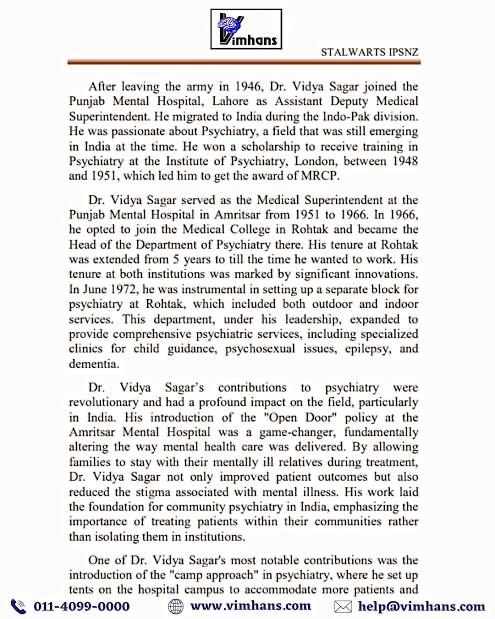
In the aftermath of India’s partition in 1947, Amritsar became a refuge for countless displaced individuals, many grappling with severe mental health challenges. The Mental Hospital was overwhelmed, with patients housed in army barracks under dire conditions. Dr. Sagar didn’t flinch. “We can’t wait for perfect facilities,” he told his team. “If we don’t act now, who will?” He introduced an innovative approach: community psychiatry. By setting up tents outside the hospital and involving patients’ families in their treatment, he created a model that was both practical and profoundly humane. This wasn’t just about administering medication—it was about rebuilding lives through inclusion and care. His methods laid the foundation for community psychiatry in India, a legacy that endures today.
Dr. Sagar’s days were long and grueling. In 1970, as recalled by Dr. Jagdish Bathla, who worked closely with him for over four years, Dr. Sagar would stay in the outpatient department (OPD) until midnight or later, often in a stiflingly hot room with no basic amenities like a water cooler. After hours of seeing patients, he’d ride home on the back of Dr. Bathla’s scooter, marveling at the sight of people sleeping peacefully outside. “Look at them, Jagdish,” he’d say, gesturing to the slumbering figures, “they rest, but our work never does.” His dedication was unwavering, starting each morning with the same vigor, undeterred by the previous night’s exhaustion.
His integrity was as remarkable as his work ethic. Dr. Bathla recounts a story that captures Dr. Sagar’s character: whenever he received a gift, he would donate its equivalent value to a cause and send the receipt to the giver. If someone paid for his travel, he’d do the same. “It’s not about the gift,” he once explained to a surprised colleague, “it’s about keeping my heart free to serve.” This rare quality, coupled with his relentless commitment, made him a role model for generations of psychiatrists, including Dr. Bathla’s son and son-in-law, both of whom followed in his footsteps in the field.
Dr. Sagar’s influence extended beyond the hospital walls. He was a teacher who inspired, a leader who set high standards, and a visionary who adapted modern psychiatry to India’s unique challenges. In November 1964, Dr. Hoch, a consultant with the World Health Organization, visited the Mental Hospital in Amritsar and was struck by Dr. Sagar’s work. “You have shown the world how psychiatry can thrive in local conditions,” he told Dr. Sagar, a testament to the global impact of his methods.

His contributions were recognized during the Triple Jubilee Celebrations of 2023-24, marking 60 years of the Pt. Bhagwat Dayal Sharma University of Health Sciences in Rohtak, where Dr. Sagar had served on deputation from the Haryana government. The university honored him with a biography written by Dr. Jagdish Bathla, celebrating his life’s work. “His sincerity and devotion to psychiatry should not be buried under the sands of time,” Dr. Bathla wrote, a sentiment echoed by all who knew him.
Dr. Vidya Sagar passed away in 1978, but his legacy lives on. The Dr. Vidya Sagar Department of Psychiatry at Pt. Bhagwat Dayal Sharma Medical College in Rohtak stands as a tribute to his contributions, where professionals like Dr. Hitesh Khurana continue his work. His pioneering efforts in community psychiatry, his compassion for the marginalized, and his unwavering ethical standards remain a beacon for mental health professionals in India and beyond.
As Dr. Sagar once said to a young resident struggling with the demands of the profession, “The mind is complex, but the heart is simple. Listen to it, and you’ll find the way to help.” His life was a testament to that belief—a blend of intellect, empathy, and an unrelenting drive to make a difference.
Sources:
- Deemagclinic.com, “Story of Dr. Vidya Sagar MD,” published April 14, 2023
- Telangana Journal of Psychiatry, “Dr. Vidya Sagar (1909–1978)”


 deemagclinic
 deemag and chest clinic