
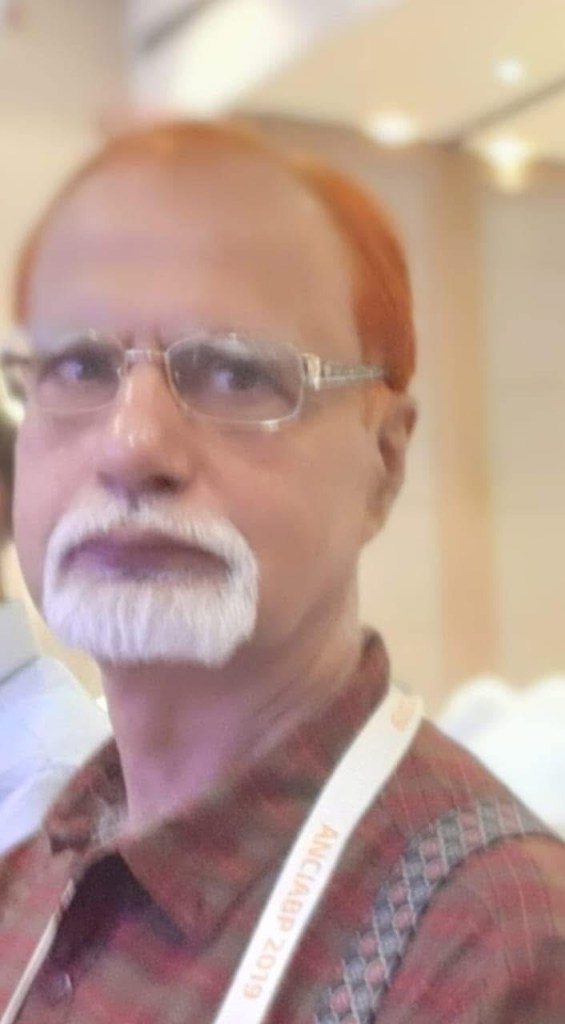
Dr. Kishan Chand Gurnani was not your average psychiatrist. He stood out, and not just because of his commanding presence or his henna-dyed hair that glowed a rich brown under the fluorescent lights of SN Medical College in Agra. A tall, fair Sindhi with a broad face and a meticulously groomed French beard, he carried himself with an air of authority softened by a twinkle of mischief in his eyes. His personality was as vibrant as his appearance, and his approach to psychiatry was a fascinating blend of science, philosophy, and human connection.
I first met Dr. Gurnani at the at the department of psychiatry where he was the lecturer in psychiatry and was immediately impressed with his persona. What a contrast they presented in department, Dr R K Jain in full white safari suit and black shoes looking every bit a doctor , while Dr Gururani in T-shirt and jeans looking every bit flamboyant. Dr R K Jain’s teeth were clean and Dr Gurnani’s were stained heavily but pan, katha and gutka or PanParag. Dr Jain had a vicious anger while Dr Gurnani was mellow.

In general if you go to a physician conference the usual dress worn by delegates would be suit or at most a safari suit. I had the occasion to go to the annual psychiatry conference of American Psychiatry society and the variety of dress was amazingly different. Delegates were there in jeans , track suits , ear rings, pony tails in addition to the usual shirt pant suit dress. The point is the psychiatrist differ in a large way in their mental make up . Many are medical oriented take history examination,investigation and then Prescription of medicine follows . But then some psychiatrist look down on them and label them as pill pushers. They would rather identify themselves as freudian or junganian or psychotherapy oriented psychiatrist. Fortunately Dr Kishan chand Gurnani was of both the types. A Sindhi by birth, fair,tall, broad face with a French beard and commanding personality he was distinguished by his brown Henna died hairs which were in plenty. He took great interest in freudian psychiatry and read my thesis which had such elements with interest. He read fish psychodynamic and would not hesitate to describe masturbating in a lady shoe in class to the booing by girls. Once he took exception to my stating the fact that schizophrenia is a thought disorder and bipolar is a mood disorder because the definition of schizophrenia is different in kaplan book. He was married to Shashi Gurnani an obstetrician who had perpetual rainy nose and was the pool officer at obstetric department of sn medical college agra. He was ad hoc appointed lecturer in sn medical college agra psychiatry department and had some issues with dr r k jain the head who wouldn’t allow him to put his name plate on his room. Also he didn’t like when Dr Rk jain used to ask us to police report his absconded indoor patients. He had a premier Padmini Fiat car which had battery issues and us residents were to fill the battery with distilled water taken out from the lithium measuring instrument. He used to come late to opd probably seeing private patients in mornings and had issues with dr r k jain about that. We had a tea club and used to make tea in afternoon and tea and Samosa party post opd was daily affair in which Dr RK jain was also invited at times. He has retired after serving as Head of psychiatry sn medical college agra and is still practising in agra with his wife Shashi and it is a pleasure to see patients bring in his prescription at my practice in dehradun.

In general, psychiatrists differ in their dress sense as much as they differ in their approach to patients. From psychoanalysis oriented psychiatrists to the modern ones, they are a breed apart. At the annual conference of the American Psychiatric Association, a place where the usual physician’s uniform of suits or safari jackets was replaced by an eclectic parade of jeans, tracksuits, earrings, and ponytails. “Look at this crowd,” someone said to me with a grin, gesturing at a delegate in a tie-dye shirt. “You’d think we’re at a rock concert, not a medical conference!”
Dr Gurnani m’s own attire—a crisp shirt paired with tailored trousers—and at times jeans, stood out as a nod to his roots while still fitting into the kaleidoscope of styles. It was a fitting metaphor for his approach to psychiatry: rooted in tradition but open to the unconventional.
Dr. Gurnani was a rare breed, straddling the divide that often splits psychiatrists into two camps. On one side, you have the “pill pushers,” as some call them—those who rely on history-taking, examinations, investigations, and prescriptions to manage mental health. On the other, there are the psychotherapy enthusiasts, who align themselves with Freudian or Jungian schools and view medication-heavy approaches with a hint of disdain. Dr. Gurnani, however, refused to pick a side. “Why choose?” he once told me over a steaming cup of tea at our department’s afternoon tea club. “The mind is a puzzle. Sometimes it needs a pill, sometimes a conversation—often both.”
His fascination with Freudian psychiatry was evident in the way his eyes lit up when discussing psychodynamic theories. I remember presenting my thesis, which leaned heavily on Freudian concepts, and Dr. Gurnani diving into it with the enthusiasm of a student. “This is good stuff,” he said, flipping through the pages. “You’re digging into the unconscious—where the real answers lie.” Yet, he wasn’t afraid to shake things up. In one memorable lecture at SN Medical College, he launched into a vivid explanation of a Freudian case study involving a man masturbating into a lady’s shoe. The girls in the class erupted in boos, half-laughing, half-scandalized, but Dr. Gurnani just chuckled. “What? It’s in Fish’s Psychodynamic! You want to understand the mind, you’ve got to get comfortable with the uncomfortable.”

He wasn’t without his quirks—or his debates. I once made the mistake of casually stating in a discussion that schizophrenia is a thought disorder and bipolar a mood disorder. Dr. Gurnani’s brow furrowed, and he launched into a passionate critique. “That’s too simplistic,” he said, pulling out his well-worn copy of Kaplan’s psychiatry textbook. “Schizophrenia’s definition isn’t just about thought—it’s about perception, reality, the whole package. Don’t box it in!” I learned quickly that he wasn’t one to let textbook definitions slide without scrutiny.
Life at SN Medical College’s psychiatry department wasn’t always smooth for Dr. Gurnani. As an ad hoc lecturer, he clashed with the department head, Dr. RK Jain. One point of contention was Dr. Jain’s insistence on not allowing Dr. Gurnani to put his nameplate on his office door—a petty slight that stung. “It’s not about the sign,” Dr. Gurnani confided in me once, his voice tinged with frustration. “It’s about respect.” He also bristled at Dr. Jain’s orders to report absconded indoor patients to the police, a practice he found dehumanizing. “These are patients, not criminals,” he’d mutter, shaking his head.
Then there was his beloved Premier Padmini Fiat car, a classic that was as much a part of his persona as his henna-dyed hair. The car had a notorious battery issue, and it wasn’t uncommon for us residents to be roped into filling its battery with distilled water siphoned from the department’s lithium measuring instrument. “You’re saving my car and my sanity,” he’d joke, clapping us on the back as we grumbled good-naturedly.
Dr. Gurnani’s days often started late at the outpatient department, likely because he was seeing private patients in the mornings—a habit that didn’t sit well with Dr. Jain. But by the afternoon, he was fully present, joining us for the daily tea club ritual. The psychiatry department’s tea club was a sacred affair, where we’d brew chai in a battered kettle and, on good days, pair it with crispy samosas. Even Dr. Jain was occasionally invited to these post-OPD gatherings, though the tension between the two men was palpable. “Tea solves everything,” Dr. Gurnani would say, raising his cup with a wry smile, diffusing the air with his charm.
His personal life was intertwined with his professional one. He was married to Dr. Shashi Gurnani, an obstetrician and pool officer at SN Medical College’s obstetrics department. Shashi, with her perpetually runny nose and warm demeanor, was as much a fixture in Agra’s medical community as her husband. Together, they were a power couple, balancing their demanding careers with a shared commitment to patient care.
After years of service, Dr. Gurnani rose to become the Head of Psychiatry at SN Medical College before retiring. But retirement didn’t mean slowing down. He and Shashi continued to practice in Agra, their prescriptions a familiar sight to colleagues far and wide. In my own practice in Dehradun, I’d often see patients walk in clutching one of Dr. Gurnani’s prescriptions, a testament to his enduring reputation. “He listened to me,” one patient told me, holding up the slip of paper. “Really listened.”
Dr. Kishen Chand Gurnani: The Larger-Than-Life Psychiatrist with a Flair for the Dramatic
Picture this: a sweltering afternoon in the psychiatry OPD at SN Medical College, Agra, circa the early 2000s. The fans are creaking, the files are piling up, and the air smells faintly of antiseptic and existential dread. I’m there, a young resident, scribbling notes, when the door swings open, and in walk four American psychiatrists—three strapping, square-jawed gents and one formidable female colleague. They’re built like they’ve been chugging protein shakes and bench-pressing textbooks on Freud. Honestly, they reminded me of our Punjabi sardars from Amritsar, except swap the ghee-soaked parathas for a steady diet of USDA prime beef. Only Dr Gururani matched them in their physique, I was left wondering to my half starved residents diet state. They’re here, they say, “just to say hello.” A casual transatlantic pop-in, as you do.
Enter Dr. Kishen Chand Gurnani, our resident legend, a man whose charisma could fill a lecture hall and whose mustache could probably bench-press more than I could. He’s in the OPD, sipping chai with the gravitas of a Bollywood hero about to deliver a monologue. The Americans exchange polite “hi’s” and “hello’s,” their accents as crisp as their starched shirts. Dr. Gurnani, however, isn’t one for small talk. His eyes light up like he’s just been handed the script to an Oscar-worthy scene.
“Welcome, my friends!” he booms, his voice echoing off the chipped plaster walls. “You cannot leave Agra without seeing the crown jewel of our psychiatry department—the Lukus Ward!”
The Americans blink. One of them, a burly chap with a jawline that could cut glass, checks his watch. “Uh, Dr. Gurnani, we’re kinda short on time. Gotta catch a flight to Delhi—”
“Nonsense!” Dr. Gurnani waves a hand, dismissing their itinerary like it’s a pesky fly. “You’ve come all the way from America. You must see the ward. It’s historic! Practically a monument!” His enthusiasm is infectious, but also non-negotiable, like a wedding invite from your mom’s favorite cousin.
Now, let me paint you a picture of Lukus Ward. Imagine a building that looks like it’s been through the Sepoy Mutiny, two world wars, and a particularly bad monsoon season. It’s the kind of place where you half-expect to see a “Contagion” hazmat team lurking in the shadows. Dilapidated doesn’t even begin to cover it—think crumbling walls, creaky floors, and a vibe that screams, “I’ve seen things.” But to Dr. Gurnani, it’s the Taj Mahal of psychiatric care, minus the marble and, well, the grandeur.
So, off we go, Dr. Gurnani leading the charge like a general marching into battle, the Americans trailing behind, looking increasingly like they’re regretting this detour. I’m tagging along, partly to witness the spectacle, partly because I’m terrified of missing whatever Dr. Gurnani’s cooking up. The ward’s a good 15-minute walk from the OPD, and by the time we get there, the Americans are sweating through their polo shirts, muttering about Uber and air conditioning.
Inside, Dr. Gurnani’s in his element. “This,” he declares, gesturing at a peeling wall like it’s a Picasso, “is where we do the real work. The heart of healing!” He introduces the staff nurse—a no-nonsense woman we all called “Aunty” behind her back, who’s roughly the size of a small refrigerator and twice as intimidating. She nods curtly, unimpressed by the international delegation. The Americans, bless their hearts, are trying to be polite, but their faces scream, Why are we here?
Dr. Gurnani, undeterred, ushers them through the ward, pointing out random features like a tour guide on steroids. “This window—excellent ventilation! This bed—very sturdy!” The Americans nod, bewildered, as if they’re on an episode of Extreme Home Makeover: Asylum Edition. Finally, he herds them back to the OPD, piling everyone into his ancient Fiat, which—miracle of miracles—starts on the first try. The Americans are quiet, probably wondering if they’ve just been pranked.
Back at the OPD, one of them—a lanky fellow with a clipboard—turns to his colleague and whispers, “Why did he show us that ward? What was the point?”
I can’t resist. I lean in, grinning. “Oh, didn’t he show you the Taj Mahal from the top floor? The view from Lukus Ward is amazing.”
They look at me, wide-eyed. “No, we didn’t see that. He didn’t mention it.”
“Oh, shame,” I say, barely holding back a laugh. “Must’ve been the staircase under repair. Next time, then!” “Yes’ what a shame!” the lady psychiatrist said. Dr SP Gupta and others exchanged knowing glances.
There’s no view of the Taj Mahal from Lukus Ward, of course. The only thing you’d see from the top floor is a stray dog napping on a pile of broken tiles. But they nod, satisfied, as if I’ve just solved the mystery of Dr. Gurnani’s grand tour. I’m pretty sure Dr. Gurnani just wanted to flex his hospitality—and maybe drop a subtle hint to the college higher-ups that he’s got American friends on speed dial. Either way, the man’s a legend, and I’m still chuckling about it years later.
About Dr. Kishen Chand Gurnani
Dr. Kishen Chand Gurnani was a prominent psychiatrist at SN Medical College, Agra, known for his larger-than-life personality and dedication to his craft. Beyond his flair for dramatic gestures—like impromptu ward tours for unsuspecting foreigners—he was a respected figure in psychiatric care, blending old-school charm with a deep commitment to his patients. While specific details about his career (dates, publications, or awards) aren’t readily available in my sources, his impact on colleagues and students was undeniable, leaving behind stories that are equal parts inspiring and hilarious.

Once as I sat with Dr. Kishan Chand Gurnani in a sleek Singapore bar, the menu’s vegan offerings caught his eye. With his trademark French beard and henna-dyed hair glinting under the dim lights, he leaned back, his broad face breaking into a mischievous grin. “Arre, yeh kya baat hui? Dharti ke aadmi ko chand par le gaye!” he exclaimed, his voice rich with amusement. “Dharti pe hi rehne do, bhai!” His playful Urdu couplet, likening the overpriced vegan dishes to an absurd lunar journey, had us both laughing. It was classic Gurnani—blending wit, poetry, and a touch of rebellion against anything too pretentious, whether in psychiatry or a bar menu.
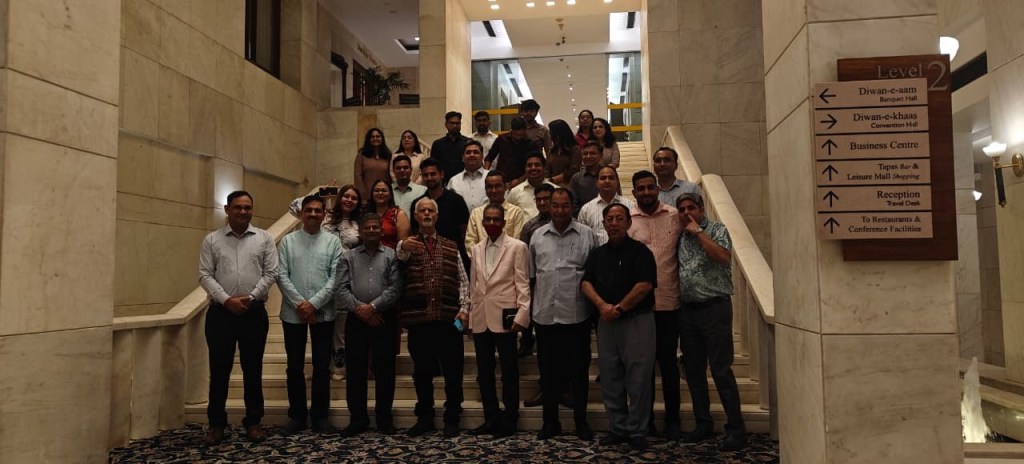
Dr. Kishan Chand Gurnani wasn’t just a psychiatrist; he was a bridge between the clinical and the human, the scientific and the soulful. His henna-dyed hair and French beard may have caught the eye, but it was his curiosity, his compassion, and his refusal to be confined by convention that left a lasting mark on those who knew him.


 deemagclinic
 deemag and chest clinic