
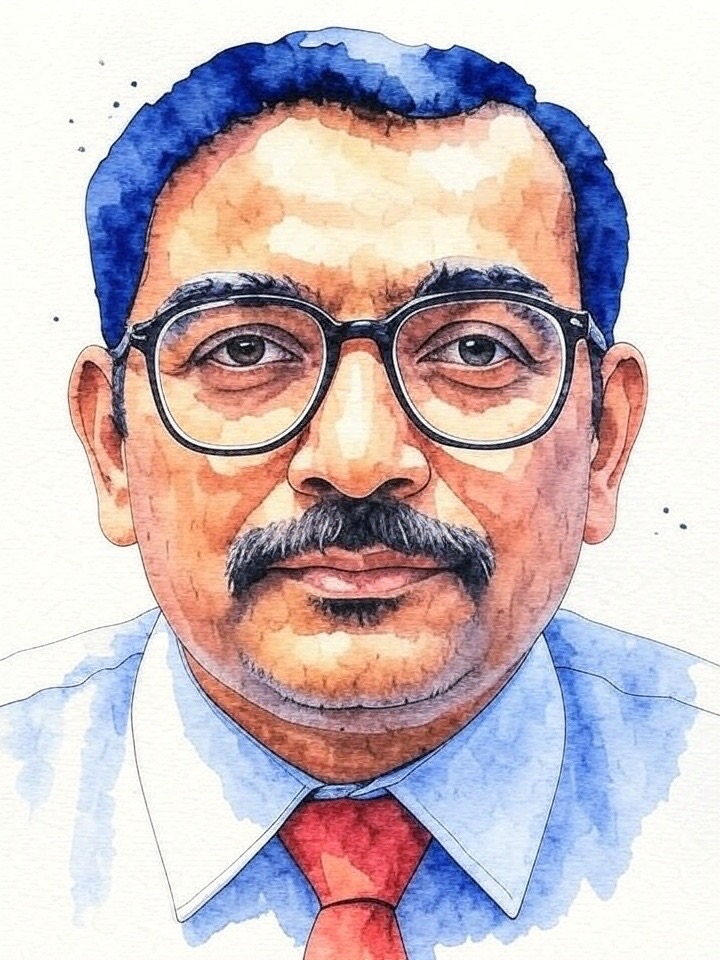
Dr. N.L. Patni was a man of contradictions, a nephrologist whose angular, rugged face could’ve belonged to a Hollywood tough guy like Yul Brynner, yet his eyes carried the weight of countless patients’ stories. His squinted gaze, peering through the windshield of his old Fiat as he drove himself to the hospital, gave him the air of a man perpetually deciphering the world. Behind that stern exterior was a sharp wit and a heart that beat for both medicine and the underdog.
In the cramped, fluorescent-lit medical OPD room we shared one humid afternoon, Dr. Patni’s presence was magnetic. The ancient dialysis machine he worked on—a hulking, imported beast donated by a generous alumnus in the USA—stood like a relic in his department, whirring and clanking as if it, too, knew the gravity of its task. “This machine,” he’d say, leaning back in his creaky chair, “is older than half my patients, but it’s got more fight in it than most people I know.”
That day, as I scribbled a prescription for Digene gel, he glanced over, his thick eyebrows arching like a silent challenge. “Digene again, eh?” he said, his voice gravelly but warm, a half-smile tugging at his lips. “Why not write one for that medical rep who just left? Poor chap’s got a family to feed, you know. We’re not just saving kidneys here; we’re keeping livelihoods alive.” He chuckled, a low rumble, but his words stuck. It was classic Patni—caring deeply, but never without a jab of humor to lighten the load.
He’d recount tales of his early days, when dialysis was a novelty and patients looked at the machine like it was a spaceship. “They’d ask me, ‘Doctor, will this thing suck my soul out?’” he’d say, mimicking their wide-eyed fear. “I’d tell them, ‘Only if you don’t pay the bill!’” His laughter would fill the room, disarming even the most anxious patient.
Dr. Patni’s hands, rough and steady, worked miracles on that outdated dialysis rig, coaxing life from it as he did from his patients. He’d mutter to himself while adjusting the dials, “Come on, old girl, don’t give up on me now.” It was as if he and the machine shared a pact, a stubborn refusal to let death win too easily.
Though he’s no longer with us, Dr. Patni’s legacy lingers in the lives he touched—patients who outlived their prognoses, colleagues who learned to laugh in the face of exhaustion, and even the medical reps who’d leave his office with a grin, knowing he’d slip in a kind word for their hustle. “Medicine’s not just science,” he’d say, squinting as if seeing something far beyond the room. “It’s about keeping the human in humanity.”

Dr. N.L. Patni is a nephrologist based in Agra, India, practicing at Arihant Kidney Clinic in Khandari, near Lajpat Kunj, Agra, Uttar Pradesh. He specializes in the diagnosis and treatment of kidney-related conditions, including chronic kidney disease, acute kidney injury, kidney stones, and renal transplantation. Dr. Patni has over 22 years of experience in healthcare and is highly regarded, with a rating of 4.4 based on 11 customer reviews on Justdial. His clinic offers services such as dialysis consultation and management of diabetic nephropathy.
In 1985, Dr. Patni, a dedicated physician in the Medicine Department at SN Medical College, Agra, received a transformative gift: a used, imported hemodialysis machine donated by an NRI alumnus. This robust device, likely a refurbished Baxter Travenol or Fresenius model, was a rare asset in India’s public hospitals. Despite its bulky design and complex operation—featuring a hollow-fiber dialyzer and lengthy 6–8-hour sessions—Dr. Patni skillfully integrated it into the department, enabling life-saving dialysis for patients with end-stage renal disease. His efforts expanded nephrology services, cementing a legacy of compassionate care at his alma mater.


 deemagclinic
 deemag and chest clinic