
In the bustling corridors of Apollo Hospitals in Chennai, where the hum of medical machinery meets the quiet hope of patients, one name resonates with reverence: Dr. M.R. Girinath. A cardiothoracic surgeon with over 45 years of experience, Dr. Girinath has not only transformed countless lives through his scalpel but also redefined cardiac care in India. His journey—from a young medical student in Madras to a Padma Bhushan awardee and a global icon in heart surgery—is a testament to skill, perseverance, and an unwavering commitment to healing.
Born in 1941, M.R. Girinath grew up in a time when India was finding its footing as an independent nation. Medicine was not just a career choice for him; it was a calling. He earned his MBBS from Madras University in 1963, followed by an MS in General Surgery (1966) and an MCh in Cardio-Thoracic Surgery (1969) from the prestigious All India Institute of Medical Sciences (AIIMS), New Delhi. He was among the first in India to receive the MCh degree, a milestone that marked the beginning of his trailblazing career.
“Back then, cardiac surgery was a fledgling field in India,” Dr. Girinath might recall, leaning back in his office chair, his eyes glinting with the memory of those early days. “We didn’t have the advanced tools or the infrastructure you see now. But we had something stronger—hope. Hope that we could save lives, one heart at a time.”
His early career took him across the globe, including a formative three-year stint in Auckland, New Zealand, where he honed his skills in coronary artery surgery and congenital heart procedures. He also worked at prestigious institutions like the New York University Medical Center and Bellevue Hospital in the U.S., performing over 3,000 coronary artery operations. Yet, in 1988, at the peak of a lucrative career abroad, Dr. Girinath made a bold choice. “I could’ve stayed in New York,” he might say with a modest smile. “But India was calling me back. My people needed me.”
Returning to India, he joined Apollo Hospitals in Chennai in 1984 as the head of the Cardiac Surgery Unit, a role he has held with distinction ever since. Under his leadership, the unit has performed over 40,000 heart surgeries, including 29,000 coronary bypass operations, with 14,000 conducted on a beating heart—a technique he helped standardize in India. His pioneering work in congenital heart surgery, heart valve surgery, and cardiac transplantation has earned him a reputation as a visionary. He was the first in India to repair a complex congenital heart defect in a child under one year old and to apply heart-lung machine-assisted coronary angioplasty.
Imagine a moment in 1987, in the operating theater of Southern Railway Hospital in Perambur, where Dr. Girinath, then a young surgeon fresh from Australia, prepares for an atrial septal defect (ASD) surgery on a three-year-old child. The room is tense, the parents waiting anxiously outside. “Don’t worry,” he might have reassured his team, his voice steady. “This little one’s heart is in our hands, and we’re going to give her a future.” That child, now 36, still credits Dr. Girinath for her life.
Dr. Girinath’s impact extends beyond the operating table. He has trained over 30 cardiac surgeons, who collectively perform 20% of India’s cardiac procedures today. His mentorship is legendary. “It’s not just about teaching technique,” he might say, addressing a group of young surgeons. “It’s about teaching responsibility. When you hold a heart, you hold a family’s hope.” His academic contributions are equally impressive, with over 275 papers presented at national and international conferences and 20 orations, including the prestigious Subroto Memorial Oration and Sadasivan Oration.
One of his proudest moments came in the 1990s when he was part of India’s first multi-organ transplant, involving the heart, liver, kidneys, and cornea. Reflecting on it, he might say, “That day, we didn’t just save one life—we gave hope to many. It showed what’s possible when we push the boundaries of medicine.”
Patients describe him as a “superhuman” and a “gentleman.” One grateful patient recalls, “When I was losing hope, Dr. Girinath looked me in the eye and said, ‘We’ll get through this together.’ And we did.” Another, whose father underwent bypass surgery, wrote, “Doctor ho toh kaisa, Mr. Girinath jaisa” (If there’s a doctor, let him be like Mr. Girinath). His compassion is as renowned as his skill, evident in cases like that of Daniel from Tanzania, whose heart rhythm was restored through a radiofrequency ablation procedure.
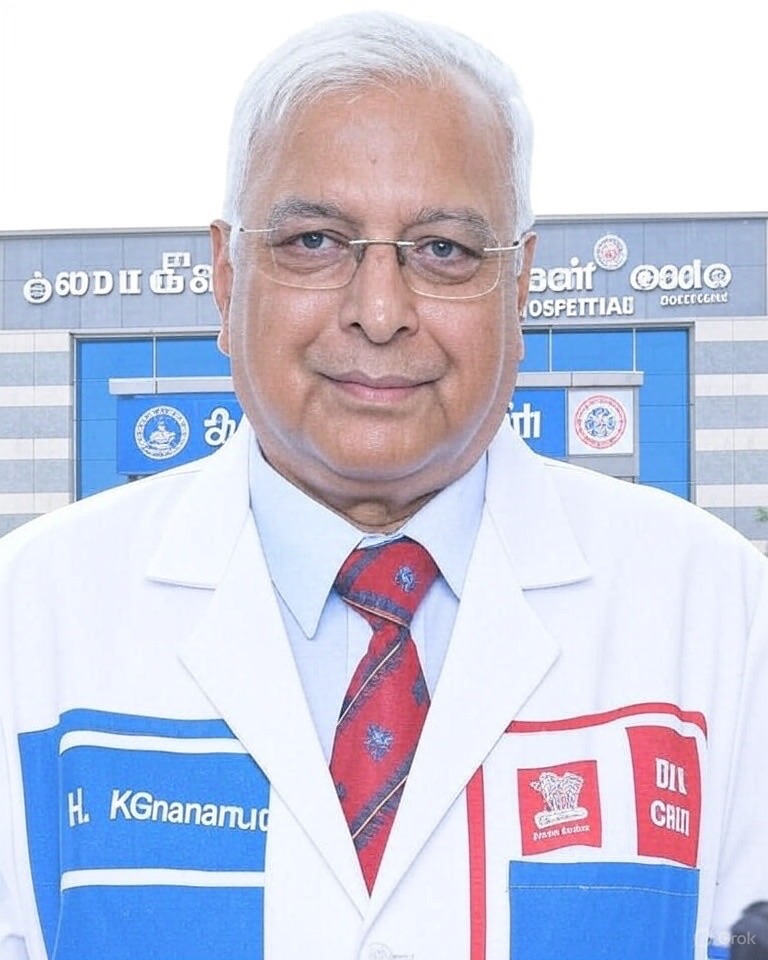
Dr. Girinath’s contributions have been recognized with numerous accolades, including the Dr. B.C. Roy National Award (1997), the Padma Bhushan (1998), and a D.Sc. (Honoris Causa) from Dr. M.G.R. Medical University (2002). He is a Fellow of the Royal Australasian College of Surgeons (FRACS) and the Indian Association of Thoracic and Cardiovascular Surgery (FLACS).
Even after decades in the field, Dr. Girinath remains driven by a simple philosophy. “Every heart I save,” he might say, his voice soft but firm, “is a chance to give someone more time with their loved ones. That’s what keeps me going.” At Apollo Hospitals, where he continues to practice, his legacy is not just in the surgeries he performs but in the lives he touches—patients, families, and the next generation of surgeons.
As he walks the halls of Apollo, a quiet figure with a giant’s impact, Dr. M.R. Girinath embodies the heart of medicine: skill tempered with humanity, innovation grounded in care. His story is not just one of a surgeon but of a man who has spent his life mending hearts, one beat at a time.


 deemagclinic
 deemag and chest clinic