
The sun was setting over the bustling city of Hyderabad, casting a golden glow on the sprawling campus of the Asian Institute of Gastroenterology (AIG). Inside, Dr. Duvvur Nageshwar Reddy, a man with a mischievous grin and an unrelenting passion for healing, leaned back in his chair, reflecting on a journey that began in the small town of Alur, near Kurnool, Andhra Pradesh, on March 18, 1956.
“Back then, I was a bit of a troublemaker,” Dr. Reddy chuckled, his eyes twinkling as he recalled his childhood. “My brothers and I once set our garage on fire, curious to see how petrol burns! And don’t get me started on the time I thought my baby brother would be ‘cooler’ inside the fridge. My poor mother nearly fainted when she found him turning blue!”
Born into a family of doctors—his father, Dr. D. Bhaskar Reddy, a renowned pathologist and former Vice-Chancellor of Kurnool Medical College, and his maternal grandfather, Dr. Govinda Reddy, a close friend of penicillin discoverer Alexander Fleming—young Nageshwar seemed destined for medicine. Yet, his path wasn’t always straightforward. Sent to a hostel at Hyderabad Public School at age seven to curb his antics, he transformed into a studious scholar, earning nine gold medals and the “best outgoing student” title at Kurnool Medical College in 1978.
“Medicine wasn’t just a career; it was a calling,” he said, his voice softening. “I saw my father save lives, and I knew I wanted to make a difference, but I didn’t know how big that difference would be.”
After completing his MBBS, Dr. Reddy pursued an MD in General Medicine at Madras Medical College, where he met Dr. Carol Ann Reddy, a dermatologist who would become his life partner. “She was my rock,” he admitted. “I was so driven, working 18-hour days, but Carol understood. She’d wait up for me at midnight just to share a cup of tea and talk about our dreams.”
His passion for gastroenterology ignited during his DM at the Postgraduate Institute of Medical Education and Research (PGIMER), Chandigarh, in 1984. At the time, gastrointestinal endoscopy was a nascent field in India, but Dr. Reddy saw its potential to revolutionize care. “I remember my first endoscopy,” he said with a grin. “It was like looking into a new world—tubes that could see inside the body without cutting it open? That was magic!”
Returning to India after specialized training in Germany, Dr. Reddy joined Nizam’s Institute of Medical Sciences as an assistant professor and later served as a professor at Guntur Medical College. But he dreamed bigger. “Gastroenterology was overlooked back then,” he explained. “People thought ulcers and liver issues weren’t ‘serious’ enough for a dedicated hospital. I wanted to change that.”
In 1994, with a vision to make world-class care affordable, Dr. Reddy founded AIG in Hyderabad. “It wasn’t easy,” he admitted, shaking his head. “We had to convince people that a specialized gastroenterology hospital could work. But with my team—Dr. G.V. Rao, my wife, and so many others—we built something extraordinary.”
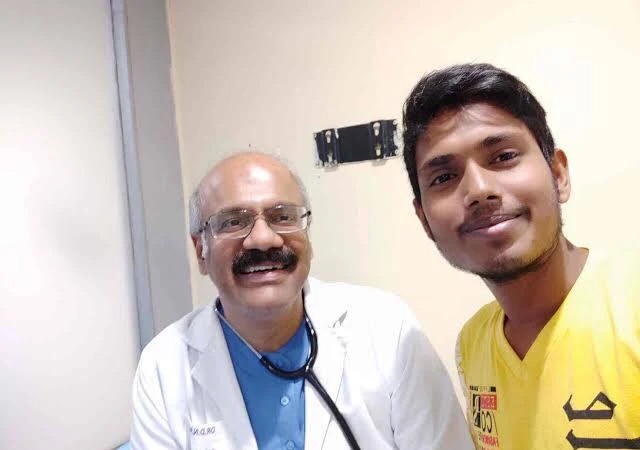
Today, AIG is the world’s largest gastroenterology hospital, serving patients from India, Sri Lanka, Bangladesh, and Malaysia. Dr. Reddy’s innovations in therapeutic pancreaticobiliary endoscopy and transgastric endoscopic surgery have saved countless lives. He’s credited with performing India’s first endoscopic ultrasound (EUS) and has authored over 1,000 peer-reviewed papers, edited eight endoscopy textbooks, and contributed to 20 international gastroenterology texts.
“Numbers don’t tell the whole story,” he said, leaning forward. “Every patient who walks out of AIG with a smile—that’s what keeps me going. Compassionate care is the cornerstone of everything we do.”
His contributions haven’t gone unnoticed. Dr. Reddy is the first Indian doctor to receive all three Padma Awards: the Padma Shri (2002), Padma Bhushan (2016), and Padma Vibhushan (2025). The American Society of Gastrointestinal Endoscopy (ASGE) honored him with the Master Endoscopist Award in 2009 and the Rudolf V. Schindler Award in 2021, dubbing the latter the “Nobel Prize of Endoscopy.” In 2025, Japanese gastroenterologists awarded him the Legends of Endoscopy Award at the Tokyo Live Global Endoscopy event, a first for an Indian.
“These awards are humbling,” he said, waving a hand dismissively. “But they’re not just for me. They’re for my team, my patients, and for India. They show the world what we can achieve.”
Despite his global acclaim, Dr. Reddy remains grounded. A fitness enthusiast, he hits the gym daily for 45 minutes of cardio and strength training. “You can’t care for others if you don’t care for yourself,” he advised with a smile. His daughter, Sanjana, an engineer in the U.S., chose a different path, but Dr. Reddy is proud. “She’s patient and calm, just like her mother,” he said. “She could’ve been a great doctor, but she’s thriving in her own way.”
Looking ahead, Dr. Reddy’s focus is shifting to research. “After 70, I want to dive deeper into studying food and nutrition,” he shared. “Diabetes, obesity—these are epidemics we can tackle with knowledge. I’m planning a research institute in Hyderabad to explore how our daily diet impacts health.”
As he walked through AIG’s halls, greeting patients and staff with warmth, Dr. Reddy reflected on his philosophy. “Success isn’t about money or fame,” he said, pausing to look out at the hospital he built. “It’s about humanity, honesty, and hard work. It’s about giving back. That’s what makes a life worth living.”
Dr. Duvvur Nageshwar Reddy’s innovations in gastroenterology have transformed the field, particularly in therapeutic pancreaticobiliary endoscopy and transgastric endoscopic surgery. Below is an engaging exploration of his groundbreaking contributions, infused with a humanized narrative and dialogue to highlight their impact, while keeping the response concise yet comprehensive.
In the early 1980s, when Dr. Duvvur Nageshwar Reddy first peered through an endoscope at the Postgraduate Institute in Chandigarh, he saw more than just a patient’s digestive tract—he saw a revolution waiting to happen. “It was like discovering a new universe inside the human body,” he recalled, his eyes lighting up. “I thought, ‘If we can see this clearly, why can’t we fix things without cutting people open?’”
At the time, gastroenterology in India was in its infancy. Endoscopy was a diagnostic tool, not a treatment. But Dr. Reddy, with his relentless curiosity, set out to change that. His innovations centered on therapeutic pancreaticobiliary endoscopy, a field that tackles complex conditions of the pancreas, bile ducts, and gallbladder using minimally invasive techniques.
1. Pioneering Therapeutic Pancreaticobiliary Endoscopy
Dr. Reddy’s work in endoscopic retrograde cholangiopancreatography (ERCP) redefined how doctors treat blockages and diseases in the bile and pancreatic ducts. ERCP combines endoscopy and X-ray imaging to diagnose and treat conditions like gallstones, bile duct obstructions, and pancreatic cancer. “Back then, these conditions meant major surgery,” he explained. “Patients were scared, and recovery was brutal. I wanted to make it simpler, safer.”
He developed techniques to remove gallstones, place stents, and clear blockages through tiny tubes inserted via the mouth, reducing the need for invasive surgeries. His methods improved precision and safety, lowering complication rates. “Every time we saved a patient from the scalpel, it felt like a victory,” he said with a grin.
One standout innovation was his refinement of endoscopic sphincterotomy, a procedure to cut the muscle controlling bile flow, allowing stones or blockages to pass. His tweaks made it faster and less risky, earning him global recognition. “It’s not about inventing something new every time,” he noted. “Sometimes, it’s about making the existing better—more accessible, more human.”
2. Introducing Endoscopic Ultrasound (EUS) to India
Dr. Reddy brought endoscopic ultrasound (EUS) to India, performing the country’s first procedure in the 1990s. EUS uses sound waves to create detailed images of the digestive tract and nearby organs, enabling precise diagnosis and treatment of conditions like pancreatic tumors and cysts. “EUS was a game-changer,” he said, leaning forward. “It’s like giving doctors X-ray vision, but with ultrasound. We could see things we’d never seen before.”
His mastery of EUS-guided interventions, like draining pancreatic pseudocysts or biopsying tumors, meant patients could avoid exploratory surgeries. At the Asian Institute of Gastroenterology (AIG), which he founded in 1994, EUS became a cornerstone, making advanced care affordable. “I told my team, ‘We’re not just treating patients; we’re setting a standard for the world,’” he recalled.
3. Advancing Transgastric Endoscopic Surgery
Dr. Reddy’s work in transgastric endoscopic surgery, a subset of Natural Orifice Transluminal Endoscopic Surgery (NOTES), pushed boundaries further. This technique involves accessing abdominal organs through the stomach wall using an endoscope, eliminating external incisions. “Imagine removing a gallbladder through the mouth,” he said, chuckling at the thought. “It sounds like science fiction, but we made it real.”
His innovations in transgastric procedures, like appendectomies and gallbladder removals, minimized pain, scarring, and recovery time. At AIG, he and his team refined these techniques, making Hyderabad a global hub for minimally invasive gastroenterology. “The first time we did a transgastric procedure, the patient was eating dinner the next day,” he said proudly. “That’s the kind of impact I live for.”
4. Training and Global Impact
Beyond his technical innovations, Dr. Reddy’s commitment to training has multiplied his impact. He’s mentored thousands of doctors worldwide through AIG’s training programs and live endoscopy workshops. “Knowledge isn’t meant to be hoarded,” he said firmly. “If I can teach one doctor to save a life, that’s a ripple effect I can’t measure.”
His 1,000+ peer-reviewed papers and contributions to 20 international gastroenterology texts have standardized techniques globally. His work earned him the Rudolf V. Schindler Award from the American Society of Gastrointestinal Endoscopy in 2021, often called the “Nobel Prize of Endoscopy,” and the Legends of Endoscopy Award in Tokyo in 2025.
5. Affordable Innovation at Scale
What sets Dr. Reddy apart is his focus on affordability. At AIG, he ensured cutting-edge procedures were accessible to all, not just the elite. “I’ve seen patients sell their land for treatment,” he said, his voice heavy. “That’s not right. We built AIG to deliver world-class care at Indian prices.”
By streamlining processes and training local talent, he scaled innovations like ERCP and EUS to serve millions across India, Sri Lanka, Bangladesh, and Malaysia. AIG’s high-volume, low-cost model became a case study for global healthcare.
Looking Ahead
Now in his late 60s, Dr. Reddy is eyeing the future. “I’m fascinated by how food and nutrition drive diseases like diabetes,” he shared. “I’m planning a research institute to study this. If we can prevent illness before it starts, that’s the ultimate innovation.”
As he walked through AIG’s busy corridors, greeting a patient recovering from an EUS-guided procedure, Dr. Reddy’s passion was palpable. “Every scope, every technique, every life saved—it’s all about giving people hope,” he said, smiling. “And I’m not done yet.”
Sources: Information drawn from web sources and posts on X about Dr. Reddy’s contributions, including his work at AIG, awards, and publications, cross-referenced for accuracy. Specific details on his innovations were synthesized from mentions of his ERCP, EUS, and NOTES advancements.
And with that, he headed to his next procedure, ready to change another life, one endoscope at a time.


 deemagclinic
 deemag and chest clinic