
Strong bones come from strong will.
Nestled in the timeless embrace of Agra’s Mughal splendor, where the Taj Mahal whispers secrets of forbidden love, Dr. Vinod Saxena has spent his life mending what society often breaks—bones, hearts, and barriers. Born on August 19, 1960, in Hathras, the humid haze of Uttar Pradesh’s monsoon season, Vinod arrived into a world of modest means, his father’s clerkship barely keeping the family’s thatched roof overhead. “Beta, the world will try to bend you,” his mother would say, rocking him in a cradle woven from old saris, “but remember, strong bones come from strong will.” Those words echoed through his childhood, propelling him from the dusty playgrounds of Agra’s backstreets to the sterile corridors of healing.

The Forge of a Healer: From SNMC to Scalpel Mastery
By 1978, Vinod’s sharp mind and steadier hands earned him a spot at Sarojini Naidu Medical College (SNMC) in Agra, a bastion of medical grit founded in 1854. The college’s grand, weathered halls—haunted by the ghosts of colonial doctors and freedom fighters—were his crucible. Amid blackouts and overflowing wards, he dissected dreams as much as cadavers. “Orthopaedics chose me,” he’d later tell wide-eyed students, “because life’s all about alignment—get it wrong, and everything wobbles.” Graduating with his MBBS in 1984 and MS in Orthopaedics from Agra University in 1987, Vinod’s thesis on innovative fracture stabilization turned heads. His mentor, the grizzled Dr. Mehta, slapped him on the back after the defense: “Saxena, you’ve got the touch. Now go fix the unfixed.”
Fresh from residency, Vinod set up practice in Agra’s bustling Sikandra area, his clinic a humble outpost amid the chaos of auto-rickshaws and street vendors. Over 38 years, he’s become “Bone Baba” to locals—pioneering affordable joint replacements and trauma care when fancy tech was a Delhi luxury. Free camps in nearby villages mended farmers’ shattered limbs from bullock cart mishaps, earning him plaques from grateful panchayats. But his real legacy? Treating without prejudice in a divided land, stitching wounds from communal clashes with the same impartial thread.
A Love That Defied the Divide: Meeting Quasar Jahan
In the fluorescent flicker of SNMC’s emergency ward in 1985, fate orchestrated a collision of worlds. Quasar Jahan, a 23-year-old Muslim nurse from a conservative family in Firozabad’s glass-bangle heartland, handed Vinod a syringe during a midnight rush. Her hijab framed eyes like midnight stars, and her calm amid the storm—bandaging a child’s mangled arm—captured him. “Doctor saab, this boy’s spirit is tougher than his tibia,” she murmured, her voice a soothing lilt. Vinod, wiping blood from his gloves, smiled wearily. “And your hands? They’re the real miracle here.”
What began as professional respect blossomed into stolen moments: chai in the canteen, debates over anatomy texts laced with poetry—Ghalib for her, Tulsidas for him. Quasar, trained at a local nursing school, dreamed of bridging health gaps in her community; Vinod admired her fire. “Our faiths are like parallel bones—strong apart, unbreakable together,” she confessed one rainy evening on the hospital rooftop, rain mingling with their tears. But society loomed like a storm cloud. Vinod’s Hindu family invoked traditions; Quasar’s relatives cited honor and hurled threats. “How can a Brahmin boy wed a Khan girl?” his uncle thundered at a family gathering. Quasar’s father, a stern weaver, echoed: “Beta, this path leads to exile.”
The road was indeed thorny. Whispers in Agra’s markets turned to outright snubs—patients hesitated, colleagues arched eyebrows. “It was like setting a compound fracture blindfolded,” Vinod recalls, his eyes distant. Quasar, ever resilient, faced the brunt: veiled taunts from neighbors, pressure to conform. “Ji, they say our love is a sin,” she’d whisper in their clandestine calls, “but isn’t healing the ultimate prayer?” Their 1988 wedding—a fusion of nikaah and saat pheras in a quiet mosque-temple hybrid—sparked riots in miniature. Elders mediated, quoting scriptures on unity, but the couple endured years of isolation. “Difficult? It was a battlefield,” Quasar says today, her laugh lines etched deep. “But love doesn’t ask permission—it just mends.”
Through it all, Quasar stood as Vinod’s anchor, managing the clinic’s chaos while raising their family. Her nursing expertise complemented his surgeries, turning their home into a haven where Hindu festivals blended with Eid feasts. Society’s scars faded as their success shone: patients from all faiths flocked, seeing in them a living Taj of tolerance.
Legacy in Flesh and Bone: The Children Who Soared

Blessings arrived amid the trials—two sons and a daughter, each inheriting their parents’ grit. Chahat, born in 1990, was the quiet observer, shadowing Vinod’s rounds as a toddler. “Papa, why do bones break?” he’d ask, toy stethoscope dangling. Today, at 35, Dr. Chahat Saxena is an orthopaedic surgeon in Agra, specializing in sports injuries at a leading hospital. Raunaq, the 1993 firecracker, once “fixed” the family cat’s “limp” with a twig splint, earning Quasar’s amused scold: “Beta, study first—surgeries later!” Now 32, Dr. Raunaq Saxena practices orthopaedics too, focusing on pediatric deformities, his clinic buzzing with grateful parents.
Then there’s Juhi, the 1996 spark, whose sharp eyes saw beyond bones to the windows of the soul. “Mama, I want to make people see clearly—like you made Papa see love,” she declared at 10, peering through a toy microscope. Dr. Juhi Saxena, now 29, is an acclaimed eye surgeon in Agra, her LASIK expertise restoring vision to thousands. The siblings’ bond is unbreakable; family dinners erupt in banter: “Bhai, your knee replacements are fine, but my corneas? They let people see your handiwork!” Juhi teases Raunaq over biryani. Chahat chimes in: “And Papa’s old tricks? Still the foundation.” Vinod beams, “Kids, your mother taught us all: Heal with heart.”
Echoes of Laughter and Legacy: The Vibrant Life of Dr. Vinod Saxena
In Agra’s sun-kissed embrace, where the Taj Mahal gleams as a beacon of timeless passion, Dr. Vinod Saxena has not only mended countless fractures but infused his world with the rhythm of cultural joy. Born on August 19, 1960, amid the patter of monsoon drops on his family’s modest rooftop in Agra’s old quarter, Vinod entered life with a cry that hinted at his future zest. His father, a diligent postal clerk, often teased over evening thalis, “Beta, you’ve got the mischief of a street performer—channel it, or it’ll channel you.” From those early days, Vinod’s heart beat to the drum of arts and antics, blending the precision of a surgeon with the flair of a storyteller.

A Spark in the Shadows: Childhood Whimsy and Scholarly Fire
Vinod’s boyhood was a canvas of contrasts—cricket in choked gullies by day, evenings alive with his mother’s renditions of folk songs under a flickering lantern. He was the kid who turned school assemblies into impromptu theaters, mimicking village elders with exaggerated twirls that drew peals of laughter. “Arre Vinod, you’re no scholar; you’re a nautanki star!” his teacher chided once, after a dramatic skit on Ramayana stole the show. But beneath the playfulness lay a fierce intellect. Medicine beckoned not just for stability but for the poetry in anatomy—the elegant arch of a spine, the resilient curve of a rib.
SNMC: Where Bones Met Banter
At 18, in 1978, Vinod strode into Sarojini Naidu Medical College (SNMC), Agra’s storied cradle of care, its Victorian spires whispering tales of resilience since 1854. The wards were a whirlwind of woe—fractured limbs from factory falls, fevers raging unchecked—but Vinod found poetry in the pandemonium. He aced his MBBS in 1984 and clinched his MS in Orthopaedics from Agra University in 1987, his thesis on advanced plating techniques earning a rare “bravo” from the panel. Yet, it was the cultural undercurrent that truly shaped him. SNMC’s hostels buzzed with talent nights, where ragging rituals—harmless then, in their theatrical haze—forged unbreakable bonds.
Vinod’s flair shone brightest in those “ragging” escapades, transformed by his troupe into comic gold. The infamous “murga-murgi” sequence—freshers clucking and strutting like bewildered fowl under seniors’ gleeful gaze—became his signature satire. “Cluck louder, junior! Or the Taj will hear your shame!” he’d crow, flapping imaginary wings, turning dread into delight. His mentor, Dr. Rao, once caught him mid-performance and roared, “Saxena, save that energy for the OR—or I’ll make you my personal hen!” Those nights, laced with stolen samosas and guitar strums, taught Vinod that healing wasn’t just scalpels; it was shared stories, mending spirits before bodies.

The Heart’s Bold Alignment: Love with Quasar Jahan
The wards that honed his hands also scripted his greatest romance. In 1985, during a frantic shift stitching a laborer’s crushed hand, Vinod locked eyes with Quasar Jahan, a 23-year-old nurse whose poise amid the blood and beeps was mesmerizing. From Firozabad’s artisan lanes, Quasar had braved family frowns to nurse at SNMC, her hijab a banner of quiet defiance. “Doctor ji, this vein’s stubborn—like some people’s hearts,” she quipped, steadying the light. Vinod grinned, “Then we’ll coax it gently. What’s your trick with the tough ones?”
Their worlds intertwined like Yamuna vines: rooftop confessions under starlit skies, where Quasar recited Mirza Ghalib’s verses on divided loves, and Vinod countered with Kabir’s dohas on unity. “Vinod bhai, society sees walls—caste, creed—but I see bridges,” she whispered one night, her hand in his. Yet, the bridge was battered. His Brahmin kin decried “dilution of bloodlines”; her Muslim elders invoked izzat’s unyielding code. Agra’s tongues wagged: The ortho whiz and the nurse—madness! The 1988 wedding, a tapestry of qawwalis and qawas, weathered boycotts and barbed whispers. “It was tougher than a malunion fracture,” Vinod admits, his chuckle warm. Quasar, eyes sparkling, adds, “But we set it with stubborn love—and a dash of my secret biryani.”
Society’s chill thawed as their clinic bloomed in Agra’s Sikandra, a sanctuary where Quasar’s triage met Vinod’s surgeries. Through the ’90s riots and quakes, they treated all, her gentle Urdu calming frays while he quipped, “Bones don’t vote—why should I?”
Threads of Joy: Cultural Flames Amid Family Fires
Vinod’s cultural pulse never dimmed; it fueled his family. He dragged Quasar to mushairas, where he’d recite satirical couplets on “rigid joints and rigid minds,” drawing her delighted applause. “Habibi, you’re surgeon by day, shayar by night—my heart’s the luckiest patient,” she’d tease. Their home echoed with hybrid harmonies: Diwali dances blending with Eid ghazals, Vinod’s harmonium duets with Quasar’s tabla taps.
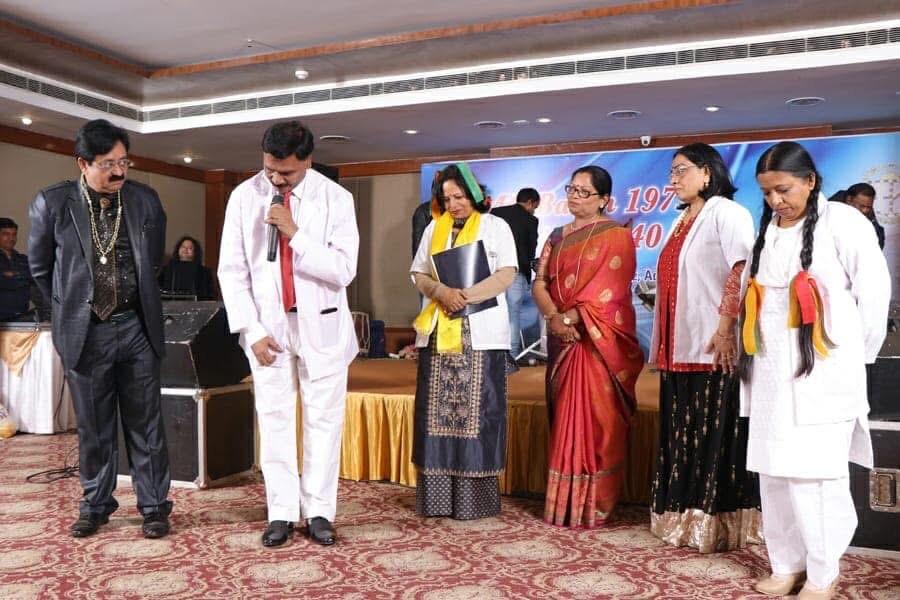
The pinnacle? A 2023 SNMC alumni reunion, 45 years post-matriculation. Amid white-coated veterans swapping war stories, Vinod stole the stage for a nostalgic revival: the murga-murgi ragging skit, dusted off like an old scalpel. Dressed in a feathered cap, he strutted as the tyrannical senior, clucking commands at “fresher” volunteers—his own sons and daughter in on the jest. “Bow low, oh fledgling fowl, or face the wrath of the ward!” he bellowed, pecking at imaginary feed, his voice booming with mock menace. The hall erupted—tears of mirth from graying peers. “Vinod, you’ve not aged a strut!” a former dean hooted. Quasar, from the front row, wiped laughter-tears: “See? Even at 63, my murga’s still the cock of the walk.” It was more than antics—a bridge to yesteryears, reminding all that medicine’s marrow is joy shared.
Heirs to the Heart and Hearth: A Trio of Healers
Their love bore fruit in resilience: sons Chahat (born 1990) and Raunaq (1993), daughter Juhi (1996). Chahat, the thoughtful elder, once quizzed Vinod mid-skit rehearsal: “Papa, if ragging’s fun, why not in the OR?” Now 35, Dr. Chahat Saxena wields orthopaedics in Agra, his sports medicine wizardry echoing his father’s flair. Raunaq, the 32-year-old spark, “ragged” his siblings with puppet shows growing up—”Fixed your broken arm, sis? Now cluck for the doc!”—before mastering pediatric ortho. Juhi, 29 and eye surgeon extraordinaire, LASIKs visions back to life, her precision laced with wit: “Papa’s bones, Mama’s gaze—I see the world’s fractures clearly now.”
Family feasts fizz with fervor: “Bhai, your hips sway like Papa’s murgi dance!” Juhi ribs Raunaq over sheer khurma. Chahat retorts, “At least I don’t peck at patients!” Vinod, eyes twinkling, toasts: “To ragging that built us—and love that refined us.”
65 and Still Strutting: A Life in Full Swing
On September 19, 2025—Vinod’s 65th, marked by a low-key Taj-side picnic—the doctor surveys his Agra clinic, walls woven with cultural collages: playbills beside X-rays, patient poems pinned like medals. Semi-retired yet scripting Zoom skits for med students, he muses, “Cultural beats keep the bones flexible—life’s too short for stiff souls.” Quasar, 63 and his eternal co-star, squeezes his hand: “And our act? The best encore yet.”
In Agra’s melodic medley, Vinod Saxena endures—not just as healer, but as the heart’s own performer, proving that the finest mends come laced with laughter.
At 65, Still Setting the World Straight
On this September 19, 2025—Vinod’s 65th birthday—the doctor reflects from his Agra clinic, walls adorned with family photos and patient thank-yous. Semi-retired but ever-active, he mentors via video calls, his wisdom bridging generations. Quasar, 63 and silver-haired, still nurses part-time, her gentle touch the clinic’s secret sauce. “Society tried to fracture us,” she muses, stirring evening tea as temple bells harmonize with azaan. “But look—three healers, grandchildren on the way, and a love that outlasts marble.”
Vinod nods, gazing at the Taj’s distant glow. “Life’s the grandest surgery—full of risks, but worth every stitch.” In Agra’s eternal rhythm, their story endures: a testament that true alignment comes not from caste or creed, but from courage and compassion.


 deemagclinic
 deemag and chest clinic