
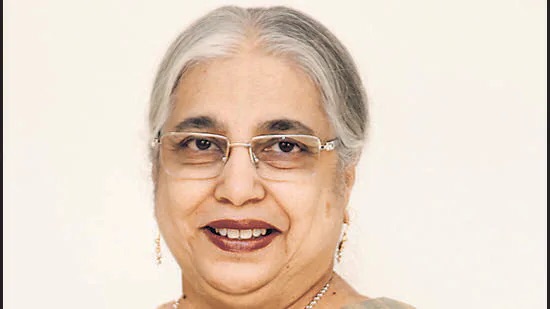
In the bustling heart of Mumbai, where the salty Arabian Sea breeze mingles with the chaos of honking rickshaws, a legacy of healing was born—not just in sterile operating theaters, but in the fierce, unyielding spirit of a woman who turned microscope slides into lifelines. Dr. Anita Maria Borges, affectionately known as the “Queen of Histopathology,” wasn’t merely a doctor; she was a bridge between despair and hope, a mentor with a laugh that could disarm the grimmest diagnosis, and a daughter who carried her father’s scalpel-sharp legacy into the quiet precision of pathology. Her story isn’t one of cold facts and awards—though there were plenty of those—but of a life lived with the warmth of family dinners, the sting of loss, and the quiet thrill of peering into the unseen secrets of cells that could rewrite fates.
Picture a young Anita in the 1950s, growing up in the shadow of Shivaji Park’s banyan trees, in a home echoing with the stories of her father, Dr. Ernest Borges. Ernest was no ordinary man; he was the trailblazing cancer surgeon who transformed Tata Memorial Hospital into India’s oncology fortress, daring to operate on esophageal cancers when most physicians wouldn’t touch them with a ten-foot pole. Born in 1909 to a Goan Catholic family that valued education like sacred scripture, Ernest had clawed his way from Grant Medical College to the hallowed halls of Memorial Hospital in New York, returning to India as a force of nature. He married Gracie Soares in 1946, and their brood of six—Anita the eldest, followed by Nina, Rita, Eric, the brief light of Marie (who passed as an infant), and Renee—filled their home with the joyful pandemonium of a doctor’s irregular hours.
Anita, with her wide-eyed curiosity and a penchant for dissecting the world around her (literally, even as a child poking at insects under her father’s watchful eye), absorbed it all. “Papa,” she once quipped during a rare family supper, her voice cutting through the clink of forks on plates, “you slice open bodies to fight the monsters inside. What if I could spot those monsters before they grow teeth?” Ernest, pausing mid-bite of his Goan fish curry, his eyes twinkling behind wire-rimmed glasses, leaned forward. “Then you’d be the guardian at the gate, my girl. Not the warrior with the sword, but the sentinel with the lantern. And in this fight, that’s the braver role.” It was a moment that lodged in her heart like a perfectly stained tissue sample—clear, indelible, prophetic.
By the 1970s, Anita had forged her own path, earning her MBBS and MD from Mumbai’s prestigious institutions, her mind a whirlwind of ambition tempered by the empathy she’d inherited from her mother Gracie, who juggled homemaking with quiet acts of charity. But Mumbai’s intensity called for broader horizons. In her twenties, Anita packed her bags for the UK and the US, spending a grueling 25 years honing her craft as a surgical pathologist amid the fog of London and the neon hum of American labs. “It was lonely at first,” she later confessed to a group of wide-eyed trainees over chai in her Mumbai clinic, her voice softening as steam curled from porcelain cups. “Nights in cold hostels, staring at slides until my eyes burned, wondering if I’d ever feel like I belonged. But every tumor I diagnosed? It whispered, ‘You’re home now—right here, in the fight.'”
Returning to India in the 1990s, Anita didn’t just unpack her suitcases; she unpacked a revolution. Pathology in India was often an afterthought, a dusty backroom science overshadowed by flashy surgeries. But Anita saw its power—the quiet authority in declaring a cancer benign or malignant, the godlike precision that could spare a life or demand its reckoning. She dove headfirst into Tata Memorial Hospital, her father’s old stomping grounds, where colleagues still swapped tales of Ernest’s legendary 12-hour marathons in the OR. There, she built the foundation for oncopathology, training generations of pathologists who would carry her meticulous eye forward.
Her crowning jewel came in the 2000s: founding the Centre for Oncopathology in Wadala, Mumbai, a beacon where cutting-edge diagnostics met compassionate care. As Consultant Histopathologist at S L Raheja Hospital (a Fortis associate) and Director of SRL Diagnostics’ Centre of Excellence for Histopathology, she transformed labs into collaborative war rooms. “Look closer,” she’d urge her team during late-night slide reviews, her finger tracing a rogue nucleus on the monitor. “That cell isn’t just a dot—it’s a story. A mother’s laugh, a child’s first steps. Get it wrong, and you rewrite their ending.” Her diagnostic acumen became legend; reports bearing her name were treated as gospel, pulling patients back from the brink in smaller towns she’d visit unannounced, armed with workshops and an unshakeable belief in precision as the ultimate kindness.
Awards flowed like monsoon rains: the Lifetime Achievement Award from the Indian Academy of Cytology, a spot on The Pathologist‘s Power List in 2015 and 2022, where she was hailed as a “passionate mentor whose heart and soul is dedicated to pathology.” She rose to Vice President (Asia) of the International Academy of Pathology, chaired accreditation committees, and served as Dean of the Indian College of Pathologists. Yet, Anita shunned the spotlight. “Fame?” she’d chuckle, waving off a journalist’s microphone during a 2020 conference, her silver-streaked hair catching the light. “That’s for surgeons like my father. Me? I prefer the shadows—where the real magic happens, one slide at a time.”
Her mentorship was her superpower, a blend of tough love and grandmotherly warmth. To the young resident fumbling a biopsy read, she’d say, “Darling, pathology isn’t about speed; it’s about patience. Like waiting for the perfect roti to puff on the tawa—rush it, and it burns.” She traveled tirelessly to tier-2 cities, democratizing knowledge in a field too often gated by privilege. Family remained her anchor: holidays in Goa with siblings Nina and Renee, regaling them with tales of Ernest’s papal honors (he was once Privy Chamberlain to the Pope, cape and sword included), or quiet evenings poring over her father’s biography, In Ernest Quest, penned by Renee—a loving chronicle of a man whose shadow Anita both honored and eclipsed in her own quiet way.
But even queens have their frailties. In her later years, Anita battled the isolation of loss—Ernest gone since 1969, Gracie’s steady presence a fading memory—and the relentless toll of a career spent staring down mortality. “Some days,” she admitted to a close colleague over filter coffee in 2023, her voice barely above a whisper, “I wonder if I’ve saved more lives than I’ve mourned. But then a student calls, saying ‘Ma’am, your lesson caught it early today,’ and suddenly, the scales tip.” It was this raw humanity—the way she’d tear up at a patient’s thank-you note or dance a impromptu jig to old Konkani tunes—that made her unforgettable.
On September 19, 2025, in the unassuming city of Gorakhpur, Uttar Pradesh, where she’d traveled for a routine engagement, Dr. Anita Maria Borges, aged 78, suffered a sudden heart attack. The news rippled through Mumbai’s medical corridors like a shockwave, tributes pouring in from Tata Memorial to global pathology forums. “She didn’t just diagnose cancers,” one mentee posted online, “she diagnosed hope.” Her father, the surgeon who carved paths through the unknown, would have nodded proudly. In the end, Anita’s life was her greatest biopsy: a testament to precision, passion, and the profound, messy beauty of fighting for others. As she might have said, with that signature spark in her eye, “The monsters don’t always win. Sometimes, the light finds them first.”
The Lasting Echoes of Dr. Anita Borges’ Legacy
Dr. Anita Maria Borges didn’t just leave footprints in the sands of Indian medicine; she carved enduring pathways through the dense terrain of oncopathology, mentorship, and human connection. Her legacy is not a static monument but a living, breathing force—seen in the slides meticulously read by her protégés, the patients who owe their lives to her diagnostic precision, and the ethos of compassion and curiosity she instilled in a field often cloaked in clinical detachment. It’s a legacy that hums in the quiet hum of microscopes and the vibrant chatter of pathology labs across India, from Mumbai’s bustling Tata Memorial Hospital to the smaller clinics she touched in far-flung towns.
A Revolution in Oncopathology
Anita’s most tangible legacy is the Centre for Oncopathology in Wadala, Mumbai, a beacon she founded in the 2000s that redefined how India approached cancer diagnostics. “This isn’t just a lab,” she’d tell her team, her voice firm as she adjusted her glasses over a stack of reports, “it’s where we turn fear into answers.” The Centre became a hub for cutting-edge histopathology, blending advanced technology with the kind of rigor that could spot a malignancy in a sea of cells. As Director of SRL Diagnostics’ Centre of Excellence for Histopathology and Consultant Histopathologist at S L Raheja Hospital, she didn’t just process samples—she set a gold standard. Her reports were legendary, often the final word in complex cases, saving lives with a precision that felt almost divine. Today, the Centre stands as a testament to her vision, training pathologists who carry her insistence on accuracy and empathy into the future.
Mentorship: The Heart of Her Mission
If Anita’s labs were her canvas, her students were her masterpiece. She trained generations of pathologists, not just in Mumbai but across India, particularly in underserved tier-2 cities where diagnostic expertise was scarce. Picture her in a cramped seminar hall in Nagpur or Bhopal, her silver hair catching the projector’s glow, as she leans over a young doctor’s shoulder. “See that shadow on the slide?” she’d say, her tone equal parts challenge and encouragement. “It’s not just a cell—it’s a clue. Follow it, and you might save a family from heartbreak.” Her mentorship wasn’t about churning out technicians; it was about sculpting sentinels who could guard lives with the same passion she did. Many of her students now lead pathology departments, quoting her maxims—part science, part poetry—like sacred mantras. The Indian Academy of Cytology, where she served as a guiding light, and her role as Dean of the Indian College of Pathologists cemented her as a mentor whose influence will ripple for decades.
Democratizing Knowledge
Anita’s legacy burns brightest in her crusade to make pathology accessible. She wasn’t content with ivory-tower accolades (though she earned plenty, like the Lifetime Achievement Award from the Indian Academy of Cytology and her place on The Pathologist’s Power List in 2015 and 2022). She traveled relentlessly, conducting workshops in places where “oncopathology” was barely a whisper. “Knowledge isn’t a privilege—it’s a right,” she’d snap at bureaucratic roadblocks, her Goan fire flaring as she pushed for better training and resources in remote hospitals. Her efforts empowered smaller labs to diagnose cancers early, giving patients in India’s hinterlands a fighting chance where none existed before. Colleagues recall her arriving unannounced in dusty towns, her suitcase stuffed with teaching slides, ready to transform a room of skeptical doctors into believers. That accessibility is her gift to India’s healthcare landscape—a democratization of hope.
A Personal Touch in a Clinical World
What made Anita’s legacy uniquely human was her ability to weave warmth into the cold precision of pathology. She’d slip handwritten notes into patient files for colleagues to find, reminding them, “This isn’t just a sample—it’s someone’s mother, someone’s child.” At Tata Memorial, where her father Dr. Ernest Borges had once been a surgical titan, she carried forward his legacy of compassion, often spending hours counseling families post-diagnosis. “I saw her cry once,” a nurse shared on an X post after Anita’s passing, “not because she was tired, but because she’d just told a young mother she’d be okay. That was Anita—she felt every victory, every loss.” Her laughter, her Konkani lullabies hummed absentmindedly during late-night slide reviews, and her knack for remembering every intern’s name made her a legend not just of skill but of soul.
Mumbai: India’s foremost oncopathologist, Dr Anita Borges, whose report on a patient’s biopsy was considered the “final verdict” on the cancer’s type and grade and helped oncologists draw up a treatment plan, passed away in Gorakhpur, Uttar Pradesh, while attending a medical conference.
The 78-year-old doctor reportedly suffered a heart attack. Tata Memorial Hospital in Parel, where she began her career, posted on X: “We deeply mourn the loss of Dr Anita Borges, India’s most illustrious oncopathologist. Her service to countless patients at TMH and beyond leaves an indelible legacy. It was indeed fitting that she left for her heavenly abode doing what she was most passionate about, teaching.”
Her younger brother, cardiologist Dr Eric Borges, said, “My sister was caring, humane in her approach to patients, and most passionate about teaching. She will be missed not only in pathology but also by thousands of young doctors whom she mentored.” Her body hasn’t yet reached Mumbai, and funeral plans haven’t yet been finalised, added Dr Eric Borges.
The road on which TMH is located is named after their father, Dr Ernest Borges, who was a director of the institute.
“A doyen amongst the pathologists, her word used to be the last word. And yet, her passion drove her to go to tier 2 cities to teach basics like staining slides well to pathologists and technologists,” said TMC professor Dr Akshay Baheti. Apart from Gorakhpur, she also visited Latur and Jammu in the last few weeks.
Dr. Borges, tragically passed away in circumstances her colleagues describe as both heartbreaking and all too common. While attending a conference in a well-equipped hospital in Gorakhpur, she experienced chest pain and sweating. A cardiologist diagnosed an acute heart attack caused by a 100% blocked left main artery, requiring immediate intervention. Instead of proceeding with an angioplasty at the hospital, her brother opted to airlift her to Mumbai for treatment. Sadly, she collapsed in the ambulance en route to the airport. Despite CPR and being rushed back to the hospital, she could not be saved. Her death highlights a critical lesson: even the most knowledgeable can make poor decisions under stress. Sometimes, opting for immediate, available treatment is better than waiting for “the best.”
A Global and Lasting Impact
Globally, Anita’s voice resonated as Vice President (Asia) of the International Academy of Pathology, where she advocated for standardized diagnostics in resource-strapped regions. Her work on accreditation committees ensured that labs across Asia met rigorous standards, a quiet but seismic shift in global health equity. Yet, she remained rooted in her Goan-Mumbai heritage, weaving stories of her father’s papal honors or her mother Gracie’s resilience into speeches that left audiences spellbound. “My father fought cancer with a scalpel,” she’d say, a twinkle in her eye, “but I fight it with a lens. Both are blades, just wielded differently.”
When Anita passed on September 19, 2025, in Gorakhpur, the tributes flooded in—not just from medical journals but from patients, students, even the chai-wallah outside her Wadala lab who called her “Didi” (sister). Her legacy endures in the thousands of lives saved by her diagnoses, the pathologists she trained who now train others, and the ethos she championed: that every slide tells a story, and every story deserves a listener. As one mentee put it, wiping tears at her memorial, “Dr. Anita didn’t just teach us to see cancer—she taught us to see the human behind it. And that’s a lesson that never fades.” In the labs she built, the students she inspired, and the hope she kindled, Anita Borges remains the sentinel at the gate, her lantern still burning bright.


 deemagclinic
 deemag and chest clinic