
In the foothills of Dehradun, where the Himalayas whisper secrets to the pine-scented air, St. Thomas’ College has stood as a bastion of learning since 1916—a co-educational haven blending British rigor with Indian warmth. Amid its echoing corridors and sun-dappled quadrangles, one man etched his legend not with grand gestures, but with the quiet precision of a well-solved quadratic: Mr. Pritam Singh Dhillon, the maths teacher whose turban was as iconic as his theorems.
The Inspiring Life of Mr. Pritam Singh Dhillon: A Sikh Scholar Who Made Math Magical
In the misty hills of Dehradun, where the air carries whispers of pine trees and ancient wisdom, lived a man who bridged the worlds of faith, frugality, and fractions. Mr. Pritam Singh Dhillon, a devout Sikh and beloved mathematics teacher at St. Thomas School, wasn’t just an educator—he was a quiet force of inspiration, turning the dread of algebra into moments of triumph for countless students like me. I am Dr. P.K. Gupta, and as one of his pupils preparing for the ICSE exams back in the day, I had the privilege of knowing him not just in the classroom, but in the intimate spaces of his life. Let me take you through his story, woven with the warmth of memories and a dash of dialogue to bring his gentle spirit to life.
Born into a Sikh family, Mr. Dhillon embodied the principles of simplicity, discipline, and service that Guru Nanak preached. Though details of his early years remain shrouded in the personal humility he carried like a turban, it’s clear his path led him to education as a calling. He settled in Dehradun, a town nestled in the Doon Valley, where the terrain tested one’s resolve as much as any theorem. There, he became a fixture at St. Thomas School, teaching mathematics with the precision of a compass and the patience of a saint.
Picture this: Every morning, Mr. Dhillon would pedal up the steep, winding roads from his modest home in the posh Race Course locality to the school. Dehradun’s hills were no joke—it’s all uphill from Race Course, a relentless climb that would leave most huffing and puffing. But not him. Astride his trusty black Atlas bicycle, dressed in a crisp black achkan (a long coat) paired with tight churidar pyjamas, he cut a striking figure. His loose, flowing beard danced in the breeze, making him look more like a Gurudwara priest than a school teacher. “Ah, the hills are my daily prayer,” he’d chuckle to himself, or so I’d imagine as I watched him arrive, barely breaking a sweat. I felt uneasy as my ambassador car with my uncle Prem Prakash driving, overtook him. He barely glacéd, peddling forcefully.
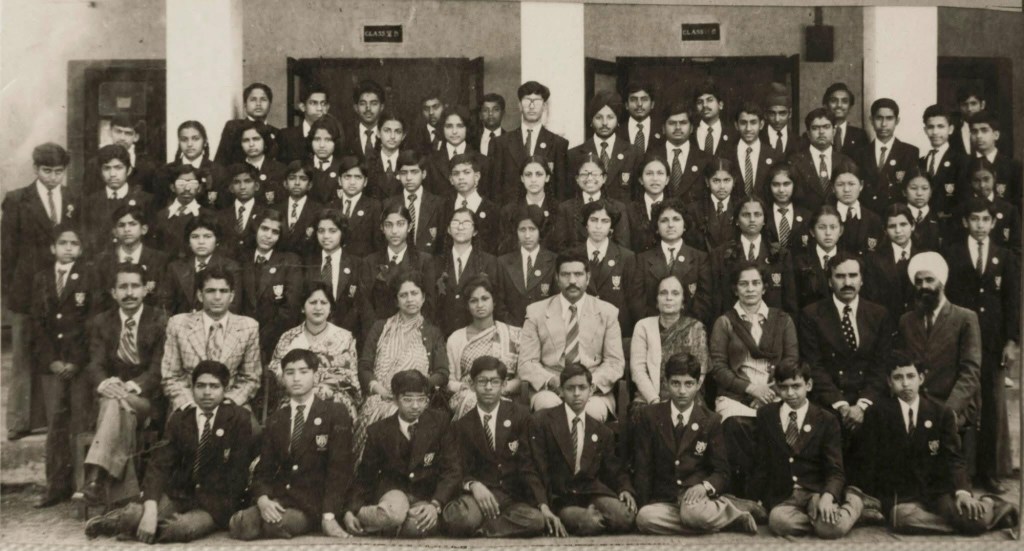
His life was a testament to living sparingly amid abundance. Race Course was one of Dehradun’s upscale areas, dotted with colonial bungalows and manicured lawns, yet Mr. Dhillon’s home was a sanctuary of minimalism. No extravagances—just enough to sustain a life dedicated to knowledge and family. His wife, also a teacher at a local school, shared his ethos. Together, they formed a partnership of quiet strength, supporting each other’s vocations while nurturing their own spiritual lives.
After a long day unraveling the mysteries of geometry and trigonometry for eager (and sometimes bewildered) minds, Mr. Dhillon would cycle back home. I’d often visit for tuitions, so I got a glimpse into his routine. “Come in, beta,” he’d greet me at the door, his voice warm like fresh roti. He’d pour himself a tall glass of milk—straight from the local dairy, no frills—and settle into a simple chair for a well-earned rest. “Milk is the elixir of the mind,” he’d say with a twinkle in his eye. “It clears the cobwebs so we can tackle those pesky equations tomorrow.”
I was one of those students who needed extra help. Math didn’t come easy to me; numbers seemed to twist and turn like the roads of Dehradun itself. For my ICSE preparations, Mr. Dhillon would make the trek from Race Course to my home on Gandhi Road—not on his bicycle, but on foot. “The walk keeps me fit, P.K.,” he’d insist when I offered to arrange a ride. “Life’s not about shortcuts; it’s about the journey.” Those walks must have been a good couple of kilometers, uphill and down, but he never complained. Instead, he’d turn our sessions into adventures.
One afternoon stands out vividly. I was struggling with quadratic equations, my notebook a mess of crossed-out attempts. “Sir, why do these x’s and y’s hate me so much?” I groaned, slumping over the table. Mr. Dhillon leaned back, stroking his beard thoughtfully, then smiled. “Ah, beta, they don’t hate you—they’re just shy. Let me show you.” He’d draw a simple diagram, his chalk (or in this case, pencil) moving like a storyteller’s hand. “Imagine x is a traveler on a hill, like our Dehradun paths. To find where he meets y, you balance the load. See? Plug in the values: x² + 5x + 6 = 0. Factor it—(x+2)(x+3)=0. Solutions at -2 and -3. Easy as climbing with a friend!”
Though I was poor in maths, he could always find a way to make it click. His methods weren’t rote; they were laced with life lessons from Sikh teachings—perseverance, equality, and finding harmony in chaos. “Guru ji taught us that all are one, just like numbers in an equation,” he’d remind me during tough sessions. “You and math? You’re meant to be allies, not enemies.”
Beyond the classroom and tuitions, Mr. Dhillon’s influence rippled quietly. As a Sikh, he volunteered at the local Gurudwara, sharing stories of the Gurus with children. His wife and he led by example, proving that a life of service didn’t require grandeur. Even in retirement (though I lost touch after school), I like to think he’s still out there, perhaps sipping milk and pondering pi under a Himalayan sky.
Mr. Pritam Singh Dhillon wasn’t just our dear maths teacher; he was a beacon of humility in a world rushing uphill. Through his black achkan and bicycle rides, he taught us that true wisdom flows loosely, like a beard in the wind—unfettered, enduring, and ever-inspiring. If you’re ever in Dehradun, pedal those hills and feel his spirit. Who knows? You might solve a problem or two along the way.
Born in the late 1950s to a Sikh family in Punjab’s verdant fields, young Paramjit grew up in a home where the Guru Granth Sahib’s verses mingled with the scratch of his father’s ledger books. “Beta, life is like pi—endless, irrational, but beautiful if you approximate wisely,” his father would say over dinner, a farmer who moonlighted as a village accountant. Those words stuck, propelling Paramjit through the hallowed halls of Punjab University, where he devoured degrees in mathematics and education like a hungry algorithm chasing convergence. By the early 1980s, armed with a turban tied tight and a suitcase of dreams, he landed in Dehradun—a city that felt like a theorem half-proven, blending colonial echoes with Himalayan resolve.
St. Thomas’ welcomed him as a junior maths instructor in 1983, a time when the school was shedding its Anglo-Indian skin for a more desi hue. Mr. Dhillon arrived in a crisp three-piece suit, his beard meticulously knotted under his chin like a bow on a gift-wrapped integral. “Good morning, class,” he’d boom in a voice like rolling thunder over the Doon Valley, adjusting his cufflinks as if they were variables in need of balancing. The boys snickered at first—”Sir looks like he’s auditioning for a Bond film!”—while the girls blushed at his Oxford polish. But oh, how he commanded that blackboard. With a piece of chalk that danced like a Sufi whirling dervish, he’d unravel the mysteries of calculus: “See here, young scholars, the derivative isn’t a monster under the bed—it’s the slope of your ambitions. Climb it wrong, and you’ll tumble; master it, and the peaks are yours.”
His knowledge was a bottomless well. Students whispered legends of his impromptu lectures on Euclidean geometry tying into Sikh philosophy—”The circle of the ek onkar, infinite yet contained, just like your limit as x approaches infinity.” He’d quote Ramanujan one minute, then Guru Nanak the next, leaving jaws dropped and notebooks filled. “Sir, how do you know everything?” a wide-eyed Class 10 boy once asked during recess. Mr. Dhillon chuckled, stroking his tied beard. “Arjan, my lad, the universe is one grand equation. I’ve just solved a few more variables than most. Now, pass the samosas—fuel for the mind!”
But beneath the erudition lurked a man more at home in abstractions than applications. Practicality? That was the elusive constant he could never quite pin down. Once, during a school hike to Robber’s Cave, the class got lost in a sudden downpour. While frantic parents rang the principal, Mr. Dhillon calmly sketched a topographic map on a soggy notebook. “See? The hypotenuse of this trail forms a 30-60-90 triangle—follow it, and we’re saved!” The students, drenched and giggling, trailed him through the mud, only for him to trip over a root he’d “theoretically” accounted for. “Ah, gravity—a force I respect but rarely befriend,” he quipped, rising with mud-caked trousers and a grin. Back at school, he’d forget to submit expense reports, leaving the accounts clerk sighing, “Dhillon Sahib, your proofs are impeccable, but where’s the receipt for those 47 biscuits?”
As the years rolled into the ’90s, India—and Mr. Dhillon—began to “Indianize.” The suits gave way to a sleek black achkan, its high collar framing his turban like a frame around a masterpiece, paired with flowing white churidar pajamas that swished like whispers during his board-striding gait. “Why fight the monsoon in wool, eh?” he told a curious colleague over chai. “This is desi calculus—elegant, enduring, and oh-so-comfortable.” And the beard? Once a prim knot, it now flowed free like the Ganges unbound, a silver-streaked cascade that caught the classroom light during afternoon sessions. “Tying it was like binding a theorem—necessary, but oh, the freedom of letting it loose!” he’d roar with laughter, much to the delight of his growing brood of alumni.
Life wasn’t all axioms and angles. Mr. Dhillon married his college sweetheart, a literature teacher from Ludhiana, in a simple Anand Karaj ceremony under Dehradun’s deodars. Their home, a modest cottage near the school’s Cross Road gate, brimmed with bookshelves groaning under tomes on fractals and folk tales. “Pritam, you’ve solved the world’s puzzles—now solve dinner!” she’d tease as he pondered perpetual motion over aloo parathas.
Yet, for all his wisdom, Mr. Dhillon’s impractical streak painted him as endearingly human—a sage who could derive Schrödinger’s equation but once drove 20 kilometers the wrong way to a PTA meeting because he’d “optimized the route on paper, not pavement.” Students adored him for it. “Sir wasn’t just a teacher; he was a glitch in the matrix—brilliant, baffling, and utterly ours,” recalls alumna Priya, now a software whiz in Delhi. During farewell assemblies, tears flowed as he’d quote, “Waheguru ji ka Khalsa, Waheguru ji ki Fateh—and may your gradients always rise.”
Continuing the Tale of Mr. Pritam Singh Dhillon: Lessons in Math, Mischief, and Perseverance
Ah, the classroom under Mr. Pritam Singh Dhillon’s watchful eye was a theater of numbers, where equations danced on the blackboard like elusive spirits. As Dr. P.K. Gupta, I look back on those days at St. Thomas School in Dehradun with a mix of fondness and frustration. Our dear Sikh maths teacher, with his priestly beard and unyielding dedication, had a style that was as unique as his black Atlas bicycle rides up those Himalayan hills. But oh, how it tested us! Let me weave in these memories, adding a spark of dialogue to bring the chalk-dusted chaos to life.
Class would begin with Mr. Dhillon striding in, his achkan swaying like a banner of authority. He’d pick a problem—say, a tricky quadratic or a geometry puzzle—and scrawl it across the board in his deliberate script. Then, the magic (or madness) would unfold. He’d hunch over, scribbling furiously, muttering to himself as if consulting the ghosts of Pythagoras and Euclid. Lines, symbols, and numbers flew from his chalk like sparks from a forge. Solve it he did, every time, emerging triumphant with the answer boxed neatly at the end. But us? We’d sit there, pencils hovering, copying it all down like diligent scribes in a medieval monastery. “Sir, how did you get from step three to four?” someone might venture. He’d pause, beard twitching, and reply vaguely, “Ah, beta, it’s the formula—apply it, and truth reveals itself.”
The trouble was, Mr. Dhillon, bless his scholarly soul, was a poor communicator. He couldn’t quite bridge the gap between his brilliant mind and our fumbling ones. There are set mathematical formulae, he’d try to convey, eternal truths that hold firm no matter the variables. But without that spark of explanation, we’d apply them blindly, without comprehension, like reciting prayers without understanding the words. The result? A classroom full of blank stares and unsolved riddles. We couldn’t tackle anything on our own; the numbers remained strangers, mocking us from the page.
Of course, a few shining stars in our class bucked the trend. They’d grind through the equations daily, homework pristine and prepared. One such prodigy was Vipin Anand, a quiet whiz who later climbed the corporate ladder to become a Managing Director at the Life Insurance Corporation of India. 0 1 While the rest of us floundered, Vipin had it all figured out—perhaps those early math battles honed his strategic mind for the world of insurance and finance.
As for the rest of us mischief-makers? We’d hatch a plan straight out of a schoolyard caper. Arriving early to school, we’d corner Vipin with pleading eyes. “Vipin bhai, just a peek at your notebook?” I’d whisper, and he’d sigh, handing it over with a reluctant grin. Copy we did, furiously transcribing his solutions to claim our homework as our own. It felt like a victory in the moment, but oh, the fallout! Our test results were dismal, a sea of red marks that left Mr. Dhillon shaking his head in quiet disapproval.
One day, after a particularly abysmal performance, he pulled me aside during tuition at my home on Gandhi Road. His walk from Race Course had left him invigorated, but his expression was stern. “P.K.,” he said, fixing me with those wise eyes under his turban, “we are in an English-medium school, where the standard of maths is gentle, like a foothills stream. If we were tackling the high school board’s rigors—those steep mountain paths of problems—your head would spin, and you’d faint from the altitude!” He chuckled softly, but the message stung; he saw my capabilities as limited, a boy more suited to milder climbs.
Yet, Mr. Dhillon wasn’t one to give up on a student, and neither was I ready to surrender. We doubled down in those tuition sessions—him patiently guiding, me sweating over sums until the formulae started to whisper their secrets. “Remember, beta,” he’d encourage, “hard work is the true formula. Apply it without shortcuts.” Bit by bit, comprehension dawned. And when ICSE results came? I passed maths—not with flying colors, but with a hard-won victory that felt like conquering those Dehradun hills on foot.
Mr. Dhillon’s lessons went beyond the board; they taught us that true understanding comes from struggle, not shortcuts. In his imperfect way, he planted seeds of resilience. Vipin’s success proves it— from copying his homework to admiring his boardroom triumphs. And me? As Dr. P.K. Gupta, I owe my perseverance to that bearded guru on a bicycle, who turned my mathematical fog into clarity, one scribbled solution at a time.
Mr. Pritam Singh Dhillon: Quirks, Slaps, and the Art of Classroom Discipline
Oh, the quirks of Mr. Pritam Singh Dhillon—they added a layer of eccentricity to our maths classes at St. Thomas School in Dehradun, turning what could have been dull drills into memorable escapades. As Dr. P.K. Gupta, I remember him not just as our dear Sikh teacher in his signature black achkan and flowing beard, but as a man whose habits sparked imitation, laughter, and sometimes a swift dose of old-school justice. Let me paint these scenes with a touch of dialogue, bringing back the chalky air and the hilly echoes of those days.
Mr. Dhillon had this peculiar tic: every now and then, he’d protrude his tongue and lick his lips, as if savoring the sweetness of a solved equation. It was subtle at first, but us students, ever the keen observers of adult oddities, noticed it quick. Whispers rippled through the back benches: “Watch this!” And soon, imitations popped up like weeds in the monsoon—tongues darting out, lips smacking in exaggerated mockery. Most times, he’d ignore it, lost in his scribbles on the board. But catch you in the act? Oh, beta, prepare for the storm.
Take Rakesh Tandon, a lanky fellow in our class who later rose through the ranks to become a major in the Indian Army. One afternoon, mid-lesson on trigonometry, Rakesh couldn’t resist. He stuck out his tongue, licked his lips, and the giggles erupted. Mr. Dhillon’s eyes narrowed behind his spectacles. “Tandon! Stand up!” he barked, his voice cutting through the snickers like a bicycle bell on a quiet hill road.
Rakesh rose slowly, towering over our diminutive teacher like one of Dehradun’s pine trees over a shrub. He even removed his glasses, perhaps in a show of respect or defiance—who knows? “Wait, sir,” Rakesh mumbled, but Mr. Dhillon was already advancing. “Now, sir?” Rakesh asked, bracing himself. Bang! A resounding slap echoed across the room, Mr. Dhillon’s hand connecting with the precision of a well-aimed theorem. Rakesh reeled, rubbing his cheek, but there was no malice—just a lesson in respect, delivered Sikh-style. We all straightened up after that, though the Army must have toughened Rakesh even more in the years to come.
Then there was Sanjeev Pathak, another bright spark in maths, always perched on the back bench with his pal Gursharan. Sanjeev was sharp with numbers but sharper with mischief, true to form. Gursharan, a fellow Sikh with a budding beard that spoke of his faith, was his perfect foil—tall, serious, and not one to take jabs lightly. Picture a typical class: Mr. Dhillon at the board, unraveling a complex polynomial, his beard swaying as he scribbled. The room hummed with the scratch of chalk and the occasional tongue-lick.
From the back, Sanjeev leaned over with a grin. “Gurri, have you shaved today?” he whispered loudly enough for half the class to hear, poking fun at Gursharan’s religious commitment to uncut hair.
Gursharan’s face flushed under his beard. “What did you say?” But instead of words, action followed—bang! His hand came down on Sanjeev’s head like a hammer on an anvil, flattening those stubborn hairs at the back that always stood erect, no matter how much Sanjeev pressed them down with his muffler every morning. Sanjeev yelped, his cowlick surrendering temporarily.
The loud bang shattered the classroom calm, disturbing Mr. Dhillon mid-equation. He spun around, chalk in hand. “Why, Gursharan? Why did you hit him?”
Gursharan stood tall, voice steady. “Sir, he was speaking against my religion—mocking the beard!”
Mr. Dhillon nodded thoughtfully, stroking his own flowing whiskers. Then, without a word, he marched to Sanjeev’s desk. By now, those rebellious hairs had popped back up, defiant as ever. Bang! Another firm thwack from Mr. Dhillon, flattening them once more. “Let that be a lesson,” he said calmly, returning to the board as if nothing had happened. Sanjeev sat there, head smoothed and ego bruised, while the class stifled laughs.
These moments weren’t just about discipline; they reflected Mr. Dhillon’s world—a blend of faith, firmness, and forgiveness. He defended Gursharan’s Sikh pride not out of favoritism, but because respect was as fundamental as any formula. And Sanjeev? Well, his maths prowess carried him forward, hairs and all. In the hills of Dehradun, where life was uphill both ways, Mr. Dhillon’s quirks taught us that a little slap could straighten more than just a cowlick—it could align our paths toward understanding.
Through it all, our bearded guru on his black Atlas bicycle remained a figure of quiet authority, turning classroom chaos into character-building tales. “Teaching isn’t about answers, class,” he told a batch, eyes twinkling over half-moon spectacles. “It’s about questions that keep you up at night. Solve them, and you’ve lived.” In a world of rote apps and rote learners, Pritam Singh Dhillon remains the unsolved beauty—the irrational root of inspiration, forever approximating perfection.
The Twilight Years of Mr. Pritam Singh Dhillon: Echoes of Solitude in the Hills
As the chapters of life unfold in the verdant valleys of Dehradun, not all pages are filled with the triumphs of theorems or the laughter of schoolyard antics. For our dear Mr. Pritam Singh Dhillon, the Sikh maths teacher who pedaled uphill both literally and figuratively, the later years brought a quiet storm of sorrow. I, Dr. P.K. Gupta, reflect on this with a heavy heart, piecing together the fragments from old conversations and shared memories. His story, like a complex equation, didn’t resolve neatly—but it reminds us of life’s fragile balance.
Unfortunately, Mr. Dhillon and his wife had no children—no little ones to fill their modest home in Race Course with the patter of feet or the chaos of crayons. They lived alone, a duo bound by shared vocations and simple joys: her teaching at another school, him with his tall glass of milk after classes, and their evenings perhaps spent in quiet reflection under the Himalayan stars. “We are content with what Waheguru provides,” he’d once told me during a tuition session, his beard hiding a soft smile as he sipped his milk. No grand family gatherings, just the two of them, cycling through life’s rhythms like his black Atlas on those winding roads.
But fate, unpredictable as a Dehradun downpour, intervened. His wife passed away, leaving him utterly alone in that once-cozy haven. The loss hit him like a unsolved puzzle that refused to yield—depressed and forlorn, he withdrew from the world he once illuminated. The man who could conquer any equation found himself defeated by grief. He left his job at St. Thomas School, trading the blackboard for silence, his achkan perhaps hung up alongside memories of better days.
“Where did he go after that?” I’d wonder in later years, chatting with old classmates like Vipin Anand or Rakesh Tandon over chai. No further information surfaced about his whereabouts—no letters from afar, no sightings on those hilly paths. Many ex-students, myself included, would have liked to help him, to repay the patience he showed us fumbling fools in maths. “Sir, let us walk with you now,” we might have said, offering a hand as he once offered formulae. But life is unpredictable, full of ups and downs steeper than Race Course to school. Opportunities slip away, like chalk dust in the wind, and we’re left with regrets.
In the end, Mr. Dhillon’s tale is a poignant reminder: even the sturdiest beards can hide a breaking heart. If he’s out there, sipping milk under some distant sky, I hope he knows his lessons endure—not just in numbers, but in the resilience he instilled. Waheguru’s grace be upon him, our guru of the hills.


 deemagclinic
 deemag and chest clinic