
In the misty hills of Dehradun, nestled within the hallowed halls of St. Thomas School, there once roamed a figure who embodied the quirky clash of cultures in an English-medium institution. Mrs. P. Upadhyaya, our beloved—or sometimes bewildering—Hindi teacher, was a woman of middle height, with a wheatish complexion that glowed softly under the classroom lights. Thin as a reed, she always draped herself in simple cotton saris, their colors fading like old memories, yet she carried herself with an air of quiet authority. Picture this: a Hindi maestro thrust into a world where English reigned supreme, valiantly attempting to sprinkle her lessons with broken English phrases, much to our amusement and her frustration.
Her classes were less about literary fireworks and more about a gentle, predictable routine. “Beta, take out Nirmala by Premchand,” she’d instruct in her lilting voice, her sari swishing as she settled into her chair. Then, she’d nod at Hardayal, our class’s reluctant reader, who would stumble through the pages aloud, his mispronunciations turning poignant Hindi prose into accidental comedy. “Haan, theek hai,” she’d murmur, knitting away furiously with her needles clicking like a metronome. No deep dives into themes, no heated debates—just the story unfolding in fits and starts until the bell rang. And poof, Hindi period over. But oh, that knitting! It reminded us all of Madame Defarge from A Tale of Two Cities, that infamous knitter of grudges during the French Revolution. We’d whisper among ourselves, “Whose name is she knitting today?” Was it a student’s? A colleague’s? Or perhaps her own unspoken regrets? The mystery buzzed like a schoolyard rumor, adding a layer of intrigue to her otherwise serene demeanor.
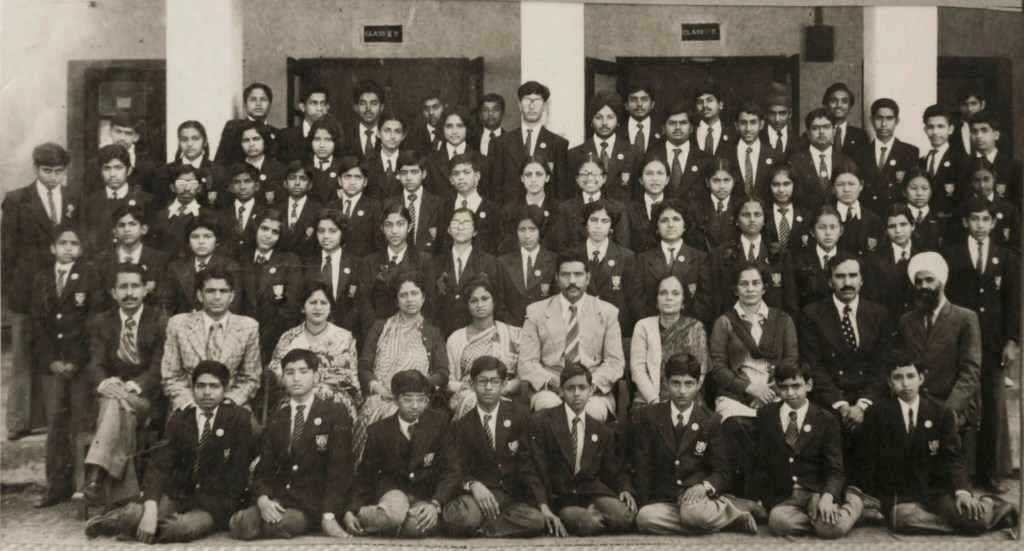
Mrs. Upadhyaya was quick to take offense, her temper flaring like a sudden Himalayan storm. I remember one afternoon when Varun Sharma—affectionately called “Vayu” because he was so thin a breeze might whisk him away—burst into class with news. “Ma’am, your daughter is calling you outside!” he announced innocently. Her eyes narrowed behind her spectacles. “Why can’t you say ‘Didi has arrived’? ‘Your daughter,’ you say? Is there no relation between you and me?” Varun, turning as red as a Himalayan apple, stammered, “Sorry, ma’am.” Little did we know back then that Vayu would grow up to become a General Manager at ONGC, trading schoolboy antics for corporate boardrooms. But in that moment, he was just another kid caught in her web of propriety.
When anger truly boiled over, she didn’t reach for a cane like some teachers might. No, her weapon of choice was her trusty umbrella, wielded with the precision of a fencer who didn’t want to scratch her blade. She’d give a light thwack—careful, always careful, not to damage her precious accessory—and the thud was so faint it felt more like a tickle than a punishment. “Discipline with dignity,” she’d probably call it, if asked.
Yet, beneath that stern exterior beat the heart of a movie buff. The 1970s craze for Bobby—that whirlwind romance starring Rishi Kapoor and Dimple Kapadia—had swept the nation, and Mrs. Upadhyaya was no exception. One day, during a rare lull in knitting, she scanned the class with a mischievous glint. “How many of you have seen Bobby?” Hands shot up everywhere, but not mine. As Dr. P.K. Gupta (that’s me, reflecting back on my school days), I confessed, “Ma’am, I haven’t seen it.” She leaned forward, eyeing me skeptically. “You don’t look so innocent,” she quipped, her lips curling into a rare smile. The class erupted in laughter, and I felt a mix of embarrassment and flattery. Who knew a teacher’s doubt could feel like a badge of honor?
Her influence lingered in unexpected ways. I ended up winning a Hindi prize in the ICSE exams—a beautiful book called Chitralekha, delving into themes of sexuality in Hindi literature. High marks in the ISC followed, and I often wonder: Was it her subtle guidance, or my teenage dives into Sigmund Freud’s works that sharpened my insights? Probably a bit of both. She turned mundane reading sessions into something that stuck, even if she didn’t know it.
Mrs. Upadhyaya was more than a teacher; she was a character from a Premchand novel herself—flawed, fascinating, and forever etched in the annals of St. Thomas lore. As the years roll on into 2025, I still smile at the thought of her knitting away, wondering whose name was next on those invisible threads. If only we could ask her now.


 deemagclinic
 deemag and chest clinic