
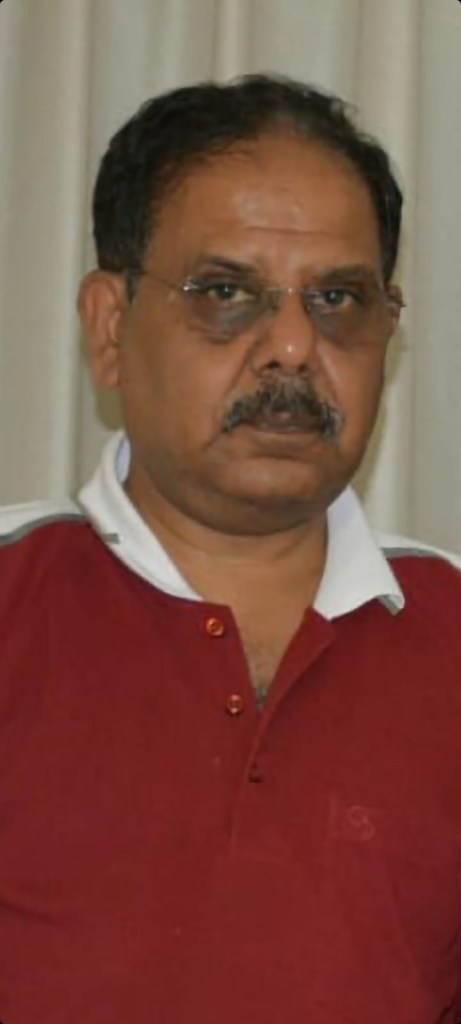
In the bustling corridors of Sarojini Naidu Medical College (SNMC) in Agra during the late 1970s, where the air hummed with the scent of formalin and the chatter of ambitious young minds, Dr. Parveen Bansal emerged as a force of nature. Short, squat, and dark-skinned, with a physique that looked like it was carved from the sturdy red sandstone of the Taj Mahal itself, Parveen was no stranger to being underestimated. But beneath that compact frame burned a powerhouse of determination—one that would carry him from the dusty hostels of Agra to the sun-baked clinics of the Arab world and, eventually, the high-stakes operating rooms of New Delhi. As an MS in Orthopaedic Surgery, Parveen didn’t just mend bones; he rebuilt lives, one unyielding fracture at a time. And through it all, he remained the steadfast “Bandhu” (friend) to his hostel mates, a man whose quirks were as legendary as his grit.
Born into a modest family in the heart of Uttar Pradesh, Parveen born on 15 Th of February 1960 in Gaziabad, arrived at SNMC in 1979, fresh-faced and wide-eyed, ready to conquer the rigors of MBBS. The college, with its grand colonial arches and chaotic anatomy halls, was a pressure cooker of intellect and mischief. Parveen dove in headfirst—literally, as his roommates would soon discover. He shared the senior boys’ hostel with the irrepressible Sunil Kumar from Ghaziabad, a pairing as mismatched as a rickshaw and a Ferrari. Sunil, with his quick wit and endless shayari, was the spark; Parveen, the steady anvil that hammered ideas into shape. “Bandhu, tu kyun itna serious rehta hai?” Sunil would tease one evening, sprawled on his bunk with a dog-eared poetry book, as the ceiling fan whirred lazily overhead. “Zindagi ek mazak hai—kyun na has le?”
Parveen, ever the pedant, would pause mid-sip of his nightly glass of milk—his ritual elixir for strength—and shoot back in his thick Hindi lilt, “Mazak? Arre Sunil, yeh mazak nahi, yeh fixed deposit hai! Jaise bank mein paise jama karte ho, waise hi sharir mein cell-bound fat jama hota hai. Roz doodh piyo, exercise karo, warna sab bikhar jayega.” His voice was calm, almost professorial, laced with that Agra twang that made even lectures sound like folksy wisdom. Milk was his religion; he’d guzzle a liter a day, claiming it built bones stronger than the Yamuna’s banks. And exercise? Dawn jogs around the hostel grounds, push-ups that left lesser men wheezing—Parveen treated his body like a temple, or perhaps more aptly, like one of his future patients’ skeletons: resilient, aligned, unbreakable.
But it was his study habits that truly baffled—and amused—his comrades. In the dim glow of a single bulb, while others crammed with coffee and cigarettes, Parveen had his “fad”: hanging upside down from the hostel window sill. “Yeh brain ko zyada khoon pahunchata hai, Bandhu!” he’d explain to a skeptical Sunil, gripping the frame with calloused hands and dangling like a bat in broad daylight. His face would flush beet red, textbooks propped open below him, as he mumbled anatomy facts to the pigeons outside. “Gravity ka khel hai, yaar—jaise orthopaedics mein alignment. Upside down hone se neurons jagte hain!” Sunil, doubled over in laughter, once quipped, “Parveen, agar tu gir gaya toh main tera pehla patient ban jaunga. Free surgery milegi na?” Parveen, unflappable even mid-inversion, grinned through gritted teeth: “Haan, lekin tab tu English mein chillayega, jaise main karta hoon jab gussa aata hai!”
Ah, yes—the English. Parveen was a son of the soil, his days woven in Hindi proverbs and hostel banter, but when anger flared—usually over some botched experiment or a lazy batchmate’s excuse—out came the clipped, furious English. “This is absolutely ridiculous! How can you be so negligent?” he’d thunder, his squat frame seeming to swell with indignation, eyes flashing like a storm over the Ganges. It was his secret weapon, a linguistic flip that turned heads and silenced rooms. “Bandhu ka gussa English mein hi suit karta hai,” Sunil would whisper later, over stolen samosas from the canteen. Those moments humanized him, revealing the fire beneath the milk-mustached philosopher.
By the time Parveen wrapped up his MS in Orthopaedic Surgery at SNMC, he was already a legend: the short guy who could deadlift a cadaver dummy, recite bone nomenclature upside down, and deliver a pathology lecture that felt like a fireside chat. But Agra’s familiar chaos couldn’t hold him. Adventure called from the sands of the Middle East. In the early 1980s, he packed his bags for the Arab countries—first Saudi Arabia, then the UAE—where his skills as a bone specialist were in high demand among expat workers and oil-rich locals alike. The heat was infernal, the hospitals gleaming with imported tech, but Parveen thrived. “Wahan log sochte the main chhota hoon, toh weak orthopaedician,” he later confided to Sunil during a rare visit. “Par maine dikha diya—bones don’t care about height, only strength!” He mended shattered limbs from construction falls, lectured on “cell-bound fat” as the silent saboteur of joint health (earning blank stares from his Arabic translators), and hung upside down in his expatriate flat to “recharge the gray matter” after 18-hour shifts.
Yet, for all his wanderlust, Parveen’s heart was a homebody. Back in India, he found his anchor in a marriage to a gynaecologist—a partnership as complementary as ortho and gynae in the delivery room. She balanced his milk-fueled routines with her own quiet grace, and together they built a life in the pulsating heart of New Delhi. Now settled in the capital, Parveen practices at a bustling multispecialty clinic, where his powerful hands still set fractures with the precision of a maestro. Patients adore his analogies—”Yeh fat aapke cells mein fixed deposit ki tarah jama ho gaya hai; ab withdraw karo exercise se!”—and his daily regimen remains unchanged: milk at dawn, weights at dusk, and the occasional upside-down ponder over a chai.
Looking back, Parveen’s journey from Agra’s senior hostel to Delhi’s ORs is a testament to quiet power. He wasn’t the tallest or the flashiest, but in a world that often overlooks the squat and steadfast, he stood—nay, dangled—tall. As Sunil once summed it up over a nostalgic peg at a batch reunion: “Bandhu, tu humara fixed deposit tha—hamesha reliable, kabhi na bikhe.” Parveen, sipping his milk-laced lassi, just smiled. “And you, my friend, were the interest that kept it growing.”
Dr. Parveen “Bandhu” Bansal: The Bone Setter’s Arabian Odyssey
Dr. Parveen Bansal, the short, squat, and fiercely determined orthopaedic surgeon from Sarojini Naidu Medical College (SNMC) in Agra, was no stranger to carving his own path. After earning his MBBS and MS in the late 1970s, he packed his milk-fueled resilience and his peculiar habit of studying upside down, and set sail—or rather, flew—for the deserts of the Middle East. The early 1980s were a time when the Arab world was a magnet for Indian doctors, with its gleaming hospitals, hefty paychecks, and a desperate need for skilled hands to mend the bones of a booming workforce. Parveen’s adventures in Saudi Arabia and the UAE became the stuff of legend, blending grit, ingenuity, and a few head-scratching moments that his old hostel buddy, Sunil Kumar, would later recount with a mix of awe and laughter. Here’s the tale of Parveen’s Arabian chapter—a whirlwind of sand, surgery, and stubborn determination.
Landing in the Desert: Saudi Arabia, 1981
When Parveen stepped off the plane in Riyadh, the heat hit him like a blast furnace, a far cry from Agra’s muggy monsoons. He’d landed a job at a bustling government hospital catering to construction workers, expats, and the occasional Bedouin with a fractured femur. The hospital was a gleaming oasis of modern equipment, but the cultural leap was dizzying. “Arre, Sunil, yahan sab Arabic mein bolte hain, aur main apna Hindi accent chhod nahi pa raha!” he wrote in a letter to his hostel mate, his handwriting as sturdy as his frame. “Par ek baat toh same hai—bones toh bones hain, chahe Agra ho ya Arabia.”
Parveen’s first challenge wasn’t the language barrier but the perception. At barely 5 feet tall, with a dark complexion and a penchant for sipping milk between surgeries, he didn’t fit the stereotype of the towering, authoritative surgeon. “Saab, aap doctor hain?” a skeptical patient once asked, eyeing his compact build as Parveen prepped to set a shattered tibia. Switching to his fiery English mode—a tic from his SNMC days when anger or authority was needed—he shot back, “Yes, sir, I am the doctor, and your leg will thank me by tomorrow!” The patient, a burly Yemeni laborer, chuckled nervously and soon became one of Parveen’s biggest fans after walking pain-free within weeks.
His days were grueling: 18-hour shifts fixing fractures from construction site mishaps, from crushed hands to snapped collarbones. The workers, mostly South Asian migrants, saw in Parveen a kindred spirit. He’d sit with them post-op, explaining in broken Arabic peppered with Hindi, “Dekho bhai, yeh haddi ab fixed deposit hai—cell-bound, strong. Par exercise karo, warna yeh deposit crack ho jayega!” His translators often scratched their heads at his analogies, but the patients nodded, charmed by his earnestness. To keep his energy up, Parveen stuck to his routine: a liter of milk daily, sourced from a local dairy with some difficulty, and morning workouts in his cramped expat flat, where he’d deadlift chairs when weights weren’t available. “Milk and muscle, yaar,” he’d later tell Sunil. “Desert mein bhi wahi mantra kaam karta hai.”
But it was his upside-down study sessions that became hospital lore. In his sparse Riyadh apartment, Parveen rigged a makeshift bar on the balcony, dangling upside down to read journals on spinal fixation. “Brain mein khoon jata hai, focus badhta hai!” he’d insist to a bemused colleague, Dr. Khaled, who once caught him mid-inversion, muttering about lumbar vertebrae. “Parveen, you’re going to fall and give me a patient!” Khaled teased in Arabic, to which Parveen, red-faced from gravity, grinned, “Then I’ll fix myself, ya akhi!” His quirks endeared him to the staff, who nicknamed him “Al-Hindi Al-Qawi” (The Strong Indian), a nod to both his physique and his unyielding spirit.
The UAE Years: A Step Up, A Step Weirder
By 1984, Parveen moved to Dubai, where the skyline was sprouting faster than the desert cacti. He joined a private clinic catering to a mix of expat executives and local Emiratis, a step up from the chaos of Riyadh’s public wards. Here, his reputation as a bone whisperer grew. He tackled complex cases—pelvic fractures from car accidents, sports injuries from overzealous expatriate rugby players, even a sheikh’s prized falconer with a mangled shoulder. “Yahan log sochte hain chhota aadmi chhoti baat karta hai,” he told Sunil over a crackly phone call. “Par maine dikhaya—chhota hoon, par haddi badi set karta hoon!”
Dubai’s glitz didn’t sway Parveen’s simplicity. He shunned the expat parties, preferring his milk and dumbbells to martinis and nightclubs. But he wasn’t above a bit of mischief. One evening, during a rare hospital social, he challenged a British surgeon, Dr. Thompson, to an arm-wrestling match. “Come on, Thompson, let’s see if your Oxford degree can beat my Agra biceps!” he taunted, his Hindi accent thick but his English sharp. The room erupted as Parveen, with a grunt and a grin, pinned Thompson’s arm in seconds. “Cell-bound fat, my friend,” he winked, sipping his milk as the crowd roared. “You need more fixed deposits in those muscles!”
His upside-down antics followed him to Dubai, though with a twist. Lacking a balcony, he’d hang from the clinic’s unused traction frame after hours, flipping through X-ray films. “Parveen, you’re scaring the night staff!” his gynaecologist friend, Dr. Aisha, once laughed, catching him dangling like a medical bat. “Aisha, yeh science hai!” he retorted, flipping upright with surprising agility. “Blood to the brain, bones to the table—both need alignment!” Aisha, who’d later become his confidante and spark rumors of a budding romance, shook her head but secretly admired his relentless curiosity.
Parveen’s biggest test came with a high-profile case: a young Emirati racer with a shattered femur from a dune buggy crash. The family demanded perfection, and the pressure was immense. Parveen, unfazed, worked through the night, aligning the bone with surgical precision honed in Agra’s dissection halls. Post-op, he sat with the boy’s father, explaining in his earnest mix of Arabic and English, “Sir, your son’s leg is like a bank vault now—strong, secure. But he must exercise, or the fixed deposit will weaken.” The father, moved by Parveen’s sincerity, gifted him a traditional dagger—a keepsake he still displays in his Delhi clinic.
The Return: A Desert Legacy
By the late 1980s, Parveen’s Arabian stint wound down. He’d saved enough to secure his future, married his gynaecologist sweetheart—now his wife and partner in Delhi’s medical scene—and returned to India with stories that lit up SNMC reunions. “Bandhu, tu toh desert ka superhero ban gaya!” Sunil Kumar roared at one such gathering, clinking glasses (Parveen’s, predictably, filled with milk). “Arre, superhero nahi,” Parveen replied, his eyes twinkling. “Bas ek chhota aadmi, jo haddiyon ko bolta tha—‘tum toot sakti ho, par main tumhe jod doonga!’”
In the Arab world, Parveen left behind a trail of healed bones, bemused colleagues, and a reputation for turning quirks into strengths. He’d faced scorching sands, cultural chasms, and skeptical patients, but his milk, his muscles, and his upside-down resolve carried him through. Back in Delhi, as he sets fractures and lectures on “cell-bound fat” to wide-eyed interns, the desert adventures remain a vivid chapter—a time when Dr. Parveen Bansal, the short, squat powerhouse from Agra, proved that bones, like dreams, can be mended anywhere, as long as you’ve got the strength to hang on.


 deemagclinic
 deemag and chest clinic