
In the sun-drenched lanes of Berhampur, Odisha, where the scent of jasmine mingles with the salty breeze from the Bay of Bengal, lives a woman whose life reads like a testament to quiet revolution. Dr. K. Laxmi Bai isn’t just a name etched in medical annals; she’s a living heartbeat of compassion, a 99-year-old force who, on the cusp of her 100th birthday, chose not to bask in cake and candles, but to pour her soul—and her savings—into saving lives. Imagine this: a lifetime of scrimping, of choosing stethoscopes over silk saris, culminating in a Rs 3.4 crore gift to AIIMS Bhubaneswar, all to battle the silent thief that steals so many women—the specter of gynecological cancer. But let’s not rush to the headlines. Her story? It’s woven from the threads of grit, giggles in the delivery room, and a fire that no age can dim.
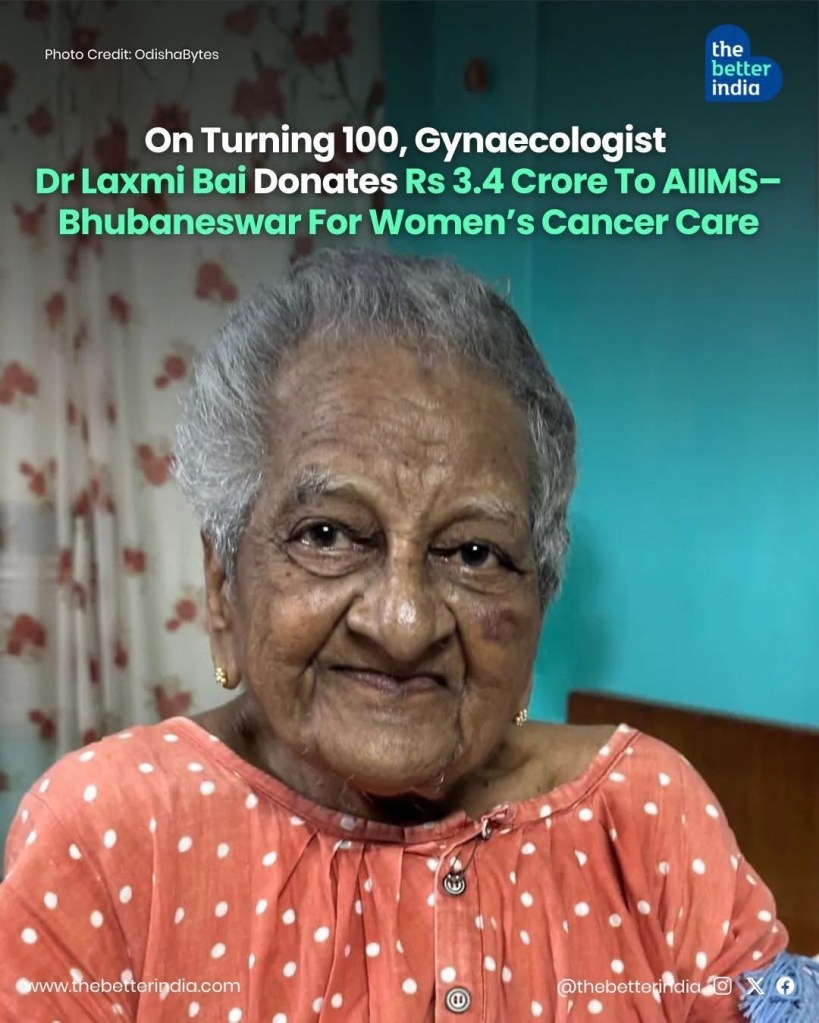
Picture it: December 5, 1926. A baby girl enters the world in a modest home in Odisha, her cries echoing against the thatched roofs of a newly independent India on the horizon. Little Laxmi, as her family called her, grew up in an era when girls were often whispers in the shadow of sons. Education? A luxury, not a given. Yet, her father, a schoolteacher with eyes like polished onyx, saw the spark in her. “Beta,” he’d say, ruffling her hair as they sat under the mango tree, “the world is a patient waiting for your cure. Don’t let anyone tell you your hands aren’t steady enough to hold the scalpel.” Those words? They were her North Star. By 1945, at just 19, she stepped into the hallowed halls of SCB Medical College in Cuttack—the very first batch of women in its MBBS program. The air buzzed with post-war dreams and the scent of formaldehyde. Classmates, mostly men with skeptical smirks, eyed her like an exotic bird. “A girl in medicine?” one quipped during anatomy class. Laxmi, undaunted, flashed a grin sharper than any lancet. “Watch me, bhaiya. I’ll deliver more than just lectures—I’ll deliver life.”
Those five years at SCB were a crucible. India was fracturing into freedom, but inside the lecture theaters, Laxmi was forging her own. She pored over textbooks by lantern light, her fingers ink-stained and calloused from dissections. Graduation in 1950 wasn’t just a degree; it was defiance. “I felt like I was birthing myself,” she later reflected in a rare interview, her voice a soft lilt laced with laughter. But the real labor pains came next. Odisha’s rural clinics were battlegrounds—women arriving on bullock carts, faces etched with pain, stories spilling out like monsoon floods. Childbirth without mercy, infections without antibiotics, taboos that chained bodies and spirits. Laxmi dove in headfirst, specializing in obstetrics and gynecology, the sacred ground where life begins and all too often, hangs by a thread.
By 1958, she’d conquered Madras Medical College, earning her DGO and MD in Obstetrics & Gynecology. Those years in the south were electric—nights stitching dreams back together in overcrowded wards, days mentoring wide-eyed interns. “Teaching isn’t about facts, it’s about fire,” she’d tell them, her sari sleeves rolled up, hands steady as she guided a forceps delivery. One stormy evening in 1962, a young fisherwoman named Sita burst into the labor room, her husband pacing like a caged tiger outside. “Doctor-ji, the baby… it’s not coming. The gods have cursed us,” Sita gasped, sweat beading on her forehead like dew. Laxmi knelt beside her, wiping her brow with a cool cloth. “Shh, Sita-di. Gods don’t curse; they test. And you? You’re stronger than any storm. Breathe with me— in, out, like waves on our shore.” Hours blurred into a symphony of grit and grace. The baby—a squalling boy with lungs like bellows—arrived at dawn. As Sita cradled him, tears carving rivers down her cheeks, she whispered, “You didn’t just save us, Doctor. You made me believe I could save myself.” Laxmi squeezed her hand, eyes twinkling. “That’s the secret, di. Every woman carries a healer inside. I just help her wake up.”
Decades unfurled like a well-loved scroll. Dr. Laxmi rose through the ranks at MKCG Medical College and Hospital in Berhampur, where she eventually retired, her retirement more a pause than a full stop. Over five luminous decades, she touched thousands—midwifing miracles in mud-floored huts, advocating for women’s dignity in hushed society drawing rooms. She battled not just disease, but despair: pushing for accessible care in a land where poverty and patriarchy conspired against the vulnerable. “Healthcare isn’t a privilege,” she’d thunder at conferences, her petite frame belying a voice like rolling thunder. “It’s a right, wrapped in compassion. How can we heal bodies if we ignore the hearts?” Her clinics became sanctuaries—places where whispers of shame turned to roars of empowerment. Patients didn’t just leave cured; they left changed, carrying her mantra: “Your body is your temple. Guard it, but don’t fear its stories.”
And then, as the calendar flipped toward 2025, whispers of her birthday stirred. Turning 100? In Bhaba Nagar, where she still tends a garden of marigolds and memories, friends plotted parties. But Laxmi? She had other plans. For years, she’d squirreled away every paisa—eschewing luxuries, investing in the future. Rs 3.4 crore, a fortune born of frugality and fierce purpose. On November 30, just days shy of her centenary, she summoned the director of AIIMS Bhubaneswar to her sunlit drawing room. Tea steamed on the table, the air thick with the aroma of cardamom and resolve. “I’ve watched too many daughters dim before their time,” she said, her eyes—still sharp as a resident’s scalpel—locking onto his. “Cancer doesn’t discriminate, but we can. Take this, all of it. Build a Gynaecological Oncology Programme. Train the healers who’ll come after me. Let it be a beacon—not for my name, but for every woman who fights in the dark.”
The director, a man accustomed to grand gestures, found himself speechless, then teary. “Dr. Bai, this… this will save lives. But why now? Why everything?” She leaned forward, a mischievous smile creasing her face like well-worn silk. “Why not now? I’ve had my century of sunrises. It’s time for theirs. And beta,” she added with a wink, “if you skimp on the training, I’ll haunt your wards. Promise me: hope first, always.”
As December 5 dawns—today, in fact—Dr. K. Laxmi Bai won’t be blowing out candles. She’ll be in her garden, perhaps humming an old Odia lullaby, plotting her next quiet uprising. A pioneer who shattered glass ceilings with gentle hands, a healer who turned savings into salvation. In her, we see not just a doctor, but a daughter of the soil who reminds us: true legacy isn’t measured in years, but in the lives we light along the way. Happy birthday, Doctor. The world is healthier for it.
Ripples of Grace: How Dr. Laxmi Bai’s Gift is Already Reshaping Lives
In the quiet hum of Bhubaneswar’s AIIMS corridors, where the air carries the faint tang of antiseptic and hope, Dr. K. Laxmi Bai’s donation isn’t just a number—Rs 3.4 crore—it’s a lifeline unfurling. Handed over in late November 2025, just days before her 100th birthday on December 5, this fortune from a lifetime of quiet thrift has already begun to stir waves. Picture the scene: a simple cheque presentation in her sun-dappled drawing room in Berhampur, the director of AIIMS Bhubaneswar, Dr. Ashutosh Biswas, clasping her frail yet firm hands. “Dr. Bai,” he said, voice thick with emotion, “this isn’t charity. It’s a revolution in a envelope.” She chuckled, her eyes crinkling like well-read pages. “Beta, revolutions start small. Just make sure it reaches the ones who whisper their pain in the dark.”
The heart of her vision? A dedicated Gynaecological Oncology Programme at AIIMS Bhubaneswar, laser-focused on the cancers that claim so many women in Odisha—cervical, ovarian, uterine—silent predators fueled by late diagnoses and scarce resources. In a state where over 5,000 women face gynecological cancers annually, and survival rates hover below 50% for advanced cases due to limited specialized care, this gift plugs a gaping hole. “I’ve held too many hands that slipped away too soon,” Laxmi confided to a cluster of former students gathered for tea post-donation. “This money? It’s their echo. Use it to train hands that won’t let go.”
Training Tomorrow’s Warriors
Right out of the gate, the funds are fueling a fellowship program for budding oncologists and gynecologists—think 10-15 spots annually, hands-on training in robotic surgeries, chemotherapy protocols, and palliative care tailored to rural realities. AIIMS, already a beacon with its 1,000+ beds and cutting-edge oncology wing, lacked depth in women’s cancers. Now, with Laxmi’s seed, they’re launching workshops starting January 2026, partnering with global names like Johns Hopkins (where she once studied herself). “We’ll bring in experts from Delhi and abroad,” Dr. Saubhagya Kumar Jena, Head of Obstetrics & Gynecology at AIIMS, shared in a press note. “Dr. Bai’s gift means we can subsidize training for underprivileged residents—turning knowledge into action.” Imagine a young doctor from a Koraput village, wide-eyed in scrubs, mastering a laparoscopy that could save her own sister’s life. That’s the multiplier effect: one trained healer cascades to hundreds in Odisha’s underserved districts.
Hands-On Help for the Hidden Fight
But it’s not all lecture halls and lab coats. A chunk—estimated at Rs 1 crore—will bankroll direct patient aid: subsidized screenings, HPV vaccinations for at-risk adolescents, and free chemo cycles for low-income women. Laxmi didn’t stop at AIIMS; she slipped an extra Rs 3 lakh to the Berhampur Obstetrics and Gynaecology Society for a vaccination drive targeting 1,000 girls in Ganjam district alone. “Cancer whispers in our villages,” she told the society secretary, Indira Pal, over a phone call buzzing with excitement. “Vaccines shout back. Make it happen before they turn 15.” Early projections? This could slash cervical cancer incidence by 70% in vaccinated cohorts, per WHO benchmarks, sparing families the gut-wrench of watching daughters fade.
Broader Echoes: Inspiration in Motion
Even before the ink dried on the transfer papers (formalized in April 2025 but revealed publicly in November), the story rippled. Neighborhood whispers in Bhaba Nagar turned to national headlines, sparking a mini-philanthropy wave—donations to local cancer funds jumped 20% in Odisha last week, per state health reports. “She’s not just giving money; she’s giving permission to dream big,” said Kailash Chandra Panda, a retired teacher and her neighbor, as marigold garlands festooned her gate for a low-key pre-birthday fete. At AIIMS, staff morale soared; one nurse quipped during rounds, “Dr. Bai’s ghost is already in the wards—reminding us why we fight.”
Of course, true impact unfolds slowly, like a monsoon building. By mid-2026, expect the first cohort of Laxmi-trained fellows to hit clinics, potentially boosting early detection rates by 30% in Bhubaneswar’s catchment area. Lives saved? Hundreds in the first year, thousands over a decade. “Metrics matter, but hearts heal too,” Laxmi mused to a journalist the day after the handover, sipping filter coffee with the poise of a woman half her age. “Tell the women: You’re not alone. This is for you.”
She could have used the years to rest. Instead, she chose to heal.
At nearly 100, Dr K Laxmi Bai gifted her entire life’s savings, Rs 3.4 crore, to AIIMS Bhubaneswar to build a gynaecological oncology unit for women battling cancer across Odisha and beyond.
Born in 1926, Dr Laxmi Bai was in the first MBBS batch at SCB Medical College, Cuttack. She later earned her DGO and MD from Madras Medical College and went on to pursue an MPH at Johns Hopkins Hospital in the USA, an extraordinary achievement for her time.
For more than five decades, she served women with care and dignity, from government hospitals in Sundargarh to teaching at MKCG Medical College, Berhampur, where she retired as professor in 1986.
Now, as she steps into her 100th year, her gift is shaping a future where more women receive timely, specialised cancer care. Her only wish is that this contribution trains future doctors and offers hope to countless lives.
Some call it charity. The world will remember it as a legacy.
DrLaxmiBai #AIIMSBhubaneswar #WomensHealth #CancerCare #Odisha #PositiveNews
[Dr Laxmi Bai, AIIMS Bhubaneswar, cancer care, Odisha, Positive News, Inspiring Senior Citizens]
As December 2, 2025, dawns—just three days shy of her century mark—Dr. Bai tends her garden, pruning roses with the same precision she once wielded in the OR. Her donation? It’s no fairy tale ending; it’s the plot twist where one woman’s thrift becomes a thousand women’s tomorrow. In Odisha’s resilient spirit, it’s blooming already.


 deemagclinic
 deemag and chest clinic