
In the shadow of the Taj Mahal, where the Yamuna whispers secrets of enduring love, Agra has always been a city of quiet miracles. It was here, in the late 1940s—precisely 30. June 1949 if family lore holds true—that Dr. Arun Nagrath entered the world, not with a cry, but with the steady rhythm of a heartbeat that would one day save countless others. Born to the legendary Prof. S.P. Nagrath, a towering figure in tuberculosis and chest diseases whose lectures could hush a room like a stern but loving father, young Arun grew up in a home where medicine wasn’t just a profession—it was the air they breathed.
Picture a boy in starched shorts, perched on the edge of his father’s worn leather armchair in their modest Civil Lines bungalow. The room smelled of old books, antiseptic, and the faint tang of pipe tobacco. “Beta,” Prof. Nagrath would say, peering over his spectacles at a chest X-ray splayed across the dining table, “the lungs are like the soul—fragile, but fighters. Treat them with respect, and they’ll thank you.” Arun, wide-eyed and scribbling notes on scrap paper, would nod solemnly. “But Papa,” he’d counter, his voice piping up with that spark of curiosity, “what if the fight’s already lost? Do we give up?” His father would chuckle, ruffling the boy’s hair. “Never give up, Arun. That’s the oath we take—not just for patients, but for life itself.” Those evenings, lit by a single bulb swinging like a pendulum, planted the seeds of a healer who would carry his father’s legacy like a stethoscope around his neck. Dr U Malviya writes” His fàther Prof Dr. Nagrath was incharge of Tuberculosis center, Agrà Medical college during my student period 1956 to 1961.
I learned every detail of Tuberculosis from him during my posting in TB center under Dr.. Nagrath (Dr. Arun’s fàther)
Dr. Nagrath was very good teacher and very good person…”
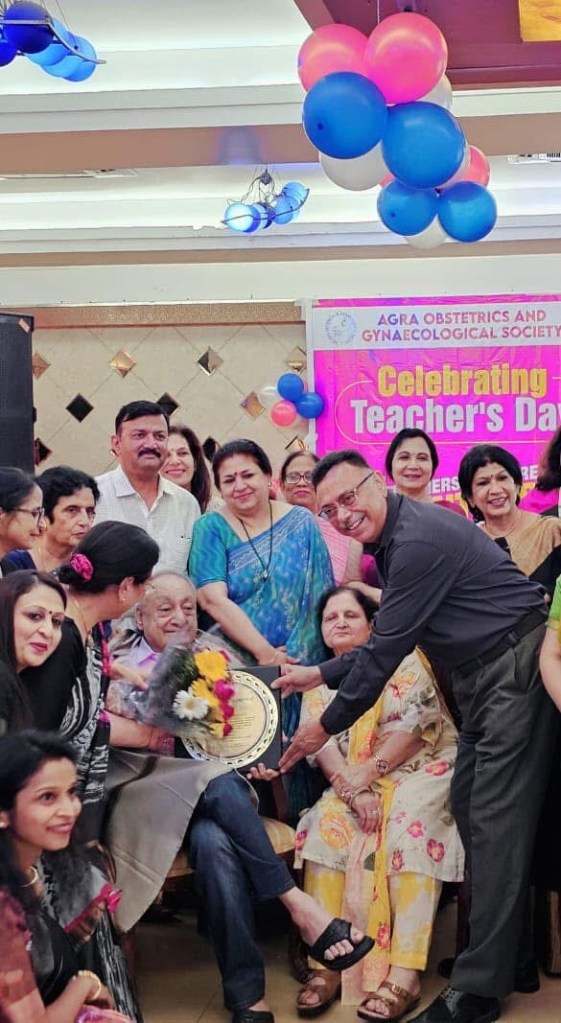
He did his intermediate from B R inter college. Prior to that he joined St. Peter’s College in Agra were a whirlwind of cricket matches on dusty grounds and late-night cramming under the mango tree in the backyard. Arun wasn’t the star batsman or the poet laureate; he was the boy who bandaged scraped knees during recess and debated biology with his teachers over chai. “You’re too soft-hearted for this world,” one nun chided him after he spent recess consoling a homesick classmate. “Sister,” he shot back with a grin, “soft hearts make the strongest doctors.” Dr S P S Chauhan writes “He was my classmate in inter he cleared pmt 1967 after inter but I was under age”. By the time he stepped into S.N. Medical College—right there in Agra, not the bustling lanes of Lucknow as some tales mistakenly wander—Arun was ready. The college’s echoing corridors, with their marble floors cool underfoot, became his proving ground. Dissections at dawn, endless rounds in the humid summer wards, and the weight of first-year exams that felt like battles. Yet, Arun thrived, his father’s words echoing: Fight, but with compassion.
Graduation brought not just a degree, but a calling. Specializing in gynecology and obstetrics, Dr. Arun Nagrath stepped into Agra’s medical fray with the gentle authority of someone who’d seen both fragility and ferocity in the human spirit. His clinic on Fatehabad Road, a modest space tucked amid the honk of rickshaws and the scent of street-side jalebis, became a sanctuary for women navigating the sacred chaos of motherhood. Patients remember him not for his white coat, but for his voice—calm, like the Yamuna at dusk. “Breathe with me, didi,” he’d say to a laboring mother, his hand steady on hers. “This pain? It’s the door to your miracle. You’re stronger than you know.” One evening in the mid-1980s, as the sun dipped behind the Taj, a young first-time mother gripped his arm during a stormy delivery. “Doctor saab, I can’t… it’s too much!” she gasped. Arun leaned in, his eyes kind but unyielding. “You already are, beta. Look—your little warrior’s almost here. Push like you’re telling the world, ‘This is my story.'” And with that, cries filled the room, a new life amid the thunder. Stories like these weren’t rare; they were Arun’s daily poetry.

But life, like medicine, demands balance. In 1975, Arun found his own anchor in Dr. Manju Nagrath, a fellow healer whose sharp mind and warmer smile could disarm the grumpiest consultant. Their wedding, a simple affair in an Agra temple fragrant with marigolds and incense, was less pomp and more promise. “Manju,” Arun whispered as they circled the fire, the flames dancing in her eyes, “you’re the steady pulse I’ve been waiting for.” She squeezed his hand, her voice a teasing lilt. “And you’re the adventure I signed up for, Arun. Just don’t forget—doctors make the worst patients.” Their union was a partnership of equals: two white coats hanging side by side, sharing midnight consultations over filter coffee and debating the ethics of late-night house calls. Manju, with her expertise in pediatrics, often joked that Arun’s gynecology rounds were “just baby prep,” while he’d retort, “And yours are the victory lap!”
Family grew as naturally as their love. Two sons arrived like plot twists in their story—first, the elder, charting his own path, and then Rahul, the dental surgeon who’s carved out a niche in Agra’s bustling clinics. Rahul’s practice at Sri Balaji Dental Clinic, just a stone’s throw from his father’s world, hums with the precision of implants and crowns, but it’s laced with the same warmth. “Dad,” Rahul once said over a family dinner of aloo parathas and laughter, as a toddler tugged at his sleeve, “you taught me teeth are just bones with stories. Fix the story, and the smile follows.” Arun beamed, clapping his son on the back. “That’s the Nagrath way, beta—no daughters to spoil us soft, but sons to keep us sharp.” No little girls twirling in frocks for this household, but the home echoed with the robust energy of boys turning into men, all under the watchful eyes of parents who led by quiet example.

Decades on, Dr. Arun Nagrath remains a fixture in Agra’s medical tapestry—now in his seventies, his hands still steady, his counsel sought from Delhi to beyond. He’s weathered hospital politics, the 2024 consumer disputes that tested his resolve like a fever breaking, and the endless evolution of medicine. Yet, he stays rooted, practicing from 4/16 Lala Lajpat Rai Marg in Civil Lines, where the Bagh Farzana breeze carries tales of lives touched. “Why Agra?” a young intern once asked him during a quiet afternoon round. Arun paused, gazing out at the eternal marble dome in the distance. “Because home isn’t a place, gamma—it’s the people you heal. And here, I’ve healed enough to fill a lifetime.”
In a world of fleeting headlines, Dr. Arun Nagrath’s biography isn’t etched in stone—it’s written in heartbeats, in the grateful squeezes of hands post-delivery, in the dialogues that bridge fear and hope. Son of a professor, husband to a partner in healing, father to sons who carry the torch—he’s the unsung rhythm of a city that knows beauty in endurance. And if you listen closely, amid the Yamuna’s murmur, you’ll hear his voice: “Fight with compassion. The miracle’s always just one breath away.”
Picture the lecture hall on a sweltering afternoon in 1982: ceiling fans whirring lazily, wooden benches creaking under the weight of aspiring doctors scribbling notes. Dr. Nagrath, a man of medium build with salt-and-pepper hair neatly combed back and wire-rimmed glasses perched on a kind, weathered face, would stride in carrying a worn leather satchel stuffed with dog-eared textbooks and handwritten charts. Fair, savvy and smart always surrounded by girls of obg he looked all bit a character artist from Hollywood. His voice, steady and warm like a fireside storyteller’s, cut through the humidity. “Bhed Chhal,” he’d begin, referencing to everyone trying to join medicine, surgery or Gynaecology. There are new specialities coming up with plenty of potential. But Arun wasn’t one for dusty relics. With a wry smile that crinkled the corners of his eyes, he’d lean on the podium, adjusting his crisp white coat, and pivot: “The world needs doers, not deceivers. We’ve got surgeons slicing away problems and physicians prescribing away symptoms. It’s time to chase the horizons: radiology that sees through flesh, cardiology that mends broken hearts, oncology that defies death itself. Specialize in the new, or you’ll be left treating echoes of the past.”
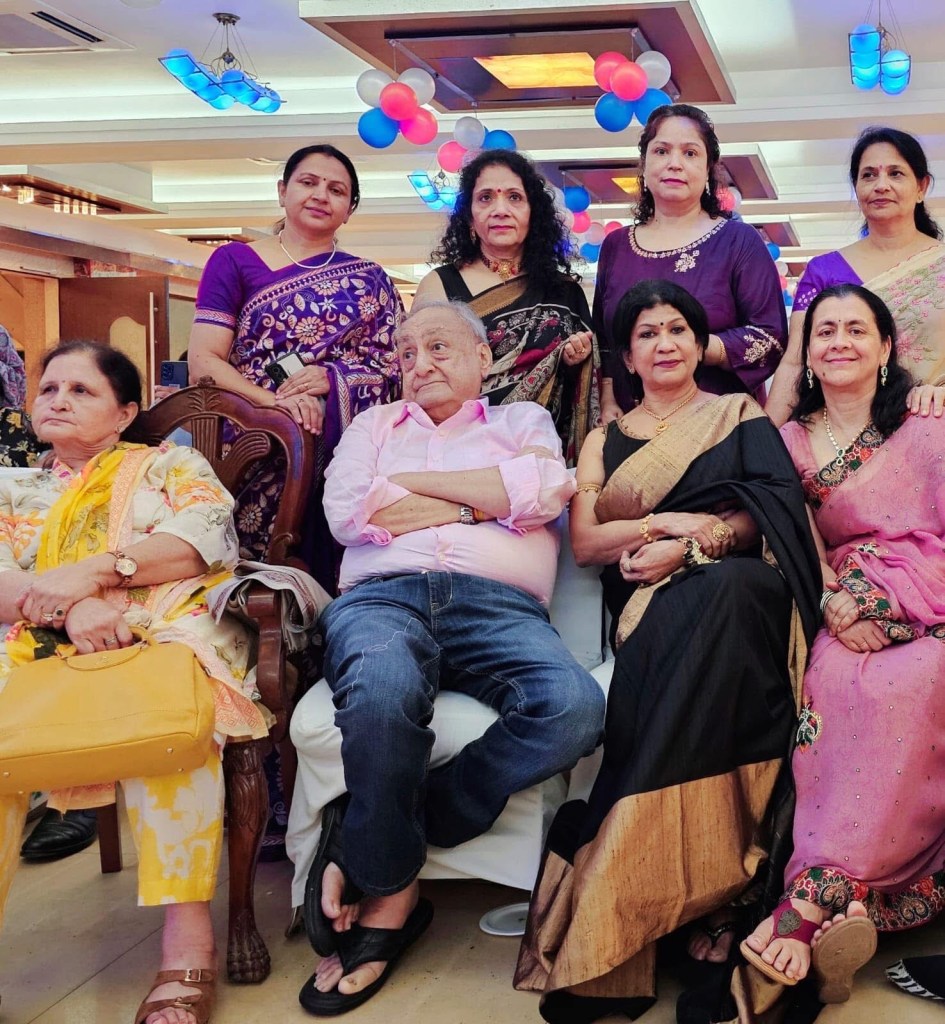
Dr. Gupta remembers one such lecture vividly, when a heated debate erupted over traditional versus emerging specialties. A fellow student had argued for sticking to “pure” medicine, dismissing radiology as “soulless machines.” Arun paused, his dark eyes twinkling with that signature mix of patience and mischief. He pulled out a faded black-and-white photograph from his satchel—a snapshot from his early days, showing him in a starched shirt, standing beside his wife, Meera, at their wedding in 1972. Meera, with her radiant smile and simple saree, held a stethoscope like a talisman; she was a nurse who’d become his lifelong partner in the wards. “Look here,” Arun said, passing the photo around. “This isn’t just a picture—it’s proof. Meera and I started in these halls, elbow-deep in the old ways. But see that spark in her eyes? That’s the future calling. I could’ve stayed a generalist, patching wounds in the ER. But I chose OBGYN because it lets me bring life into the world, not just mend it. And you? Don’t settle for enough specialists—be the one who invents the next. Bhed Chhal might fool the patient for a day, but innovation heals for a lifetime.”
Those words stuck with Dr. Gupta, who later credited Arun’s nudges toward psychiatry as the spark for his own career. Arun’s classes weren’t rote recitations; they were conversations laced with humor and humanity. He’d share tales from the delivery room—whispered stories of midnight births under flickering bulbs, where a mother’s grip on his hand was the real lifeline. “Medicine isn’t about the scalpel,” he’d quip, “it’s about the soul behind it.” Students adored him for his accessibility; after lectures, he’d linger in the courtyard, sipping chai from a clay kulhad, counseling the anxious or debating ethics with the bold. One evening in 1985, as fireflies danced in the college gardens, he confided in a small group, including young Gupta: “I came from nothing—worked to afford books. Now, I teach because every one of you is a chance to rewrite that story. But remember, heal the whole person, or you’re just a mechanic in a white coat.”
.
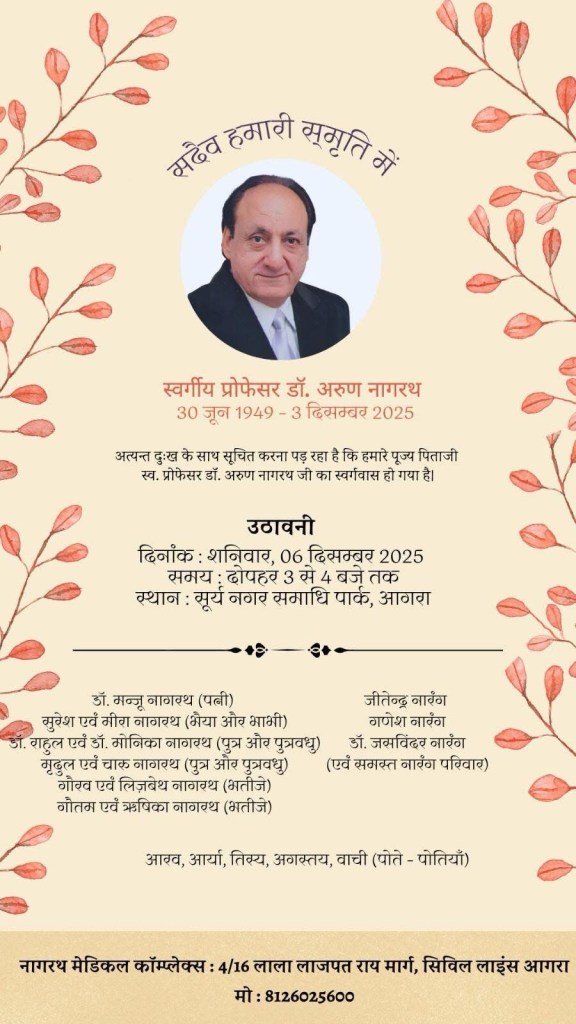
On December 2, 2025, Agra awoke to a somber hush. Dr. Arun Nagrath, aged 82, passed away peacefully at his home in Civil Lines, surrounded by the family he’d built and the books that had shaped him. The cause was a sudden cardiac event, post CRF, a cruel irony for a man who’d spent decades mending hearts—literal and figurative. News rippled through alumni networks like a stone in the Yamuna: “Our guiding light dims,” one post read. His funeral at the family crematorium drew hundreds—former students, nurses, patients clutching faded thank-you notes.

Obituary
Prof. Dr. Arun Nagrath
With profound grief and sorrow, we regret to announce the sad demise of our beloved Prof. Dr. Arun Nagrath, former Head of the Department of Obstetrics and Gynaecology at S.N. Medical College, Agra, and Rural Institute of Medical Sciences, Saifai.
The Shavyatra will proceed to Tajganj Crematorium from the family residence at 4/16 Bagh Farzana, Agra, on Wednesday, 3rd December 2025, at 2:00 p.m.
He is survived by his loving family:
- Wife: Dr. Manju Nagrath
- Bhaiya and Bhabhi: Suresh and Meera Nagrath
- Son and Daughter-in-law: Dr. Rahul and Dr. Monika Nagrath
- Son and Daughter-in-law: Mridul and Charu Nagrath
- Nephew: Gaurav and Lizbeth Nagrath
- Nephew: Gautam and Rishika Nagrath
- Grandchildren: Aarav, Arya, Tisya, Agastya, Vachi
For inquiries, please contact: 8126025600
May his soul rest in eternal peace.
Dr. Arun Nagrath wasn’t a headline maker; he was a heartbeat in the rhythm of medicine—a man who humanized the white coat, urging us toward specialties not just of the mind, but of the soul. In an era of rapid tech and fleeting cures, his legacy endures: Teach boldly, heal wholly, and never stop chasing the new. As the Taj gleams eternally across the river, so does Arun’s wisdom—timeless, gentle, profound. Om Shanti.


 deemagclinic
 deemag and chest clinic