
Dr. Kishore Panjwani’s life was a testament to quiet resilience, boundless compassion, and an unyielding spirit that turned personal battles into sources of inspiration for others. Born in the mid-20th century into a family with medical ties, Kishore grew up in the vibrant yet historic city of Agra, India. His cousin, Khem Chand Panjwani, was already paving the way in medicine as a batch mate of Dr. P.K. Gupta at Sarojini Naidu (SN) Medical College in 1979. When Kishore was selected for MBBS at the same institution in 1980, he arrived as the immediate junior—a small, frail, and intensely serious young man who roamed the campus with a focused determination that belied his slight frame. Those who knew him then, like Dr. Gupta, recall a student whose earnest demeanor hinted at the profound dedication he would bring to his calling.
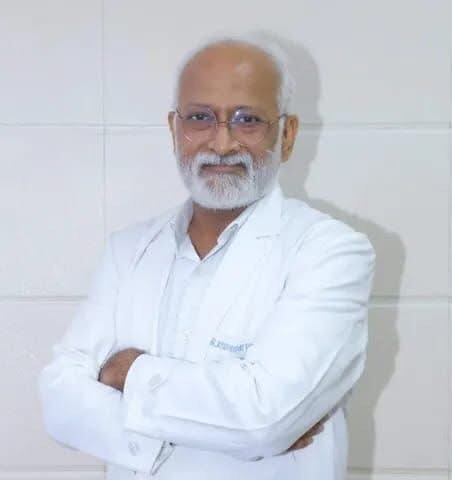
After completing his MBBS around 1985, Kishore pursued further specialization, earning his MS in General Surgery and later an MCh in Pediatric Surgery from the prestigious Banaras Hindu University (BHU). This path led him back to Agra, where he established himself as a revered pediatric and neonatal surgeon. Over a career spanning nearly four decades, he became a beacon of hope for families across Agra and neighboring districts. Working at institutions like Pushpanjali Hospital and Asopa Hospital, he performed intricate surgeries on the tiniest patients, earning a reputation for his gentle hands and empathetic bedside manner. Parents brought their children to him not just for his expertise in laparoscopic and general pediatric procedures, but for the reassurance he provided in moments of fear. In 2019, he even hosted a Pediatric Surgery Awareness Program, sharing his knowledge through talks and videos to demystify complex medical issues for the community.

But Kishore’s impact extended far beyond the operating room. In a city known for its majestic Taj Mahal, he founded a laughter club at Khel Gaon, a unique initiative that gathered doctors, locals, and people from all walks of life each morning. Drawing from the philosophy of laughter yoga, the club transformed tears into chuckles, helping participants combat stress and find joy amid life’s hardships. It was Kishore’s way of healing not just bodies, but souls— a reflection of his belief that medicine was as much about emotional upliftment as physical recovery. Friends and colleagues remember him as someone who could light up a room with his subtle humor, even as he navigated his own profound challenges.
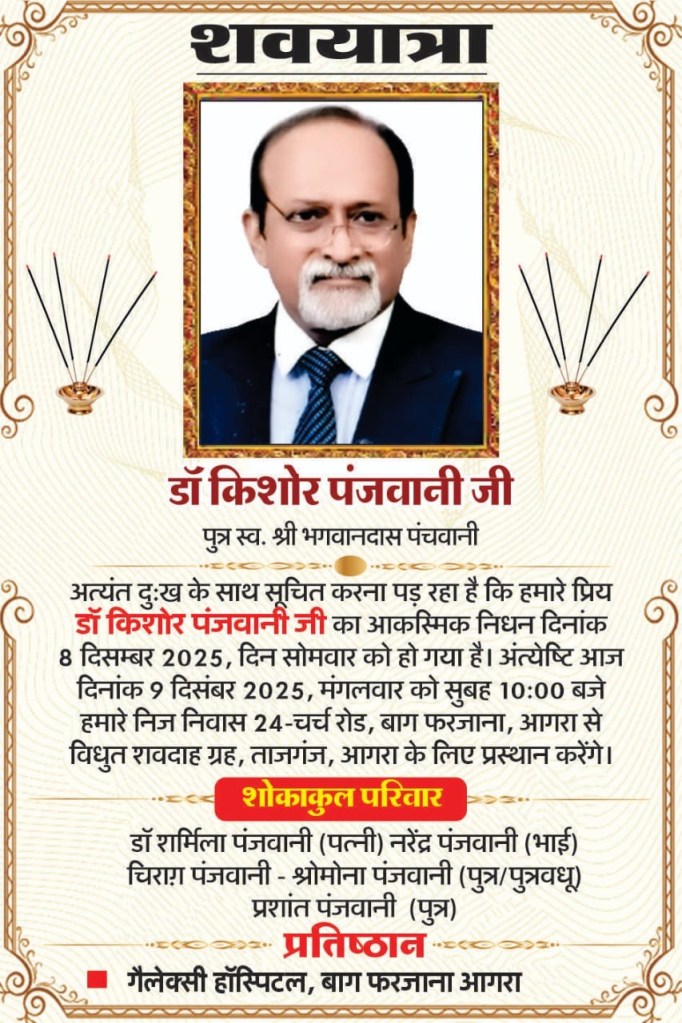
Dr. Kishore Panjwani: The Surgeon Who Made Even Death Laugh in Defeat
I am Dr. P.K. Gupta, one year senior to Kishore at S.N. Medical College, Agra – 1977 batch. He was 1978. Even in those hostel days everyone knew something was different about him. While the rest of us trembled during ragging, Kishore would squat like a murga, grin, and say, “Senior, ab to hans bhi lijiye – medical ki padhai mein hasi ki dawa hi sabse zaruri hai!”
That line still rings in my ears forty-seven years later.
Twenty-Two Years of Cancer – And Not One Day Without Laughter
2003: Penile cancer. Major surgery. When he came to see me afterwards, he laughed and said,
“P.K. sir, ab to main aadha aadmi reh gaya hoon… lekin aadhi hasi se poora Agra hasana baaki hai!”
2011: Oral cancer. A large part of his tongue gone. Speech became slurry, eating painful, but he never missed morning laughter club at Khelgaon. People would ask, “Doctor sahab, doesn’t it hurt?”
He’d reply slowly, “Hurts a lot… but laughter is the only painkiller with no side-effects.”
2012: Both kidneys failed. His wife, senior gynaecologist Dr. Sharmila Panjwani, donated one of hers without a second thought. From the recovery room he sent me a message:
“Sir, ab mere andar Sharmila ki kidney hai… matlab ab main aadha aurat ho gaya! Ab aur zor se hasunga!”
2021: Massive heart attack.
June 2025: Third cancer – again on the tongue. Radiotherapy in Delhi every week, but every weekend he would drag himself back to Agra to operate. His last surgery was on a one-day-old newborn with intestinal perforation. I met him just before he scrubbed in. His mouth was burnt raw from radiation, yet he whispered,
“Sir, that child will die if I don’t operate today. Meri jeebh jal rahi hai, par us bacche ki zindagi nahi jalni chahiye.”
He did the surgery. It was successful. As the nurses wheeled him out, he managed a masked smile and said,
“Tell the mother… from today her son will laugh because of me.”
The 28 Days That Could Not Break Him
I almost forgot the darkest chapter – most people deliberately do.
It was a sweltering afternoon in Agra back in the early 2000s—exact date lost to the haze of time, but locals still whisper about it—when Dr. Kishore Panjwani, a dedicated pediatric surgeon from SN Medical College’s 1982 MBBS batch, was en route to the hospital near Bhagwan Talkies. Fresh from completing his MCh in Pediatric Surgery at BHU, he was known in the city not just for his skillful hands saving tiny lives, but for his infectious laughter that could light up the gloomiest wards. “Laughter is the best medicine,” he’d often quip to his patients, channeling the spirit of Babu Moshay from the classic film Anand, even forming clubs to uplift cancer and kidney transplant survivors with group chuckles and stories. 15
But that day, fate took a dark turn. As his car slowed in traffic, a gang of dacoits—ruthless bandits from the Chambal ravines—swarmed him. “Get out, doctor! This is your unlucky day,” one growled, pistol in hand, as they yanked him from the vehicle and blindfolded him before he could react. 15 Dr. Panjwani, ever the fighter, tried to reason: “I’m just a healer, not a rich man. What do you want from me?” The leader laughed menacingly. “Your family knows your worth—crores in ransom, or we make sure you never operate again.” Bundled into a hidden lair, he endured 28 grueling days of captivity, chained and fed scraps, his mind racing with worries for his wife, Dr. Sharmila Panjwani, a gynecologist who’d later donate her kidney to save him in 2012. 15
Negotiations dragged on in secrecy. “Pay up, or he’s gone,” the dacoits demanded over hushed phone calls to his frantic family. Finally, after what felt like an eternity, a ransom was allegedly paid—details murky, as such tales often are in India’s underbelly—and Dr. Panjwani was released, stumbling into freedom, battered but unbroken. “I survived by telling jokes to myself in the dark,” he’d later share with friends, turning even that horror into a lesson in resilience. 15
It was sometime in the early 2000s—the exact date remains shrouded in mystery, as no public records pinpoint the precise day—when Dr. Kishore Panjwani, the beloved pediatric surgeon from SN Medical College in Agra, found himself in the clutches of Chambal’s notorious dacoits. En route to the hospital near Bhagwan Talkies, his routine drive turned into a nightmare. “Stop the car, doc! You’re coming with us,” barked the lead bandit, waving a rusty pistol as they dragged him out, blindfolding him in seconds. “What the hell is this? I’m a doctor, not some tycoon!” Kishore protested, his heart pounding, but the reply was cold: “Your life is worth crores to your family. Pay up, or forget about seeing them again.”
Held captive for an agonizing 28 days in a hidden ravine lair, he faced threats and deprivation, chaining him like an animal. “How much do you want? Let’s talk sense,” he’d negotiate during sparse interactions, trying to humanize his captors with stories of the children he’d saved. “Two crores, no less,” they’d demand, relaying the figure to his terrified family via clandestine calls. Whispers suggest the ransom was eventually paid—though the exact amount stays murky, likely in the range of crores to secure his freedom—but official details are scarce, buried in the era’s spotty reporting.
Released at last, Kishore stumbled back to Agra, vowing to turn the trauma into triumph. “I joked my way through the darkness,” he’d later confide to colleagues over chai, “telling myself punchlines to stay sane.” His ordeal, while undated in archives, became part of his legend—a testament to resilience amid India’s shadowy underbelly of crime.
Life threw more curveballs his way. Cancer struck first in 2003, attacking his genitals, but he beat it. It returned in his mouth in 2011—defeated again. A heart attack in 2021 required angioplasty, and kidney failure in 2012 led to that life-saving transplant from his devoted wife. Yet through it all, he kept practicing, helping the needy across Agra’s society, his laughter clubs a beacon of hope. 15 “Pain is temporary, but a good belly laugh? That’s eternal,” he’d say, inspiring patients battling similar demons.
Tragically, cancer reared its head once more in 2025, this time in his tongue, aggressive and unrelenting despite radiotherapy. On December 8, 2025, at Synergy Hospital in Agra, Dr. Panjwani passed away from the advanced stage of the disease, leaving the medical community in mourning. 15 “He fought like a warrior till the end,” a colleague reflected at his funeral, “always with a smile.” His story, a blend of heroism, humor, and heartbreak, reminds us that even in the face of bandits or illness, the human spirit can shine through—like a punchline in the darkest comedy.
- He had just finished a long surgery and was driving home in his old Fiat when four armed men forced him off the road near Sikandra. They kidnapped him, car and all.
For twenty-eight days he was kept blindfolded in a village hut near Aligarh, chained to a charpai, fed roti and dal once a day. The ransom demand was one crore – an impossible amount in those days for a government doctor. His family and the entire city of Agra lived in terror.
Every night the kidnappers would put a gun to his temple and say, “Call your rich friends again.”
Kishore would laugh – yes, laugh – and answer, “Arre bhaiya, main to garib doctor hoon, par hasi ke liye toh crore rupaye bhi de dunga. Ek joke sunau?”
They say one of the younger kidnappers actually started laughing with him on the fifteenth day.
On the twenty-eighth day the police raided the hideout after the ransom money was finally arranged. When they broke open the door, they found Kishore sitting cross-legged, telling the kidnappers the story of how he once made an entire OT laugh during a complicated surgery.
The first thing he asked the SHO was, “Inspector sahab, aap log itne din kahan the? Main to in logon ka laughter therapist ban gaya tha!”
That incident should have finished any man. It didn’t even slow Kishore down.
The Last Ten Days
Twenty-five days after his final radiotherapy session, he collapsed. The last ten days were spent at Synergy Plus Hospital. I sat by his bed two days before the end. He could barely speak.
He took my hand and whispered,
“P.K. sir… ab to mar jaane do… bahut hasa liya… thak gaya hoon.”
I choked. He managed one last crooked smile and said,
“Remember the ragging? You wanted me to become a full murga… aaj main sach mein poora murga ban gaya… lekin is baar senior Death hai.”
On the evening of 8 December 2025, he breathed his last.
Agra’s mornings are quieter now. But if you pass Khelgaon at six, you can still hear a few hundred people laughing out loud in perfect rhythm. They say it’s not their laughter any more – it’s his.
Kishore didn’t lose to cancer.
He laughed at it for twenty-two years, and when he finally decided he’d had enough laughs for one lifetime, he simply closed the show with the biggest smile of all.
For 23 years, Kishore waged a private war against testicular cancer, a battle that began around 2002 and tested the limits of human endurance. He faced multiple recurrences with stoic grace, overcoming each one through rigorous treatments. However, the aggressive therapies took a toll, leading to iatrogenic chronic kidney disease (CKD)—a condition caused by the very medications meant to save him. Undeterred, he underwent a renal transplant, emerging stronger and resuming his practice with renewed vigor. Patients marveled at his ability to treat them while managing his own health, often traveling to Delhi for care but returning to Agra to continue his work. Tragically, secondary metastases developed, turning the tide in this long fight. On December 8, 2025, Dr. Kishore Panjwani passed away at Synergy Plus Hospital in Agra, surrounded by the love of those he had touched. His death sent ripples of sorrow through the medical fraternity and the community he served so selflessly.
In the end, Kishore’s story is one of quiet heroism: a frail student who grew into a giant of compassion, a surgeon who mended hearts as well as bodies, and a fighter who laughed in the face of adversity. He leaves behind a legacy of healing, humor, and hope, reminding us that true strength often comes wrapped in humility. Though gone, his laughter club echoes on, a fitting tribute to a man who taught Agra how to smile through the storms.


 deemagclinic
 deemag and chest clinic