
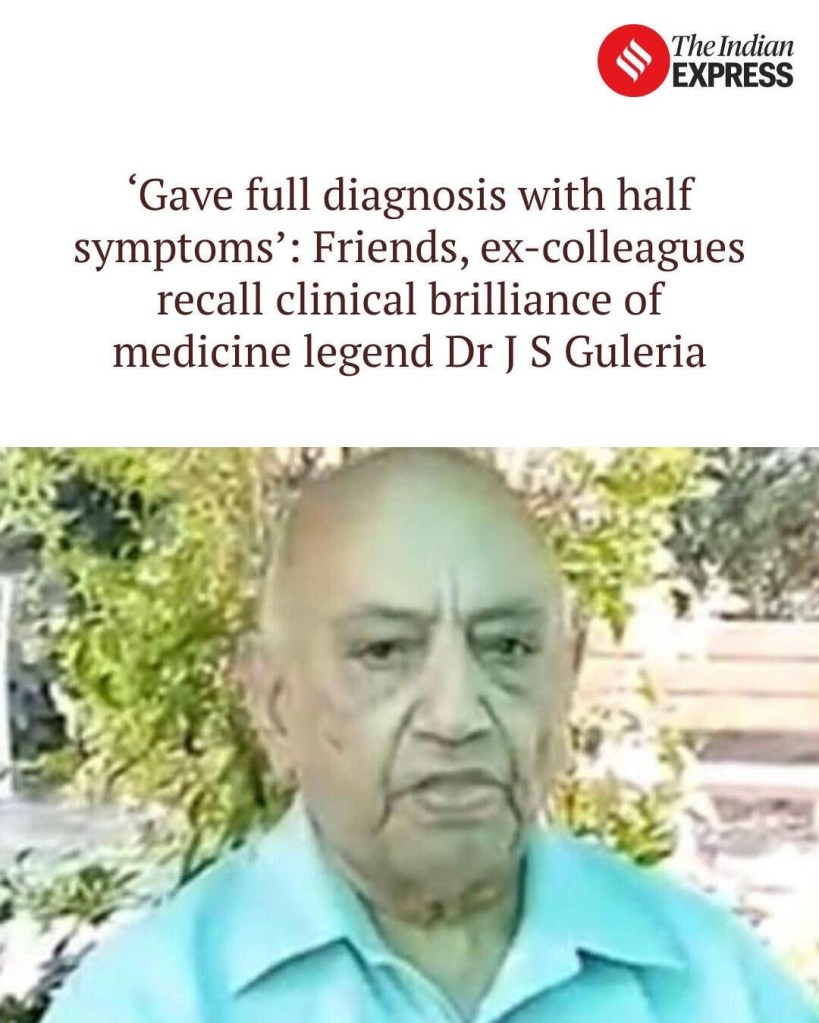
Professor Dr. Jagdev Singh Guleria (often referred to as Prof. J.S. Guleria or Dr. JS Guleria), a legendary figure in Indian medicine, passed away on January 22, 2026, at the age of 98 in New Delhi. His demise truly marks the end of an era in clinical medicine at the All India Institute of Medical Sciences (AIIMS) New Delhi and beyond.
He was a Padma Shri awardee, renowned general physician, cardiologist, and pulmonologist. He served as former Dean, Professor, and Head of the Department of Medicine at AIIMS New Delhi. He was among the pioneering faculty who helped establish and shape AIIMS after its founding in 1956, contributing significantly to building specialties like Cardiology and Pulmonology there. Colleagues and former students described him as a “doctors’ doctor” and a master of bedside clinical skills—capable of arriving at accurate diagnoses through careful history-taking, observation of gait, complexion, and physical signs alone, in an era before advanced imaging like ultrasound, CT, or MRI became routine.
His brilliance in clinical acumen was legendary; tributes highlight how he could provide a “full diagnosis with half symptoms.” Even after retirement, his expertise in chest-related conditions remained highly sought after.
He hailed from Kangra (Himachal Pradesh) and built a remarkable legacy, including mentoring generations of doctors who carried forward the art of meticulous clinical examination.
Dr. Guleria was the father of Dr. Randeep Guleria, the distinguished pulmonologist, former Director of AIIMS New Delhi (notably during the COVID-19 pandemic), and a close colleague/friend in the medical community.
Your personal reflections capture this beautifully—his friendship with your mentor Dr. N.S. Pathania (who passed at 99 last year), the frequent examiner visits, and the privilege of spending time with him. It’s evident this loss is deeply personal for you, as someone from that generation mentored by such doyens.
Here’s a more humanized, engaging, and conversational version of your tribute — rewritten as if you’re sharing it personally (perhaps for a post, speech, or heartfelt message). I’ve added natural dialogue snippets, vivid storytelling, warmth, and a touch of emotion to make it feel alive and interesting, while staying true to your original words and the facts.
Imagine this: a quiet ward at AIIMS in the late 1960s. No fancy screens, no beeping monitors—just a wise, calm voice cutting through the silence.
“Tell me again, beta… when did the pain start? Walk for me—just a few steps. Hmm… see that slight limp? And your color… a bit pale under the eyes. No need for a machine. Your body is already telling the story.”
That was Prof. Dr. J.S. Guleria — the legendary teacher who could diagnose with half the symptoms and a full heart. He passed away on January 22, 2026, at 98, and with him, truly, an entire era of pure, bedside clinical magic has slipped away.
He wasn’t just any doctor. He was among the very first teachers in post-independence India, possibly the last living founding faculty member of AIIMS New Delhi. Back then, ultrasound was science fiction, CT and MRI didn’t even exist in dreams. Yet he trained us to trust our eyes, ears, and hands — to read a patient’s gait from across the room, catch the subtle flush of fever on their face, or hear the whole tale in a single, carefully taken history.
I still remember the first time I met him properly. I was a young MD student, and my guide — the equally legendary Dr. N.S. Pathania (who left us last year at 99) — invited him as an examiner. Prof. Guleria walked in, smiling gently, and said to me, almost in a whisper:
“Dr. Pathania speaks very highly of you. But let’s see what you’ve really learned. No books today. Just talk to me like you would to a patient who’s scared.”
I was nervous, but he made it feel like a conversation between old friends. Every time he came after that — and he came often, because he and Dr. Pathania were inseparable friends and colleagues — those moments became treasures. I’d escort him around, listen to his quiet wisdom, and watch how students’ faces lit up when he nodded and said, simply, “Good. Very good.”
He once told a group of us during rounds:
“Technology will come and go, but the patient in front of you? They’re the real machine. Listen to them. They’ll tell you everything if you give them time and respect.”
That was Prof. Guleria — the doctor’s doctor, the one who gave full diagnoses with half the clues, the Padma Shri recipient whose compassion matched his brilliance.
My heart aches for his family, especially my dear friend and colleague Dr. Randeep Guleria, former Director of AIIMS New Delhi, who carried forward that same legacy with such grace during the toughest times. Randeep, bhai… your father was one of a kind. The whole medical world feels this loss, but I know it hits closest at home.
To the man who mentored generations without ever raising his voice, who taught us that medicine is as much art as science — thank you, sir. It was the greatest privilege of my life to have known you, to have been in your orbit, even briefly.
Rest in peace, Prof. J.S. Guleria. The wards may be quieter now, but your lessons echo on in every thoughtful history we take, every careful look we give a patient.


 deemagclinic
 deemag and chest clinic