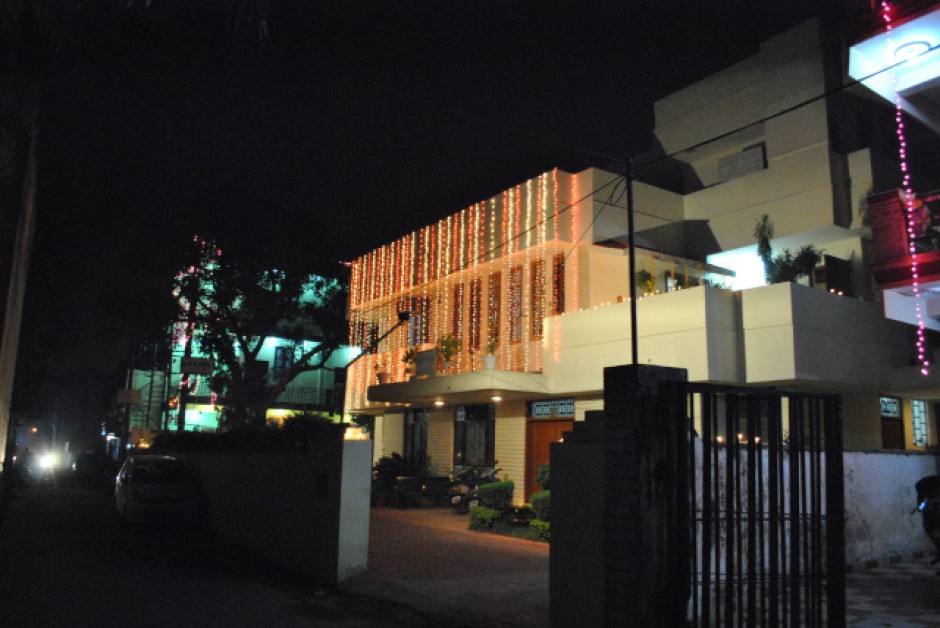
I was born into a middle-class joint family, affectionately known in the community as the “Bhatwara Wale.” On May 1, 1940, I came into the world in Bhatwara, a small village in Uttar Pradesh. However, fate had its own plans for us. Just a month after my birth, a major dacoity struck the village, forcing my entire family to relocate to Khurja, a nearby town. We rented a house there, famously called the “Calcutta House.” Though my birthplace was Bhatwara, for all practical and official purposes, Khurja became my hometown.
A Large and Vibrant Joint Family
Our family was large and deeply rooted in tradition. My grandfather, Late Shri Triveni Swarup, was the respected head of the household. He had five sons, my father Late Shri Har Saran Das being the eldest. At the time of my birth, my father and one of his brothers were already married, and as the years passed, our family expanded. My father had four sons and two daughters. Our house was always lively with conversation, bustling activities, and the comforting aroma of home-cooked meals.
Each of my uncles had their own families:
- Late Shri Keshav Saran: One son and one daughter.
- Late Shri Rameswar Saran: Six daughters and three sons.
- Late Shri Madhav Saran: Three sons and one daughter.
- Late Shri Pramod Saran: One son and one daughter.
Despite our differing personalities and aspirations, we were bound by strong familial ties.
My Father’s Journey as a Freedom Fighter & Entrepreneur
My father was a freedom fighter who actively participated in India’s struggle for independence. He was even jailed for his involvement. However, due to family pressure, he was released before serving a longer term. After leaving his studies, he turned to dairy business, initially running his business in Bhatwara before shifting to Khurja. His entrepreneurial journey took him to Ranikhet, Calcutta, and multiple military locations, where he supplied dairy products, primarily butter.
After Independence, communal tensions in Calcutta forced him to return to Khurja, where he expanded his dairy business. He later moved to Delhi, collaborating with his two younger brothers in expanding the business. Meanwhile, my third uncle took a different route—after earning a degree in science, he worked in a sugar mill in Sri Ganganagar. My youngest uncle, Late Shri Pramod Saran, pursued his studies in Delhi before joining the family’s dairy enterprise.
My Mother: The Pillar of Strength
My mother, Smt. Shanti Devi, embodied peace and resilience—true to the meaning of her name. After my grandmother’s passing, she became the backbone of our home, taking on immense responsibilities. Every morning, she prepared breakfast for over twenty family members, working tirelessly on a traditional chulah (clay stove), its smoke often bringing tears to her eyes.

She was remarkably patient, even when dealing with my short-tempered uncle, who would angrily throw his plate if meals were delayed. Regardless of her exhaustion, she would always rise to serve me food as soon as I returned from school. As a child, I suffered frequent illnesses—fevers, diarrhoea, and typhoid—and my mother’s unwavering care carried me through.
Sibling Stories and Unforgettable Childhood Moments
One of the most terrifying incidents in my childhood was when my younger brother, Naresh, fell gravely ill. A doctor prescribed penicillin, which, at the time, was a new and risky medicine. His fever dropped dangerously, and his pulse became undetectable. Panic filled our home. Traditional Ayurvedic doctors were called in, and they applied hot ash and herbal medicines. Miraculously, he survived. Years later, Naresh earned a PhD in Canada and settled in the United States, becoming a great source of pride for our family.

Each of my siblings carved commendable paths in life:
- Dr. Rajeshwar Saran Agarwal: A respected doctor who retired as Chief Medical Officer in Haryana.
- Naresh: Settled in the USA, leading a fulfilling and commendable life.
- Jai Kumar: Studied electrical engineering, specialized in instrumentation, and later launched his own successful company.
- Harsh Lata: Married Shri JK Gupta, an engineer in All India Radio, but sadly passed away due to sodium imbalance.
- My youngest sister: Married Dr. SC Agarwal, an eminent dermatologist, and now resides in Kanpur.
Memorable Events and Hardships
Life at home was filled with small yet unforgettable experiences. We kept three cows, and I took part in feeding and caring for them. One day, while tossing hay from the rooftop store, I lost my balance and fell nearly ten feet. A wire broke my fall, saving me from serious injury.

Another striking memory was the earthquake that shook our home late one night. I was sleeping on the top floor when the tremors knocked me off my bed. In panic, I rushed down the stairs, witnessing the devastation around town—including deep cracks in the newly constructed Reserve Bank building.
Final Reflections
In one summer, when most of the family had left town and only my grandfather and I remained at home, a kind Swamiji from the neighbourhood started cooking for us. He also taught me to make Dal and Roti. I still remember how proud I felt eating meals I had helped prepare, sitting beside my grandfather.
During those days electric fence were rare. I would sit by my grandfather at night, gently pulling a hand Pankha for hours while he slept. It was a satisfying moment for me.

Evenings at our home were a time for wisdom and discussion. My grandfather often hosted conversations with engineers, Ayurvedic doctors, and scholars from our village, debating politics and philosophy. Sitting in silence and absorbing their discussions awakened my early curiosity about the world.
The times we lived in were uncertain. After Independence, communal riots became a real fear, and my uncles and I stored stones on our rooftop in preparation for defense. Thankfully, we never had to use them.
One winter, a tragedy struck close to our home. A family in our neighbourhood sealed their room with a Chulah burning inside for warmth. By morning, four people had died of suffocation. I saw their bodies laid down outside the room – site too painful to forget.
The most defining moment of my childhood came with the assassination of Mahatma Gandhi. His ashes were sent across India so people could pay their respects. When I heard the train carrying his ashes was passing through Khurja, I walked four kilometers alone, determined to witness history. The station was overflowing, and among the crowd, I stood in awe as Gandhiji’s final journey passed by.


 deemagclinic
 deemag and chest clinic