
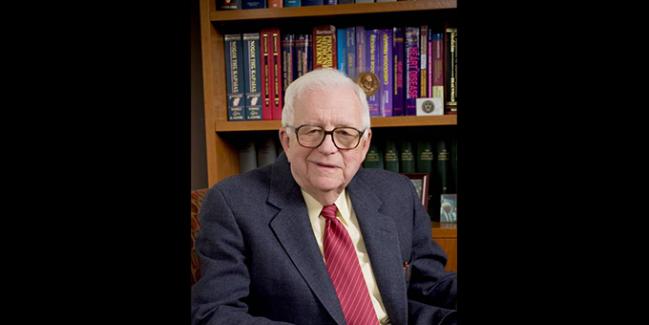
Eugene Braunwald, MD, who fled the Holocaust as a boy to become one of the most influential figures in cardiovascular medicine, died yesterday. He was 96.
Braunwald’s death was confirmed by Mass General Brigham, parent organization of Brigham and Women’s Hospital (Boston, MA), where he most recently held the title of Chief Academic Officer.
From his groundbreaking discovery that heart attacks are progressive events that can be stymied by quick intervention to his countless pivotal studies and textbooks published throughout his career, Braunwald leaves behind a legacy that will affect patients and practitioners alike worldwide.
“Braunwald came along just as [the field of cardiology] was getting active” said Thomas Lee, MD (Brigham and Women’s Hospital, Boston, MA, and Press Ganey), who wrote Braunwald’s biography, Eugene Braunwald and the Rise of Modern Medicine, in 2013. “The change was going to happen—and Braunwald was part of that, of course—but he rode the wave, he accelerated the wave as we went from being passive to active, and he did it with incredible effectiveness and brilliance.”
One of the biggest lessons Braunwald taught Lee was what it meant to make a contribution. “He epitomized what excellence really meant,” Lee said. “It was something more than writing a lot of papers and getting a lot of grant funding. What he taught us and the people who trained with him is to focus on a problem and never let go of that problem and keep coming at it from every angle. . . . It’s a path to being more resilient and gritty and to having a good career as opposed to just a good job.
Victor Dzau, MD (National Academy of Medicine, Washington, DC), who served as chief resident under Braunwald and eventually went on to succeed him as Hersey Distinguished Professor of the Theory and Practice of Physic at Harvard Medical School, remembered his mentor with great respect.
“He’s a giant and he’s an icon, and he’s left a gaping hole in medicine and humanity,” Dzau told TCTMD. “Much of Dr. Braunwald’s teaching, his mentoring, has enabled me to do what I’ve been able to do.”
Marc Sabatine, MD, MPH (Brigham and Women’s Hospital), current chair of the Thrombolysis in Myocardial Infarction (TIMI) Study Group, called Braunwald a “treasured mentor and good friend.” He told TCTMD: “While he touched many lives, we at TIMI were truly blessed to directly work with and learn from him over decades. There could be no greater gift. We will deeply miss him but gain some comfort in knowing that we will carry forward his legacy and continue his lifelong mission to advance cardiovascular care.”
Numerous professional groups, including the American Heart Association (AHA) and European Society of Cardiology, have released tributes to Braunwald as well.
Rising Through Adversity
Born in Vienna, Austria, on August 15, 1929, Braunwald and his family, who were Jewish, fled Nazi-occupied Europe with only “their shirts on their backs” in 1938. Braunwald and his younger brother Jack briefly lived on a farm in northern England before moving with his family to New York in 1939. According to the AHA, he considered a career in engineering as a high school student before his mother encouraged him to pursue medicine.
After graduating from high school as class valedictorian, he graduated magna cum laude from New York University with an AB. He stayed at NYU for medical school, where he was the youngest student admitted to his class, and also the last admitted given the quotas at the time for Jewish medical students. He graduated in 1952 earning the highest marks in his class as well as receiving the student research award.
He met his first wife, Nina Starr Braunwald, while a premed student at NYU, and both attended NYU medical school together. They were married in 1952 and had three daughters. Starr would go on to be the first female cardiothoracic surgeon to be board-certified by the American Board of Thoracic Surgery. She died in 1992.
Cardiology called because of how closely it mirrored the field of engineering, but it was during his final year in medical school, through a reluctantly accepted elective, that Braunwald discovered the cardiac cath lab—a rarity at the time. He completed his internal medicine and cardiology training at Johns Hopkins Hospital (Baltimore, MD) and did 2 years of clinical training at Mount Sinai Hospital (New York, NY). From there, he became a postdoctoral fellow in the laboratory of Nobel prize-winning André Cournand, MD, at Columbia University (New York, NY).
He began working at the National Heart Institute (now known as the National Heart, Lung, and Blood Institute) in 1955. Braunwald rose through the ranks to become first chief of cardiology in 1961 and eventually clinical director in 1966.
Through Nina, he met the late Andrew Glenn Morrow, MD, a man whom he would later call his “greatest mentor.” Together, in 1959, they published in Circulation about their experience with a mysterious condition now known as hypertrophic cardiomyopathy and continued to work together to analyze and treat this condition with many of their techniques still used today.
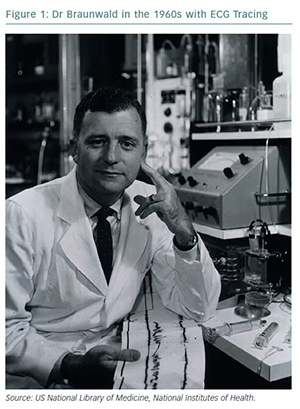
In 1968, he moved with his family to La Jolla, CA, where he served as the founding chair of the Department of Medicine of the new University of California, San Diego School of Medicine for 4 years. They moved back to the East Coast in 1972 when he was offered the oldest endowed medical chair at Harvard Medical School. At that time, his titles also included chair of the Department of Medicine, which he held until 1996, and physician-in-chief of the Peter Bent Brigham (now the Brigham and Women’s) Hospital.
Countless Contributions
Braunwald founded the TIMI Study Group in 1984, which he chaired until 2011. Known as one of the most prolific academic research organizations in cardiovascular disease, the TIMI group has published more than 70 prospective randomized trials to date, many of which have defined best practices for the care of patients with ACS, diabetes, dyslipidemia, heart failure, and peripheral artery disease.
Another of his pivotal contributions was the “time is muscle” discovery. In a 2019 article in European Cardiology Review, Braunwald remembered a pivotal clinical experience: “I saw the ECG of a patient with acute myocardial infarction showing changes that seemed to be associated with changes in blood pressure, which occurred over the course of several hours. I suspected there might be interventions that could be carried out in patients experiencing MI. The development of an infarction was comparable to a rheostat that could be turned up or down slowly, as opposed to a binary light switch.”
At UC San Diego, he showed that both the size of an MI and the damage it does can be reduced following the initial obstruction. “We showed that early reperfusion was key and the longer the heart is ischemic, the more heart muscle dies,” he wrote. “These experiments were performed before coronary angioplasty had been developed but, once this new technique was popularized, the concept of infarct size limitation was applied successfully to many patients.”
Braunwald was also the first to describe how to measure ejection fraction and showed the effect that angiotensin-converting enzyme inhibitors can have on prolonging life post-MI in patients with reduced EF. He was involved in the earliest studies showing that lower LDL is linked with reduced risk of MI or stroke.
Braunwald was a member of the National Academy of Sciences, and in 1996, Harvard created the Eugene Braunwald Professorship in Medicine as a permanently endowed chair. In 1999, the AHA created the annual Eugene Braunwald Academic Mentorship Award while Brigham and Women’s Hospital dedicated a 16-story tower in his honor in 2019.
He’s authored more than 1,600 publications, with his first peer-reviewed paper appearing in Circulation Research in 1954. He was editor-in-chief of several editions of the leading textbook in internal medicine, Harrison’s Principles of Internal Medicine, and he was founding editor of Heart Disease, a textbook that is now known as Braunwald’s Heart Disease and is in its 13th edition.
Braunwald was known to be a great lover of music and always had classical pieces playing while he worked. He was a passionate fan of opera—perhaps spurred by the fact that his parents met in the standing-room-only section of the Vienna Opera—and during medical school, worked as an extra at the Metropolitan Opera in New York. Braunwald remarried, to Elaine Smith, who was a former chief operating officer at Brigham and Women’s Hospital. He is survived by his three daughters (Karen, Allison, and Jill), seven grandchildren, and multiple great-grandchildren.
A ‘Thoughtful’ Mentor
Lee also remembers Braunwald for being a flexible mentor. “I think it’s because he had such a fluid growing-up experience, fleeing one country and coming to another, making his way in the world despite Jewish quotas and all sorts of other barriers. He was open to everyone and everything,” he said.
Dzau agreed. In Lee’s book, Dzau is quoted as urging Lee to come to train with him, saying Braunwald “wouldn’t care if you were purple” and that he’d find success if he worked hard. He told TCTMD that Braunwald was a “thoughtful” advisor who was not only generous with his time but also his resources.
“The biggest lesson he taught me is always think about what’s important and find a way to get it done, and don’t let distractions and naysayers prevent you from doing it,” Dzau said. “But always do it, of course, with a lot of diplomacy and thoughtfulness.”
Braunwald understood the power he wielded but never used it for the sake of using it, Lee said, adding that those who worked closely with him also got to witness his humor and “wonderful sense of irony.” Additionally, “because he was such a believer in meritocracy, he ended up being very supportive of women in medicine.”
Elizabeth Nabel, MD (ModeX Therapeutics and OPKO Health, Miami, FL), trained under Braunwald and went on to serve as president of Brigham and Women’s Hospital and director of the National Heart, Lung, and Blood Institute. She called him the “father of modern-day cardiology,” and credits him with launching her career.
“There probably is no other figure who had such a major substantial impact on cardiovascular science, research, medicine, and therapeutics than Gene Braunwald,” Nabel told TCTMD. “He trained hundreds of individuals, but more importantly, his work influenced the practice of cardiology throughout the world for decades. It’s really with a sad heart that I mourn his loss.”
Speaking specifically to his promotion of women and immigrants in medicine, Nabel called Braunwald “extremely supportive” and always willing to give wise advice.
Through it all, Braunwald was motivated by curiosity. “The questions change,” Braunwald once said. “They’ve become bigger questions. . . . I think this is a very exciting time in cardiology and I wish I could keep going, because it’s so interesting.”
Todd Neale contributed to the reporting for this obituary.


 deemagclinic
