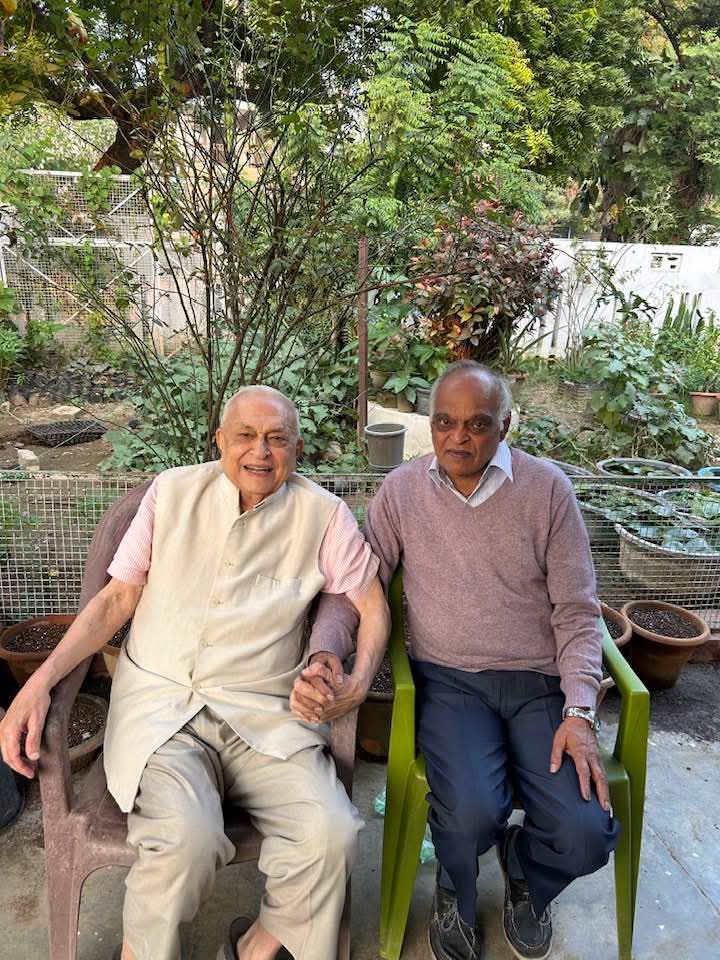
A chance meeting with a distinguished medical personality can sometimes become an opportunity to revisit the history of an entire institution. Meeting Padma Shri Dr. Mansoor Hasan, the veteran cardiologist of Lucknow, brings to mind the story of a generation of doctors who built medical institutions through dedication, vision and perseverance.
I have written this as a warm, humanised, book-style biographical profile, beginning with the chance meeting and moving into his professional journey and contribution to Indian cardiology. The imagined dialogue is literary reconstruction, not a verbatim record of your meeting.
A Chance Meeting with Padma Shri Dr. Mansoor Hasan
The Man Who Helped Give Lucknow Its Heart
Some doctors treat the heart. Some doctors teach generations to understand it. And a rare few leave behind institutions that continue to serve humanity long after they have laid down their instruments.
An Unexpected Encounter
There are certain meetings in life that are not planned. They happen unexpectedly, without an appointment or a formal introduction, yet leave behind memories worth preserving.
My chance meeting with Padma Shri Dr. Mansoor Hasan, one of India’s distinguished cardiologists and a pioneer of cardiac care in Uttar Pradesh, was one such occasion.
As I met this elderly medical personality, I was reminded that behind every great medical institution there are people whose names may not always be visible on its buildings, but whose vision, determination and hard work are deeply embedded in its foundations.
Dr. Hasan is not merely a senior cardiologist with impressive academic qualifications. He belongs to that generation of physicians who witnessed the evolution of modern Indian medicine and actively participated in building it.
A physician holding MD, FRCP (London) and FRCP (Edinburgh), he devoted several decades to King George’s Medical College, now King George’s Medical University (KGMU), Lucknow.
He joined the institution in 1962 and retired in 1996 as Head of the Department of Cardiology.
His professional journey is closely associated with the development of organised cardiac services in Uttar Pradesh and, particularly, the establishment of the Lari Cardiology Centre.
The Making of a Physician
Dr. Mansoor Hasan was born in 1938 in Uttar Pradesh. His early education took place in Aligarh, where he completed his intermediate studies.
His family background was associated with education, medicine and public service. His father, Dr. Ajmal Hasan Khan, was a medical practitioner, while his maternal family had connections with the former royal household of Bhopal.
The intellectual atmosphere of his upbringing helped shape his interests beyond medicine. Philosophy, literature and Sufism would remain important influences throughout his life.
He subsequently went to London for medical education and professional training.
For a young Indian doctor in those days, travelling abroad for higher medical education was a significant undertaking. Medical science was developing rapidly, and British institutions remained important centres of postgraduate medical training.
Dr. Hasan acquired his professional qualifications and subsequently obtained MRCP from Edinburgh in 1964. He went on to receive fellowships from the Royal Colleges of Physicians of London and Edinburgh.
His specialised training in cardiology included exposure to the London Chest Hospital and St Bartholomew’s Hospital.
These experiences equipped him with an international perspective on a specialty that was still developing in India.
Returning to India: A Decision That Shaped a Career
Having received training in the United Kingdom, Dr. Hasan could have pursued a career abroad.
But he returned to India.
In 1962, he joined King George’s Medical College, Lucknow.
At that time, cardiology was not the highly developed superspecialty that we know today. Diagnostic facilities, invasive cardiac procedures, intensive cardiac care and specialised training programmes were limited.
The management of heart disease was undergoing a major transformation internationally, but the benefits of these advances had not yet reached large sections of India’s population.
The decision to devote his professional life to an Indian medical institution would eventually have a lasting impact on cardiac healthcare in northern India.
Building a Department: Beyond Individual Practice
A medical department is not built merely by appointing doctors or acquiring equipment.
It requires a vision, an academic culture, trained manpower, diagnostic infrastructure, research, clinical protocols and, above all, continuity of purpose.
Dr. Hasan became one of the principal architects of the Department of Cardiology at KGMC.
Over the years, he helped establish its clinical and academic foundations, developing comprehensive cardiac diagnostic and therapeutic services.
His work also contributed to the development of postgraduate and superspecialty cardiology training.
He eventually became Head of the Department, a position he held from 1977 until his retirement in 1996.
The department was no longer simply a place where patients with cardiac complaints were examined. It was evolving into a centre for specialised cardiac treatment and academic training.
The young doctors trained under such pioneers would go on to carry forward the specialty to other institutions.
The Lari Cardiology Centre: A Dream Born Out of a Queue
Perhaps the most memorable chapter of Dr. Mansoor Hasan’s professional life is associated with the establishment of the Lari Cardiology Centre.
The story is particularly interesting because its inspiration reportedly came from an observation made during his visit to the cardiology department of AIIMS, New Delhi, in the 1970s.
He noticed long queues of patients waiting for cardiac consultation.
Many had travelled from distant parts of eastern Uttar Pradesh.
One patient reportedly told him that he had come all the way from Ballia.
Imagine the situation.
A person suffering from heart disease, already anxious about his health, had to undertake a long journey to Delhi because specialised cardiac facilities were not readily available closer to home.
For Dr. Hasan, this was more than a medical observation. It was a reminder of the geographical inequality in healthcare.
A question must have naturally arisen:
Why should a patient from Uttar Pradesh have to travel all the way to Delhi for specialised heart treatment?
Why could such a facility not be developed in Lucknow?
The idea of establishing a dedicated cardiac centre began taking shape.
He returned to Lucknow and started mobilising resources and support from well-wishers and colleagues.
It was not an easy undertaking. Building a specialised cardiac centre required institutional cooperation, financial support, equipment, trained professionals and considerable administrative effort.
But the idea gradually became a reality.
The Lari Cardiology Centre emerged as an important centre for cardiac diagnosis and treatment, serving patients from Lucknow and distant parts of Uttar Pradesh.
What makes this achievement particularly meaningful is the original thought behind it: bringing specialised healthcare closer to patients who otherwise had to travel long distances.
In a newspaper interview following his Padma Shri recognition, Dr. Hasan described Lari Cardiology as a dream come true.
That statement perhaps captures the emotional significance of the project better than any institutional description.
The Teacher and the Institution Builder
Dr. Hasan’s contribution was not restricted to clinical cardiology.
He was also an academician and mentor.
An institution becomes sustainable only when knowledge is transferred from one generation to another.
His involvement in developing cardiology education and the DM Cardiology superspecialty programme helped create a foundation for future generations of specialists.
His academic contributions included publications in national and international medical journals and the guidance of postgraduate students.
He also held important professional responsibilities, including serving as President of the Cardiological Society of India and Vice-President of the International Society of Heart Research.
His professional associations extended beyond Lucknow, reflecting the recognition he received within the medical fraternity.
The Padma Shri: Recognition of a Lifetime of Service
In 2011, the Government of India conferred the Padma Shri on Dr. Mansoor Hasan for his contribution to medicine.
The award recognised not merely an individual doctor’s professional accomplishments but also his role in developing cardiac services in the region.
For a doctor who had spent decades working within an academic institution, it was a significant national recognition.
Yet, in interviews, Dr. Hasan spoke with particular satisfaction about the Lari Cardiology Centre.
His pride was not simply in the honour he had received, but in seeing the institution continue to serve patients.
Beyond Medicine: Philosophy, Sufism and the Human Heart
There is another interesting dimension to Dr. Hasan’s personality.
He has spoken about his interest in philosophy and Sufism.
His ancestral home, situated on a mound near the banks of the Ganga in Garhi Samdabad, in the Kalakankar region of Pratapgarh, was a source of inspiration.
Perhaps the environment of such a place, with its association with the river, history, reflection and spirituality, helped nurture his philosophical interests.
Medicine deals with the physical heart, but the physician who understands the emotional and spiritual dimensions of human life often develops a broader perspective on suffering.
Dr. Hasan’s interest in preventive and rehabilitative cardiology also reflected an understanding that treating disease is only one part of healthcare. Preventing illness and helping patients regain their quality of life are equally important.
A Legacy That Continues
Dr. Mansoor Hasan retired from KGMU in 1996, but retirement did not mean complete withdrawal from medicine.
He continued to remain involved in clinical cardiology and maintained an interest in developments in the specialty. He was also associated with hospitals in Lucknow, including Sahara Hospital and Divine Heart and Multispeciality Hospital.
His career illustrates an important aspect of medical history.
The growth of a medical specialty is not the achievement of a single generation. It is a continuous process in which pioneers establish foundations, their students develop new techniques, and subsequent generations introduce newer technologies.
Today’s sophisticated cardiac facilities in India stand on the foundations laid by earlier generations of dedicated physicians.
A Meeting Worth Remembering
As I reflect upon my chance meeting with Dr. Mansoor Hasan, I feel that encounters with senior medical personalities offer something that textbooks and professional degrees cannot always provide.
They offer an opportunity to understand the human stories behind institutional achievements.
Here was a physician who returned from London, joined an Indian medical college in 1962, spent decades developing cardiology services, helped establish a major cardiac centre and trained generations of doctors.
His story is not simply about MD, MRCP or FRCP qualifications.
It is about vision, commitment and the willingness to build something that will benefit people whom one may never personally meet.
A doctor may save one patient’s life at a time.
But a doctor who builds an institution can influence the lives of thousands, perhaps millions, over several generations.
Padma Shri Dr. Mansoor Hasan belongs to that tradition of medical pioneers.
His professional journey reminds us that the true measure of a physician is not merely the number of patients treated, but also the institutions created, the students inspired and the avenues of healthcare opened for future generations.
Some people leave behind buildings. Some leave behind memories. A few leave behind institutions that continue to heal long after they have retired.
Dr. Mansoor Hasan’s contribution to the development of cardiology in Lucknow is a story worth remembering and documenting.
With deep respect and warm regards to a distinguished physician whose professional journey has been intertwined with the evolution of cardiac care in Uttar Pradesh.
Historical references
The following sources were useful in establishing the biographical details:
- Lucknow Society – Padma Shri Dr Mansoor Hasan: Doctor of Heart & Doctor by Heart — education, career and professional associations.
- The Milli Gazette – Interview with Prof. Mansoor Hasan — personal background, education, philosophy and Sufism.
- The Times of India – Padma Shri for the Man Behind Lari — the inspiration behind Lari Cardiology Centre.
- Official KGMU Department of Cardiology — institutional record confirming Prof. Mansoor Hasan as Head of Department from 1977 to 1996.
- Divine Heart Hospital – Dr. Mansoor Hasan — professional qualifications and contribution to cardiology.
One personal touch could make this biography even more memorable: If you share where and how you met Dr. Hasan, what he said, and whether you had a photograph together, I can turn the opening into a genuinely personal account of your encounter rather than a general introduction.


 deemagclinic

