
Dr Dipak Dhar Choudhury — also written as Dr D.D. Choudhury or Choudhary — is not a celebrity surgeon of multiplex hospitals. He is the quieter kind of Indian doctor whose name lives in association files, blood-bank registers, and the memory of a state that did not exist when he first hung his stethoscope in Dehradun.
A boy from the wet hills
He was born on 29 October 1951 in Shillong, Meghalaya, when the town still smelled of pine, rain, and the last years of a different Northeast.
Shillong was not yet a tourist postcard. It was a hill station of boarding schools, army messes, and families who had come from Bengal, Assam, and the plains for work. A child growing up there learned early that India is not one climate. Winter mist. Summer thunder. Neighbours who spoke Khasi, Assamese, Bengali, Hindi, English.
Schooling took him to Silchar in Assam. He finished his Higher Secondary in 1969. Then Gauhati University: first a B.Sc., then M.B.B.S. That path — Shillong to Silchar to Guwahati — is the first exclusive fact most Dehradun patients never guess. The doctor they meet on Raipur road began in the wet, green, politically complicated Northeast.
Imagine a young intern walking a Guwahati ward in the 1970s.
“Sir, this patient has come from the village with fever for ten days.”
“Then don’t look only at the chart,” a senior might have said. “Look at the feet. Look at how far he walked.”
That habit — seeing the journey as part of the disease — would travel with him to Nagaland, to the border, and finally to Raipur.
He married. They have one son. The public record stops there, as it should. The private house on Arya Nagar, Rajpur Road, is not a press release.
Nagaland: where the road ended and the work began
From 1980 to 1983, and again from 1984 to 1987, he served in the Nagaland State Health Services. Between those two stretches, in 1983–84, he served with the Indo-Tibetan Border Police.
This is the chapter that should sit near the front of any book about Indian doctors.
Nagaland in the early 1980s was not a posting people requested for comfort. Hills. Landslides. Villages hours from a district hospital. Languages that a Gauhati graduate had to learn with humility. Insurgency was not a television word; it was the atmosphere in which a medical officer decided whether to travel after dark.
Mokokchung remembered him. In 1986 the Rotary Club of Mokokchung named him Best Community Worker. A year earlier, in 1983, the Director General of the ITBP gave him an Appreciation Award. Those two pieces of paper are not decoration. They mean a young doctor was useful in places where usefulness is measured in whether a woman in labour reached help, whether a jawan on a high post received care, whether a village still trusted the government clinic.
A reconstructed evening in a Nagaland quarter:
The generator coughs. A compounder holds a lantern. A man from a distant village has carried his wife on a bamboo stretcher.
“Doctor sahib, the pains started at dawn.”
Choudhury would have washed his hands in cold water.
“How many hours on the road?”
“Six. The bridge was broken.”
“Then we work with what we have. Stay. Don’t go back tonight.”
ITBP service is another exclusive thread. Border forces live on thin air, thin roads, and sudden trauma. A physician there is not only a clinician. He is a listener to men who cannot easily speak of fear. The DG’s appreciation in 1983 suggests he did that work without fuss.
When he left Nagaland in 1987, he did not go to a metro corporate hospital. He went to Raipur, Dehradun, and opened a private practice. Raipur then was not the dense suburban sprawl it later became. It was the edge of the valley — orchards, small houses, patients who still measured distance in walking time.
Raipur, 1987: a clinic at the edge of the valley
Why Dehradun?
The public files do not print a love letter to the Doon. But the choice is easy to understand. After the hard hills of Nagaland and the high posts of the ITBP, the valley offered a place to raise a son, run a family practice, and still remain close to mountains. Uttar Pradesh then still included these hills. Uttarakhand as a state was thirteen years away.
A general physician in Raipur in the late 1980s saw everything: monsoon fevers, hypertension in retired officers, a labourer’s crushed finger, a new mother’s cracked nipples, a truck driver with an ulcer who had driven from Rishikesh because “the big hospital queue is too long.”
“Doctor, only give me a strong injection. I have to drive tonight.”
“No. First eat. Then medicine. If you drive on an empty stomach and this tablet, you will sleep at the wheel. I will not sign that death.”
That is the voice of old general practice — unfashionable, necessary.
He added courses that tell you what kind of GP he wanted to be: lactational management, oral contraceptive programme, sexually transmitted infections. These are not glamorous diplomas. They are the grammar of family medicine: mothers, spacing of children, infections people are ashamed to name.
The teacher who trained two hundred and fifty doctors
Here is another fact that rarely appears on clinic visiting cards.
He was Lead Trainer of the National Family Welfare Programme and trained more than 250 doctors of the then Uttar Pradesh. He was Master Trainer of the National STI Programme. He was State Coordinator of BPNI — the Breastfeeding Promotion Network of India.
Picture a government training hall in the 1990s. Ceiling fans. Charts of the menstrual cycle. Young medical officers from hill districts who would rather be in a city.
A trainer stands at the blackboard.
“You think family planning is a target. It is not. It is a conversation in a room where the mother-in-law is sitting behind the curtain. If you cannot speak to that curtain, your tablet will stay in the cupboard.”
On breastfeeding:
“Colostrum is not dirty milk. Tell the grandmother that. If you cannot convince the grandmother, you have not treated the baby.”
That is why BPNI coordination matters in a biography of Indian doctors. In those decades, formula advertising was loud and village custom was older than any pamphlet. A state coordinator’s job was to change rooms, one delivery at a time.
He also sat on bodies that most patients never hear of: advisory work with the State AIDS Control Society, the organ-transplant committee, the Uttaranchal Health and Family Welfare Society, even a term as Deputy Registrar of the Uttarakhand Medical Council (2000–2001) and later a member of the Council. Ethics, registration, quackery — the unglamorous skeleton of a profession.
9 November 2000: a state is born, and so is a medical association
Uttarakhand was carved out of Uttar Pradesh in November 2000. Doctors suddenly needed a state branch of the Indian Medical Association that was not an afterthought of Lucknow.
Dr D.D. Choudhury is credited with laying the roots of the IMA Uttarakhand branch. From the formation of that branch he served as its Honorary State Secretary — for the better part of two decades, until December 2020, and later returned to the secretary’s chair. That kind of continuity is rare. Presidents change. A secretary who stays becomes the memory of the organisation.
A reconstructed conversation from those first months:
“The files are still in Lucknow.”
“Then we start new files,” he would have said. “A state without its own IMA is a state whose doctors will be spoken for by someone else.”
“Who will do the minutes?”
“I will do the minutes. You bring the members.”
Locally he had already climbed the Dehradun branch ladder: Joint Secretary, Treasurer, Secretary (three years), Vice President, President Elect, President (2001–02), Central Council member for nearly twenty years. Under his secretaryship the Dehradun branch collected “best branch” awards from the UP State and from IMA Headquarters. He himself took Best Honorary Secretary awards at state and national level, year after year — the sort of prize given to the person who answers the phone when nobody else wants to.
He also held national offices that place him in the small circle of IMA organisers, not merely local notables:
- National Joint Secretary, IMA College of General Practitioners
- Dean, IMA CGP Headquarters, 2011–12
- Member, Medical Ethics
- National Chairman, Blood Bank, 2016
- National Director, IMA Hospital Board of India
- National Vice President, 2019–20
- Ethics Revision Committee, Tourism Committee, Anti-Quackery Committee since 2016
That last one matters. Anti-quackery work is thankless. It makes enemies. A biography that wants honesty should say he chose the unfashionable committees.
His biodata also records organisational work in the BJP Medical Cell at mandal, district and state level. A book about Indian doctors after liberalisation cannot pretend that medicine and public life never touch. The fact is on his own CV; a serious biographer would ask him what he thought a doctors’ cell should and should not do.
“No needy patient should die for lack of blood”
If there is one institution that should carry his name in a chapter heading, it is the IMA Blood Bank of Uttarakhand.
He is a Founder Life Member of the IMA Blood Bank Society, was Honorary Joint Secretary 2008–2013, and Honorary Secretary from 2013. The bank itself was inaugurated on 30 May 2006 by then Vice-President of India Bhairon Singh Shekhawat. Founders’ Day is still kept.
The bank’s public claim is unusual in India: a not-for-profit, NABH-certified centre that runs on 100 per cent voluntary donation, with mobile vans, barcodes, component separation, and a written mission — no needy patient should ever die due to lack of safe and quality blood in Dehradun and its surrounding areas. It issues free components to thalassaemia children, haemophiliacs, sickle-cell patients and the poorest, on some days worth thousands of rupees.
In 2017 he spoke, as Honorary General Secretary of IMA Uttarakhand, about a national idea: interlink IMA blood banks so a donor in one state could be honoured in another, because road accidents were killing people in the “golden hour” for want of blood. That sentence is him in one line — organisation as a form of emergency medicine.
A reconstructed scene at a camp:
A college boy hesitates at the couch.
“Doctor, will I become weak?”
“You will feel like a man who has helped three strangers you will never meet. Sit. Look at the ceiling. Talk to me about football.”
At the annual conference Rakt Pravah, it is often Choudhury who stands at the end and proposes the vote of thanks — the secretary’s job, the job of the man who stayed after the speeches.
The long list of honours, and the one in Patna
His award list is long because IMA loves plaques, but a few stand out for a biographer:
- DG, ITBP Appreciation, 1983
- Rotary Mokokchung, Best Community Worker, 1986
- Best Family Planning Trainer, 1996
- Dr B.S. Mehta Award, IMA UP, 1996
- Honorary Fellowship in Family Medicine (FCGP), 1999
- IMA Chikitsa Ratan, Delhi, 2006
- Repeated IMA AMS Distinguished Service Awards
- Dr K.P. Shukla Memorial Award with cash, 2015
- Best State Secretary awards across the mid-2000s
- Honorary Fellowship in IMA Medical Speciality, 2014–15
Then, in July 2023, at the IMA office in Patna, Justice Rajeev Ranjan of the Patna High Court presented him the Dr A.K.N. Sinha IMA Rashtriya Samman-2023. The citation was not for a single famous operation. It was for a life spent building the profession in a new hill state.
One can invent the quiet remark he might have made to a colleague on the train back from Patna:
“They gave it for the files I kept. The files were never mine. They were the members’.”
Whether he said it or not, it fits the record.
- The Shillong childhood. Who were his parents? Why Silchar for school? Was there a teacher who pointed to medicine?
- Nagaland casebook. One night delivery. One epidemic. One journey on a broken road. Rotary does not give “Best Community Worker” for sitting in an office.
- ITBP year. Altitude. Isolation. The difference between treating a villager and treating a soldier.
- Why Raipur, not Paltan Bazaar. The first rent, the first compounder, the first patient who paid in vegetables.
- The 250 doctors. Find two of them. Ask what sentence of his they still use in OPD.
- Breastfeeding work. A single mother in a Doon hospital in the 1990s whose mother-in-law was convinced colostrum was poison — and how the conversation ended.
- 9 November 2000. The room in which IMA Uttarakhand was argued into existence. Who opposed a separate state branch? Who paid for the first letterhead?
- 30 May 2006. Shekhawat cutting a ribbon. What did Choudhury fear that morning — empty fridges or empty ethics?
- The son. One line in the biodata. A whole second generation lives behind it.
- The anti-quackery years. Names can stay out; the principle should stay in.
The Man Who Stayed After the Meeting Ended
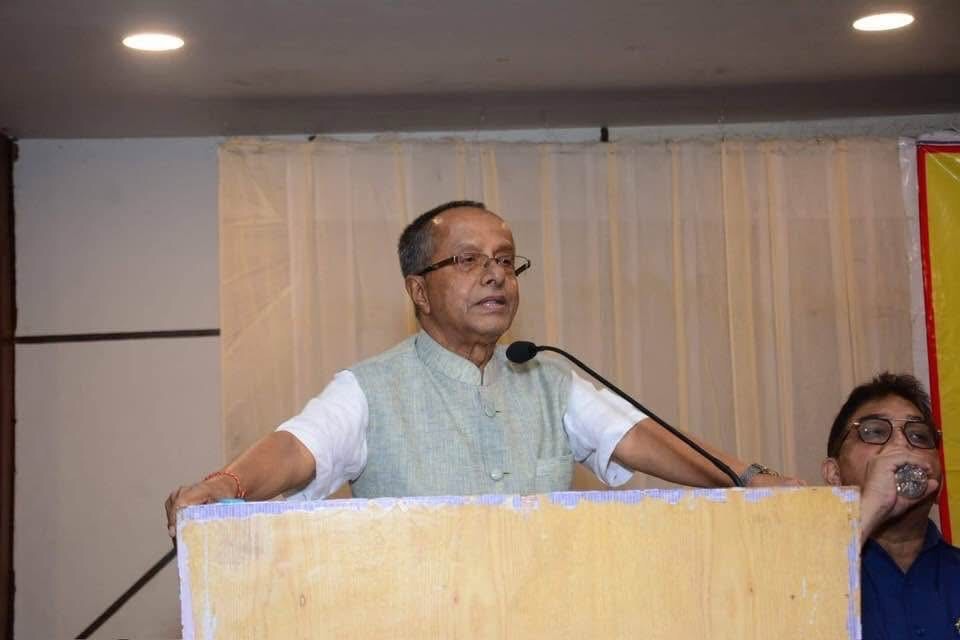
On a winter evening in Dehradun, when mist hangs over Rajpur Road and the last patients have left the clinic in Raipur, Dr. Dipak Dhar Choudhury still sits with a file open. Colleagues call him Dr. D.D. Choudhury. Some write it Chawdhary. In IMA circles he is simply “D.D. sir” — the doctor who was President of IMA Dehradun in 2001–2002, and who, long after that year, never quite left the association’s workbench.
The story does not begin in Dehradun.
It begins on 29 October 1951, in Shillong. A boy grows up in the Northeast, finishes school in Silchar in 1969, and takes his B.Sc. and MBBS from Gauhati University. There is no public legend of a famous teacher or a sudden calling. There is only the ordinary fact that he became a doctor and then went where doctors were scarce.
Nagaland first. State health services, 1980 to 1983, then again from 1984 to 1987. In between, a year with the ITBP. The hills taught him what a city OPD never could: that medicine is often a matter of reaching people before the road gives out. In 1983 the ITBP’s Director General gave him an appreciation award. In Mokokchung the Rotary Club named him Best Community Worker. He trained later as a family-welfare lead trainer, an STI master trainer, a breastfeeding coordinator. He liked work that did not look glamorous on a visiting card.
In 1987 he opened a clinic in Raipur, Dehradun. Patients came with fever, pregnancy, childhood coughs, the quiet worries of a valley turning into a city. At home in Arya Nagar he was a husband and the father of one son. At IMA House he began the long climb that would define him more than any single prescription.
Joint Secretary in 1994. Treasurer the next year. Honorary Secretary for three years running. Junior Vice President. President Elect. Then, in 2001–2002, President of IMA Dehradun. During his secretary years the branch collected Best Branch awards from the state and from Headquarters. Someone once told him the trophies looked well on a shelf.
“They look better,” he is remembered as saying, “if the village camp still happens when no one is watching.”
Then the map itself changed.
On 9 November 2000 Uttarakhand became a state. Doctors who had belonged to IMA Uttar Pradesh woke up inside a new geography. On 28 January 2001, in Dehradun, they formed the IMA Uttaranchal State Branch. Dr. Mahabir Singh became the first President. Dr. D.D. Choudhury became the first Honorary State Secretary.41
There must have been a meeting that week when someone asked whether a small hill state could carry an association of its own.
“We already do,” he would have answered, in the manner of a man who has filed more minutes than speeches. “We only have to write it down and keep doing it.”
He kept doing it for nearly twenty years, until December 2020. In December 2024 he took the secretary’s chair again — State Coordinator, CWC member, past National Vice President, back at the table as if the work had merely paused. A newspaper put it simply: he pioneered the state branch in 2001.
The blood bank became the other half of his story. He was a founder life member of the IMA Blood Bank Society of Uttarakhand, Joint Secretary, then Honorary Secretary from 2013. The bank’s mission is blunt: no patient in and around Dehradun should die for want of safe, voluntary blood. He spoke once of linking IMA blood banks across states so a donor card from one place could help a stranger in another. Accidents on the highways had taught him the price of the golden hour.
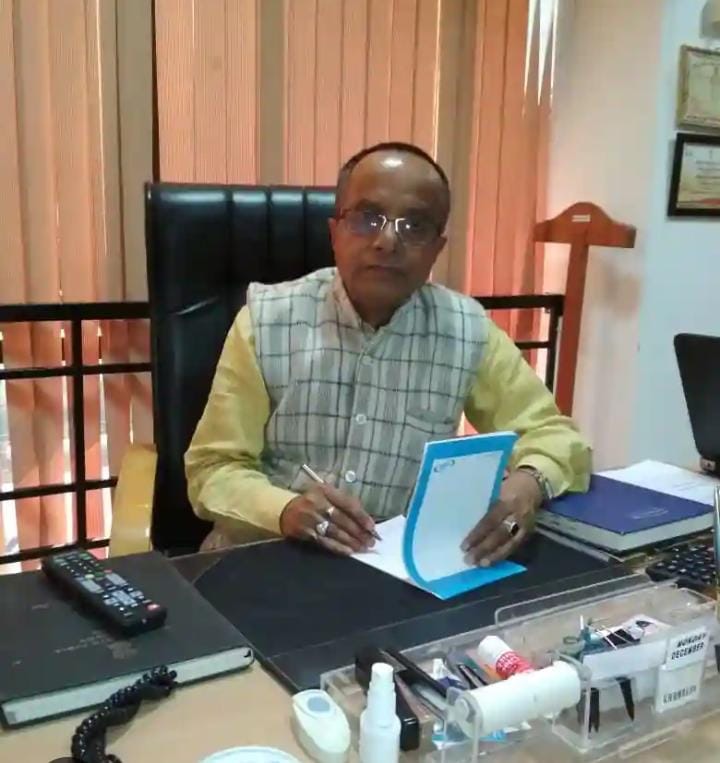
National IMA noticed the same stubborn consistency. Central Council. Dean of the College of General Practitioners. National Chairman of Blood Bank. Director of the Hospital Board of India. Ethics. Anti-quackery. In 2019–20 he served as National Vice President. In July 2023, in Patna, Justice Rajeev Ranjan handed him the Dr A.K.N. Sinha IMA Rashtriya Samman. The award was not for a famous surgery. It was for a lifetime of holding an organisation together.
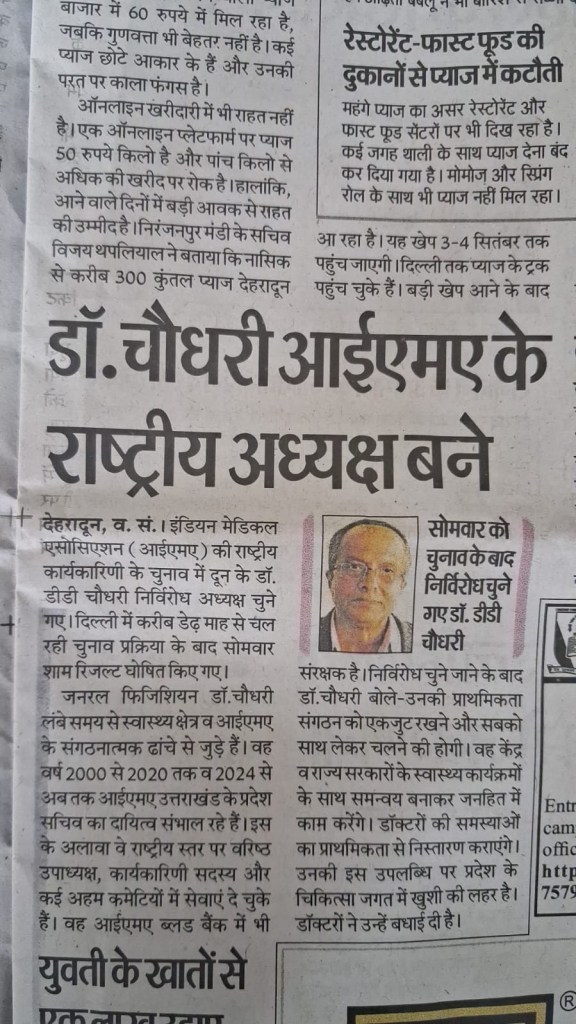
Dehradun woke up this week to news that one of its own had just taken one of Indian medicine’s most visible national posts. Dr Dipak Dhar Choudhury, a senior practitioner who has practised in the city since 1987, was elected unopposed as national president of the Indian Medical Association for 2026–27. He will speak for roughly 3.5 lakh doctors across the country, succeeding Dr Anil Kumar J Nayak.
The path that brought him here began far from Uttarakhand. A graduate of Gauhati University, Choudhury trained in lactational management, contraceptive protocols and the control of sexually transmitted infections. In the 1980s he worked with Nagaland’s state health services and the Indo-Tibetan Border Police before settling into private practice in Dehradun. Over the years he became a lead trainer for the National Family Welfare Programme, preparing more than 250 medical officers, and a master trainer for the national STI programme. Inside the IMA he served as honorary state secretary for Uttarakhand, dean of the College of General Practitioners, deputy registrar of the state medical council and member secretary of the IMA Blood Bank of Uttarakhand.
Speaking to The Times of India, he set out two priorities that will shape his year in office: the welfare of doctors and their families, and medical service in rural India aligned with the government’s health agenda. Those words sit against a record of disaster work that Uttarakhand still remembers. He treated the injured after the 1991 Uttarkashi earthquake and again during the 2013 Kedarnath floods, work for which he received the President’s Appreciation Award in 2013.
For a profession often stretched between city hospitals and remote valleys, the election of a hill-state general practitioner to the IMA’s top chair is more than a local honour. It is a reminder that the association’s next chapter will be written, at least in part, from Dehradun.
He is now national President IMA INDIA
He is still a general physician. That is the part of the story people outside IMA sometimes miss. The man who sat on national committees still sees patients in Raipur. The man who built a state branch still answers to the title that fits him best: doctor.
If you met him after a long IMA meeting, the conversation would not sound like a citation.
“President is one year,” he might say, closing the file. “The branch is every year. Blood is every night. The rest is only names on a letterhead.”
That is the story of Dr. D.D. Chawdhary of Dehradun: not a man who passed through the president’s chair, but a man who stayed after the meeting ended.


 deemagclinic
