
Pune in the early 1950s still treated psychiatry as something whispered about in corridors. Hospitals had wards. Families had secrets. Women doctors were rare enough. A woman who wanted to sit across from patients in her own consulting room, listen to their fears, and charge a fee for it? That was almost unthinkable.
Roshen Master was born in 1923 into a Parsi family that prized books and argument. Education was not a luxury in that house; it was expected. When she walked out of B. J. Medical College in 1953 with her MB, some relatives still asked, half-joking, whether she would now settle down.
She did not.
In 1955 she took her DPM from the College of Physicians and Surgeons in Mumbai. The following year she finished a fellowship in neurology and psychiatry. Then she did the thing that made older colleagues pause.
She opened her own practice.
A senior doctor is said to have told her, not unkindly, “Psychiatry is still finding its feet in this country. A woman in private practice? Patients may not come.”
Roshen is remembered as having smiled and answered something close to: “Then I will wait. But I will not wait inside someone else’s hospital forever.”
They came. Slowly at first, then steadily. Housewives who could not name their sadness. Young men whose families called them “difficult.” Elderly patients whose tremors were dismissed as old age. She listened longer than most. She wrote more than most. Over the years she published more than a hundred papers and still found time for pieces in the lay press because she believed mental illness should not remain a specialist’s secret.
She spoke on All India Radio. Neighbours later recalled turning the volume up when her voice came on, explaining depression or anxiety in language that did not frighten people.
At B. J. Medical College she helped raise the postgraduate department of psychiatry from almost nothing. Later she became Honorary Professor at KEM, Pune, and then Professor Emeritus—the first such honour from Pune University. Students remembered a teacher who could be exacting and warm in the same hour.
“Read,” she would tell them. “Then go and sit with the patient. The book will not tell you everything the face will.”
In the 1950s and 1960s she co-founded, with Sindhutai Joshi, what began as a small school for mentally challenged children—the Kamanayai School. It grew into a proper institution. She chaired the organising committee of a major psychiatric conference in Pune in 1979. In 1990 she was associated with the Adolescent Mental Health Conference. She helped found the Poona Psychiatrists Association and later played a part in instituting the PPA I and PPA II awards of the Indian Psychiatric Society.
She never treated any of this as separate from ordinary life. Psychiatry, in her view, belonged in the clinic, the classroom, the newspaper, the radio, and the street.
One of her last pieces was “Growth of Mental Health in Pune,” written for the ANCIPS 2001 souvenir. She was still working on the city’s mental-health story almost until the end.
On 12 November 2001 she left home for her office and did not arrive. She was seventy-eight.
People who knew her said the city lost more than a doctor that morning. It lost the woman who had decided, decades earlier, that if psychiatry in India was going to grow up, it would have to make room for women who were willing to dare, to lead, and to build—and then leave the door open behind them.
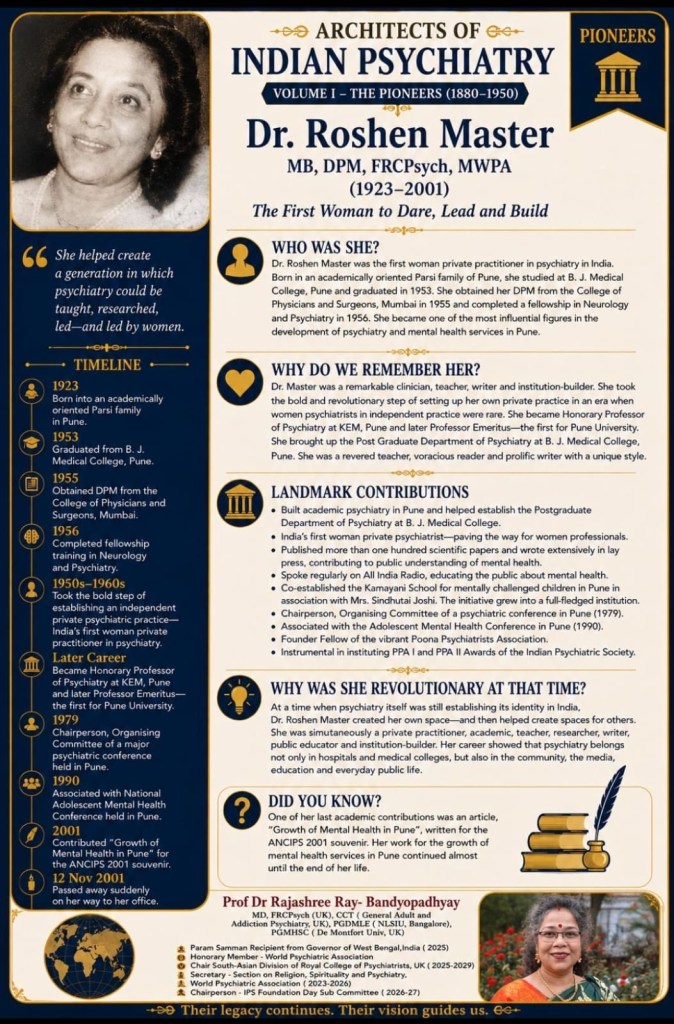
Architects of Indian Psychiatry
Volume I – The Pioneers (1880–1950)
Pioneers
Dr. Roshen Master
MB, DPM, FRCPsych, MWPA
(1923–2001)
The First Woman to Dare, Lead and Build
She helped create a generation in which psychiatry could be taught, researched, led—and led by women.
Timeline
- 1923 – Born into an academically oriented Parsi family in Pune.
- 1953 – Graduated from B. J. Medical College, Pune.
- 1955 – Obtained DPM from the College of Physicians and Surgeons, Mumbai.
- 1956 – Completed fellowship training in Neurology and Psychiatry.
- 1950s–1960s – Took the bold step of establishing an independent private psychiatric practice—India’s first woman private practitioner in psychiatry.
- Later Career – Became Honorary Professor of Psychiatry at KEM, Pune and later Professor Emeritus—the first for Pune University.
- 1979 – Chairperson, Organising Committee of a major psychiatric conference held in Pune.
- 1990 – Associated with National Adolescent Mental Health Conference held in Pune.
- 2001 – Contributed “Growth of Mental Health in Pune” for the ANCIPS 2001 souvenir.
- 12 Nov 2001 – Passed away suddenly on her way to her office.


 deemagclinic
