
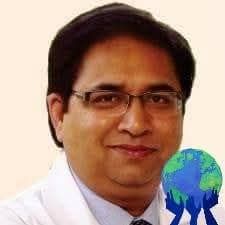
Dr. Krishan Avtar, born on 19 July 1970, is a Dehradun neurologist who built a hospital so that people from the hills would not have to travel to Delhi for brain and nerve care. He is Chairman and CEO of Synergy Institute of Medical Sciences on Canal Road, Ballupur, and still heads its Department of Neurology. Public listings put his training at over three decades..
The long training
He completed MBBS in 1992 and MD in General Medicine in 1997 at Lala Lajpat Rai Memorial Medical College, Meerut. He then took DM Neurology at King George’s Medical College, Lucknow, finishing in 2001. Hospital material also calls him a gold medalist and lists a Diploma in Hospital Administration. Those letters sit on his chairman page: MD (Medicine), DM (Neuro), DHA.
His listed clinical interests are epilepsy surgery, intraoperative neurophysiological monitoring, and neurocritical care — the work that happens when a seizure will not stop, when a surgeon needs the nerves watched in real time, or when a patient is hanging between the ICU and recovery.
Why Synergy exists
After practising in other cities, he returned to Dehradun with a simple complaint that many families already knew: serious neurology, cardiology, and trauma care were too far away.
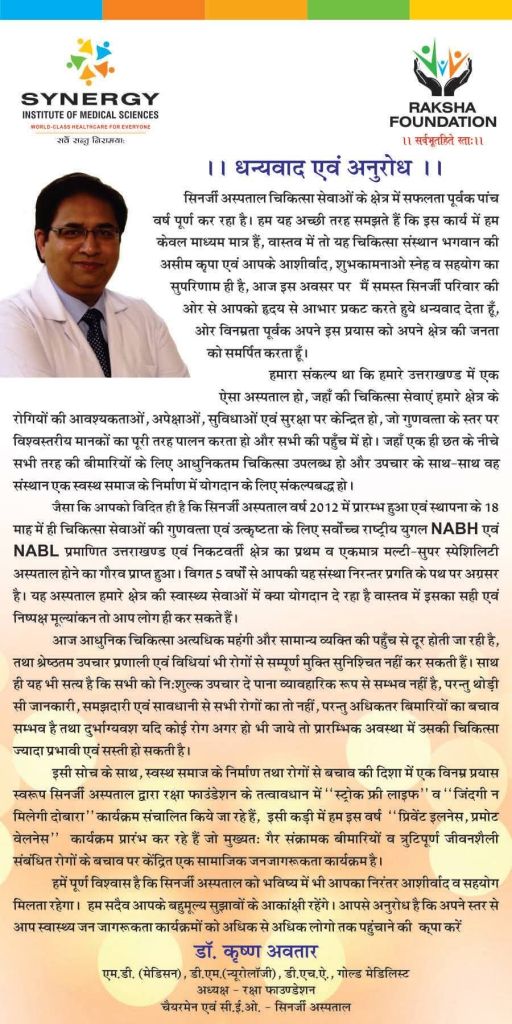
The hospital opened on 1 August 2012. In a later video he put the dream in plain words: Uttarakhand should have facilities built around what people here actually need, with safety and technology that meet world-class standards, under one roof.
On the hospital website he wrote the same idea more formally:
“We stand committed to provide value added innovative, consistent and continuously improving health and medical care… We believe that it is due to blessings of Almighty and overwhelming support and patronage of all our people who have posed their trust in us that we have been able to transform our dream into reality. We dedicate our mission to people of our region with utmost humility.”
That is the closest thing to his own voice in print.
A reconstructed corridor scene, based on that message rather than an invented interview:
A family from the hills waits after a long night on the road. The son has had a seizure. Someone asks whether they should still go to Delhi.
“Stay,” the doctor says. “First we find what the brain is doing. Then we decide. You should not have to choose between a mountain road and a good ICU.”
That is the argument Synergy was built to answer.
The man behind the hospital
Walk into a room and Dr Krishan Avtar is hard to miss. Tall, well built, fair, with a pleasant face that seems to arrive already smiling, he has the easy presence of someone who likes people as much as he likes medicine. Friends say that flair is not an act. He collects people the way some doctors collect degrees—without calculation, just by being present.
That same warmth sits beside a practical mind. Managing a large hospital is not only about neurology. He equipped himself with hospital administration training (including a Diploma in Hospital Administration, and later an MBA in the field) because he knew that compassion without systems collapses, and systems without compassion feel cold. The combination is what let him scale from a modest chamber to an institution.
His wife, Dr Seema Avtar, a pathologist trained at LLRM Medical College, Meerut—the same college where he did his MBBS and MD—stands with him as Chief Managing Director. Colleagues often remark that the hospital’s “synergy” is not only a name; it is a marriage of clinic and laboratory, of the man who listens to the nervous system and the woman who reads the body’s finer print.
He did not begin with a campus. He started practice from a small chamber in Tagore Villa. Those who knew him then remember the same smile, the same unhurried greeting, the same habit of turning a first visit into a relationship. From that chamber he scaled up—step by step, patient by patient—until Synergy Institute of Medical Sciences rose on Canal Road, Dehradun, a super-specialty hospital built around neuro, cardio, gastro, renal, trauma and critical care.
The personality never shrank as the building grew. When a colleague once said he wanted to bring a relative for consultation, Dr Avtar’s reply was immediate and sweet:
“Aapke relative hamare relative hai. Welcome.”
That sentence travels. Relatives hear it and unclench. Staff hear it and remember why the work matters. Patients hear it and feel, for a moment, that they have not entered a machine but a household.
Ask him about the journey from Tagore Villa to a large hospital and he does not speak of square footage. He speaks of trust, of nights when the numbers did not add up, of the blessing of people who came anyway. Then the smile returns, as if the whole story were still a conversation between friends.
The hospital he runs
Synergy is a multi-super-specialty centre focused on neuro, cardiac, gastro, renal sciences, trauma, and critical care, with diagnostics on the same campus. It is repeatedly described as NABH- and NABL-accredited, and as the first hospital in Uttarakhand and the adjoining region to hold both. Listings put it around 140 beds with a large ICU block. Address: Canal Road, Ballupur Chowk, Dehradun. Emergency lines are published on the hospital site.
He is Chairman and CEO. His wife, Dr. Seema Avtar, MD Pathology, is Chief Managing Director and works in the laboratory service. The administration page lists them together. It is a family-run institution with a professional specialist panel around them.
Patients on listing sites rate him highly for diagnosis and a calmer manner. Hospital videos show families thanking the neurology and critical-care teams by name. Those clips are short and polite; they do not turn him into a celebrity. They do show why the hospital talks about “compassionate” care as policy, not decoration.
The man, not only the titles
What the public record actually shows is a clinician who became a builder. He did not leave neurology when he became CEO. He still heads the department. He has given local interviews on everyday warning signs — memory loss, sleeplessness, tiredness, blurred vision — and told people those can be neurological, not just “age” or “stress.”
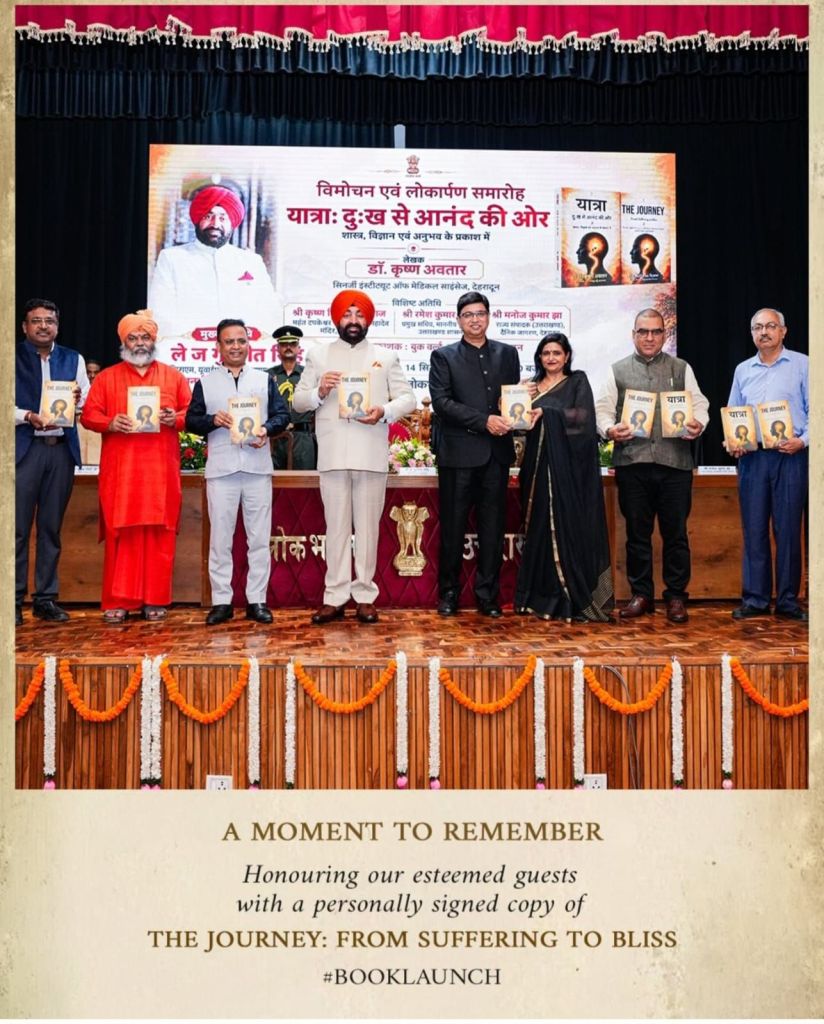
Yatra is a manuscript, a private memoir, or a book under another spelling, it is not yet visible in open sources. Until it is, the journey that can be told honestly is this one: Meerut and Lucknow classrooms, years of practice, a hospital that opened in 2012 so that a seizure in Doon would not automatically mean a night bus to another city, and a chairman’s note that still ends in humility rather than slogan.

PublicPublic sources describe Dr Krishan Avtar as a practising neurologist whose work sits at the meeting point of epilepsy care, operating-room monitoring, and neurocritical care—not as a high-volume academic whose papers dominate PubMed. Directory profiles say he has “participated in research work and various workshops under the Neurology department and published many papers,” but those titles are not listed on open indexes under his name. What is clear is the shape of his neurology interest.
Clinical research focus (as stated)
- Epilepsy surgery Drug-resistant epilepsy is the area he is most often linked to: who is a surgical candidate, how the seizure focus is mapped, and how medical and surgical teams work together so patients in the hills do not have to travel to metro centres for every evaluation.
- Intraoperative neurophysiological monitoring (IONM) IONM is the live electrical “watchdog” during brain and spine operations—EEG, evoked potentials, and related signals that warn the surgeon before a pathway is permanently injured. His listed interest here is the applied, safety-first side of neurology: protecting function while the knife is in.
- Neurocritical care Status epilepticus, severe stroke, traumatic brain injury, raised intracranial pressure, and the first hours after a catastrophic neurological event. This is hospital-floor research in the practical sense: protocols, monitoring, and outcomes in a regional super-specialty unit rather than a bench lab.
Those three threads fit his training: MD Medicine (LLRM Meerut, 1997) and DM Neurology (King George’s Medical College, Lucknow, around 2000–2001), then building Synergy’s Institute of Neuro Sciences with a neurosurgery colleague so medical and surgical neurology sit under one roof.
How he has communicated neurology outside journals
- Hospital and media interviews on everyday neurological symptoms—memory complaints, insomnia, fatigue, blurred vision—and when those need specialist work-up. One Synergy video from 2018 is framed exactly that way: public education rather than a trial report.
- Workshops and teaching inside the department, which profiles mention without giving dates or programmes.
- A later, more personal strand: after three decades of seeing that scans and medicines do not answer every kind of suffering, he published The Journey: From Suffering to Bliss, treating neurology as a starting point for questions about mind and consciousness. That is not laboratory neurology; it is the clinician stepping past the report.


 deemagclinic
