
Extract: Nobel Prize in Physiology or Medicine 2026 (announced 5 October 2026)
- Laureates: Karl Deisseroth (HHMI and Stanford, USA), Peter Hegemann (Humboldt University of Berlin), Georg Nagel (University of Würzburg)
- Citation: discoveries concerning light-gated ion channels and optogenetics
- Prize amount: 12 million SEK, shared equally
- Announced by: Nobel Assembly at Karolinska Institutet (Committee Chair: Per Svenningsson)
- Press contacts: Pernilla Witte and Thomas Perlmann
Who did what
- Hegemann and Nagel: In the early 2000s, they found channelrhodopsin in the single-celled alga Chlamydomonas, which swims toward light. Blue light opens a channel in the protein, ions flow in, and an electrical impulse results. It worked in whatever cell type they put it in.
- Deisseroth: He put the channelrhodopsin gene into rat nerve cells and triggered nerve signals with blue light (published 2005). Two years later, he made the light-controlled switch work in the brains of living mice.
Elaboration
Why it mattered: Earlier brain mapping, such as lesion studies, electrical stimulation and imaging, mostly showed correlation. You could see which regions were involved, but you couldn’t prove causation. Optogenetics lets researchers switch a specific, genetically defined set of neurons on or off, with millisecond precision, and watch what happens to a memory, a mood or a behaviour. That is the causal link the press release says earlier methods lacked.
How it works: Channelrhodopsin is a light-gated cation channel. A virus delivers the gene to chosen cell types, and an implanted fibre-optic delivers blue light. The neuron then fires on command. Related opsins that silence neurons extended the toolkit.
Clinical angle: The release highlights two directions. One is mapping circuits behind neurological and psychiatric disorders. The other is attempts to restore sight in people with visual impairment by making surviving retinal cells light-sensitive.
A point of interest: The discovery came from basic curiosity about how an alga finds light, not from a neuroscience question.
Light-Seeking Algae and the Switch for Nerve Cells
The 2026 Nobel Prize in Physiology or Medicine honours Karl Deisseroth, Peter Hegemann and Georg Nagel for discoveries on light-gated ion channels and optogenetics. The prize of 12 million Swedish kronor is shared equally.
A sketch map full of question marks. For decades, neuroscientists could only ask which brain regions were involved in a function. Lesions, electrical stimulation and imaging showed that a region was active or needed, but not that it caused a particular memory, feeling or behaviour. As the Nobel Assembly puts it, the brain’s image was a sketch map full of unknowns. Electrodes also stimulate everything nearby, so they cannot single out one type of cell.
The alga that swims toward light. The answer came from basic curiosity. Peter Hegemann wondered how Chlamydomonas, a single-celled alga, swims toward a light source. In the early 2000s, he and Georg Nagel identified channelrhodopsin, a protein on the cell surface. When blue light hits it, a channel opens through the protein and charged ions flow into the cell, creating an electrical impulse. Crucially, they found that any cell they put the protein into became light sensitive.
From alga to brain. Karl Deisseroth turned this into a tool. He introduced the channelrhodopsin gene into rat nerve cells, and illuminating them with blue light triggered nerve signals. He published this in 2005. Two years later, he made the switch work in the brains of living mice, which showed it could control circuits in a behaving animal.
How it works in practice. Researchers deliver the gene, usually by a harmless virus, to a chosen type of neuron. Light, typically through a thin implanted optical fibre, then switches those neurons on with millisecond precision. Related light-sensitive proteins that silence neurons extend the toolkit, so one cell population can be turned on or off while everything else stays untouched. This gives the causal proof that earlier methods lacked.
Impact. Optogenetics has spread worldwide. It is used to reveal circuits governing specific memories, feelings and behaviours, including those relevant to neurological and psychiatric disorders. In clinical medicine, researchers are using it to try to restore sight in people with visual impairment by making surviving retinal cells light sensitive.
Why it resonates. A tool for understanding the human brain began with an alga’s way of finding sunlight. As Per Svenningsson, Chair of the Nobel Committee, put it, optogenetics offers ways to map the brain “we could once only dream of.”


- Home
- E-Paper
- Cricket
- India News
- Entertainment
- World News
- Lifestyle
- Trending
- Cities
- Astrology
- HTCity
- NRI
- US News
- HT Te
…
…
How a light switch from algae won the Nobel and began restoring sight
Karl Deisseroth, Peter Hegemann and Georg Nagel made discoveries that opened a new technique, called optogenetics.
Updated on: Oct 6, 2026, 06:14:01 IST
By Kabir Firaque, Binayak Dasgupta
Advertisementhttps://b30417de971b011ce59e2cd18b27f7ca.safeframe.googlesyndication.com/safeframe/1-0-45/html/container.html?n=0
In 2021, researchers reported that a 58-year-old man who had lost his sight to an inherited eye disease could locate and touch objects on a table in front of him, wearing special goggles. A gene taken from a single-celled green alga had been injected into one of his eyes. Last month, the US Food and Drug Administration accepted a licence application for a similar treatment.
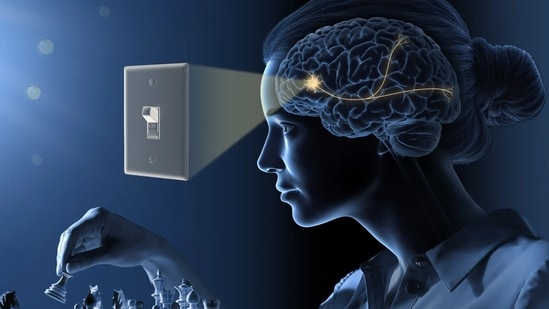
Optogenetics uses light to switch living cells on and off, and it works the same way in a patient’s eye as in a laboratory mouse. (nobelprize.org)https://b30417de971b011ce59e2cd18b27f7ca.safeframe.googlesyndication.com/safeframe/1-0-45/html/container.html?n=0
That work traces back to the three scientists awarded this year’s Nobel Prize in Physiology or Medicine on Monday. Karl Deisseroth, Peter Hegemann and Georg Nagel made discoveries that opened a new technique, called optogenetics.
Optogenetics uses light to switch living cells on and off, and it works the same way in a patient’s eye as in a laboratory mouse. A modified virus carries the alga’s gene into chosen cells, which begin making a protein that opens when light falls on it, letting charged particles flow through and creating an electrical signal. When light is shone on those cells, they fire; related proteins let light silence cells instead.null
In the laboratory, this lets scientists switch on or switch off the activity of individual nerve cells. We know different nerve cells control different brain functions, but earlier methods struggled to identify which kinds of cells were responsible for which kinds of functions. In the clinic, optogenetics has been used to restore partial sight.
The seeds for this were laid more than 30 years ago by Hegemann (currently with Humboldt University of Berlin) and Nagel (University of Würzburg, Germany), and followed up by Deisseroth (Howard Hughes Medical Institute, and Stanford University). The work started with a humble alga.
Also Read: 2026 Nobel Prize for Medicine: The protein that can unlock secrets of the brain
The protein
The green alga Chlamydomonas has only one cell, but reacts astonishingly to light. When one side of a petri dish is illuminated, the alga swims towards it, sensing the light with a tiny orange dot called the eyespot.
In the 1990s, Hegemann, then at the Max Planck Institute for Biochemistry in Martinsried, found that the eyespot produced an electrical impulse just half a millisecond after light reached it, more than 20 times faster than the corresponding process in the human eye, which takes at least 10 milliseconds.
In the human eye, a complex chain of events is involved. The final step is an ion channel (a specialised type of protein) that allows charged ions to flow, creating an electrical signal. Hegemann suggested that in the alga, a single protein must be not only capturing the light but also acting as the ion channel. The hypothesis was met with scepticism then.https://b30417de971b011ce59e2cd18b27f7ca.safeframe.googlesyndication.com/safeframe/1-0-45/html/container.html?n=0
Using the DNA of Chlamydomonas mapped by Japanese researchers, Hegemann’s group found two promising genes and sent them to Nagel, then at the Max Planck Institute for Biophysics in Frankfurt. Nagel injected them, separately, into frog eggs, which began to mass produce two unknown proteins. They were ion channels that opened when exposed to light, proving the hypothesis Hegemann had made a decade earlier.
These proteins were named channelrhodopsin-1 and channelrhodopsin-2. It is the second that opened the road to optogenetics. When Hegemann and Nagel introduced its gene into human and hamster kidney cells, the cells became light-sensitive.
Suneel Kateriya, now dean of the School of Biotechnology at Jawaharlal Nehru University in Delhi, is an author on both papers that described the two proteins, which the Nobel Committee lists among the prize-winning work.https://b30417de971b011ce59e2cd18b27f7ca.safeframe.googlesyndication.com/safeframe/1-0-45/html/container.html?n=0
From petri dishes to mice
Deisseroth, at Stanford, then took this work forward to nerve cells. He wrote to Nagel, who sent him the DNA encoding channelrhodopsin-2. Introduced into rat nerve cells cultured in petri dishes, it made them react to blue light, producing a nerve signal. In 2006, this method was given the name optogenetics.
In 2007, Deisseroth’s team introduced the gene into a specific type of nerve cell in living mice and, by illuminating it, controlled movements of the mouse whiskers. In 2012, Deisseroth, Susumu Tonegawa (the 1987 Nobel Prize winner) and their colleagues identified which nerve cells in the mouse brain appeared to form a memory of a fearful experience, and later reactivated them. The mice showed signs of fear, despite not being in danger at the time.
What it has revealed
Optogenetics gives researchers a tool to identify which cells and neural circuits are involved in particular brain functions, from pain and thirst to the circadian rhythm. Deisseroth has shown that heart rhythm can affect emotions such as anxiety. Optogenetics has also enabled better understanding of the neural activity involved in depression, anxiety, schizophrenia, Alzheimer’s disease and Parkinson’s disease.
Restoring sight
The man in the 2021 study, reported in Nature Medicine by a team led by José-Alain Sahel, had retinitis pigmentosa, a disease in which the retina’s light-sensing cells die. The injected gene made other, surviving cells in his retina respond to light, and the goggles converted the scene in front of him into pulses of amber light. He located and touched objects in 36 of 39 attempts. He could not do this before the injection, or with the goggles alone.https://b30417de971b011ce59e2cd18b27f7ca.safeframe.googlesyndication.com/safeframe/1-0-45/html/container.html?n=0
That treatment, from the French company GenSight, has stalled; the company said in September 2025 that it was seeking a partner to finance it. A second, from the US company Nanoscope, uses a synthetic light-sensitive protein and needs no goggles. In a trial of 27 patients, it improved sharpness of vision significantly more than a sham injection over a year, and it is the treatment now before the FDA. Two other companies, Bionic Sight and Ray Therapeutics, have treatments in earlier human trials. Patients in these trials regain low-resolution vision that depends on strong contrast, and everyone treated so far had late-stage disease.
The eye can be reached with an injection, tolerates foreign material better than most tissue, and can take light shone in from outside, so nothing has to be implanted. Dozens of different faulty genes cause retinitis pigmentosa, and Luxturna, the best-known gene therapy for inherited blindness, works only for faults in one of them. Optogenetics leaves the broken gene alone and makes whatever cells survive sensitive to light.https://b30417de971b011ce59e2cd18b27f7ca.safeframe.googlesyndication.com/safeframe/1-0-45/html/container.html?n=0
A study of more than 7,000 people aged over 40 in Tamil Nadu found retinitis pigmentosa in about one in 372 rural residents and one in 930 urban residents, against a Western estimate of about one in 4,000.
Beyond the eye
Elsewhere in the body, optogenetic treatment has so far been tested only in animals. In the brain, light does not travel far through tissue, so a treatment would need an implanted light source as well as a gene. In one study, light at the strengths used in animal experiments warmed brain tissue by up to 2°C and suppressed the firing of neurons, even in animals carrying no light-sensitive protein.
Some optogenetic findings have reached patients through other technologies. In mice with Parkinson’s-like symptoms, using light to excite one type of nerve cell while silencing another produced benefits that lasted hours after the stimulation stopped. Because light cannot be used in a human brain, researchers rebuilt the finding as a pattern of electrical deep brain stimulation and tested it in six patients in 2024. It proved safe and as effective as standard stimulation, and the researchers have called for larger studies.
A group in Göttingen is developing a cochlear implant that stimulates the auditory nerve with light instead of electricity, which spreads inside the ear and blurs pitch. It has restored hearing-driven behaviour in deafened rodents, and the group plans its first human trial for 2029.

ABOUT THE AUTHOR

ABOUT THE AUTHOR

nobel prizemedicineus food and drug administration
Home/Ht Vital/How a light switch from algae won the Nobel and began restoring sight
Advertisementnullnullhttps://b30417de971b011ce59e2cd18b27f7ca.safeframe.googlesyndication.com/safeframe/1-0-45/html/container.html?n=0null
SHARE THIS ARTICLE ON
…
…Next Story
Robotic hip, knee surgeries no better than conventional ones: Studies
Two large UK studies find that robotic hip and knee replacements produce similar results to conventional surgery.
Published on: Oct 3, 2026, 08:23:24 IST
By Rhythma Kaul
Robot-assisted hip and knee replacements produce no better results than conventional surgery, two large UK studies have found, raising questions over how quickly hospitals, including in India, have adopted the technology.Robotic joint replacement has also spread rapidly in India over the past decade, mainly in the private sector. (Representational/Pexel)
The studies, published in The BMJ, drew on National Joint Registry data for 666,283 total hip replacements, 10,203 of them robotic, and 697,145 total or partial knee replacements, 22,111 of them robotic, performed in UK public and private hospitals between 2018 and 2024. The researchers matched patients for factors including age, sex, body mass index, diagnosis, physical fitness, implant type and surgeon volume. They then found no difference in implant survival, revision risk or complications during surgery over an average of 2.5 years. Patient survival after hip replacement did not differ either.
Also Read | Quest to regain movement, one robot at a timeRead More








Watching damage in liver, and the science of healing its scarsThe evolving science around longevity, and its unknownsThe disorder that hides in ordinary, everyday tirednessThe scientific way to look at BMI and the weighing scaleBengaluru ‘peptide party’ called off: The Silicon Valley trend and what science says about itDetecting Alzheimer’s: A new blood test is out, but it’s not for allHeart of tomorrow: The therapies shaping the cholesterol control battlemRNA’s second act: A bespoke cancer vaccine & what new melanoma trial could mean for oncologyGains clear, but no single GLP-1 or other weight loss drug wins on every count: Studyhttps://b30417de971b011ce59e2cd18b27f7ca.safeframe.googlesyndication.com/safeframe/1-0-45/html/container.html?n=0


 deemagclinic
